Dolores Huerta, Farmworker Leader Who Gave Us 'Sí Se Puede,' Dies at 96
The co-founder of the United Farm Workers died at home Wednesday, her family said, closing a life that ran from the Delano grape strike to the Presidential Medal of Freedom.
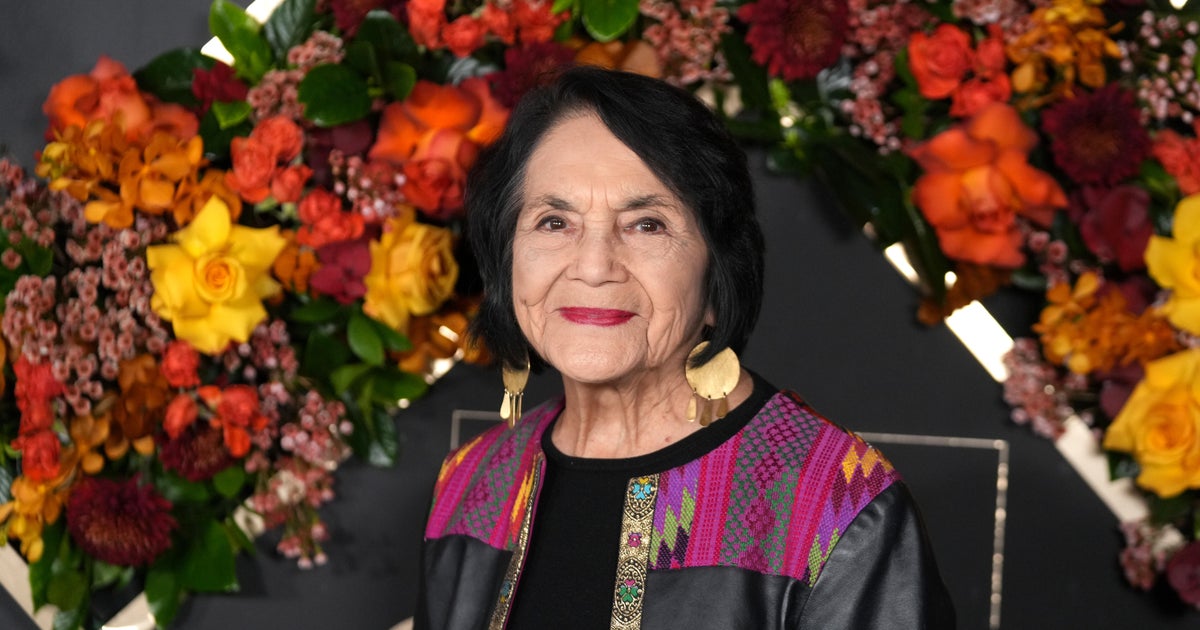
Dolores Huerta, the labor activist and civil rights leader who co-founded with Cesar Chavez the group that became the United Farm Workers, has died. She was 96. Her family announced her death in a statement posted to social media through her foundation, saying she died Wednesday at home.
"As you can imagine, this is an incredibly difficult time for us, and we ask for privacy as we grieve this incredible loss to our family," the family said. "We know that many of you around the world share in our mourning." Huerta kept a busy schedule well into her 90s, marching in protests and speaking in cities across the country about race, poverty, LGBTQ+ and women's rights on behalf of her Bakersfield, California-based foundation.
Her three-word Spanish-language slogan, "Sí se puede," which translates to "Yes, it can be done," became one of the best-known rallying cries in American political life. When then-President Barack Obama presented Huerta with the Presidential Medal of Freedom in 2012, he praised her as a tenacious leader and joked that he had borrowed her slogan for his 2008 campaign. She was also the first Latina inducted into the National Women's Hall of Fame and received nine honorary doctorates from U.S. universities.
Huerta was born Dolores Clara Fernandez in 1930 in Dawson, New Mexico. Her father was a miner and union activist who later won a seat in the state Legislature. Her parents divorced when she was 3, and her mother took her and her brothers to California. As a young elementary school teacher in the San Joaquin Valley, she grew frustrated by her students' living conditions. "I couldn't stand seeing kids come to class hungry and needing shoes," she said in a 2017 PBS documentary on her life. "I thought I could do more by organizing farmworkers than by trying to teach their hungry children."
Her early work with a civil rights group in Stockton led to her meeting Chavez, and in 1962 the two started the National Farm Workers Association, which became United Farm Workers of America a few years later. She was a key leader and negotiator for years. She joined Filipino grape pickers on the picket line in the five-year Delano Grape Strike, and with Chavez she negotiated contracts with big growers, winning the first health and benefit plans for farmworkers. By directing nationwide boycotts of grapes and lettuce in the early 1970s, she helped create the economic pressure and political climate that led California to pass the first state law recognizing farmworkers' right to collective bargaining.
She met Sen. Robert Kennedy during his 1968 visit to Delano and volunteered on his presidential campaign, registering Mexican Americans to vote. Huerta was onstage with Kennedy after he won the California primary, and he publicly thanked her moments before he was shot. She was jailed 22 times for union demonstrating. In 1988 she was seriously injured while protesting George H.W. Bush's opposition to the grape boycott in San Francisco, when a police officer's baton broke three ribs and ruptured her spleen. She needed more than a dozen blood transfusions and later reached a settlement with the city.
Her legacy also carries a painful chapter. This year Huerta revealed that she had been sexually abused by Chavez in the 1960s, which led to the birth of two children, a secret she had kept for 60 years and long after he died in 1993. Asked in a 2026 interview with Latino USA why she stayed silent, she said she feared coming forward would compromise her life's work and unravel progress made for workers. "It was my personal pain, it was my personal problem and, you know, I think it was worth it because it was my cross to bear," she said. Her disclosure sent shockwaves through the Latino community.
From the early 1970s, Huerta's life partner was Richard Chavez, Cesar's brother, and together they had four children. She also had seven children from two earlier marriages. Her son Emilio once said that dedicating her life to building a union for farmworkers and taking on agriculture, still a powerhouse, "took a lot of guts." Schools in California, Texas and Colorado carry her name, and her image is painted on murals across the country. She leaves behind 13 children and a movement that is still organizing.