Chinese Team Builds Chip That Turns Ultraviolet Photons Into Fiber-Ready Light
A lithium niobate converter shifts 393 nm photons from trapped calcium ions to 1550 nm telecom light with 28.8% efficiency and very little noise, a step toward larger quantum networks.

Quantum networks promise more secure and efficient ways to share information. Building them usually means linking stationary qubits, units of quantum information stored in trapped ions or other systems, with photons sent through optical fibers. A stubborn obstacle is that some of the best qubit platforms emit ultraviolet light, with wavelengths of roughly 100 to 400 nanometers, and optical fibers carry those wavelengths poorly. Researchers in China say they have built a converter that closes the gap, and they reported it in Physical Review Letters.
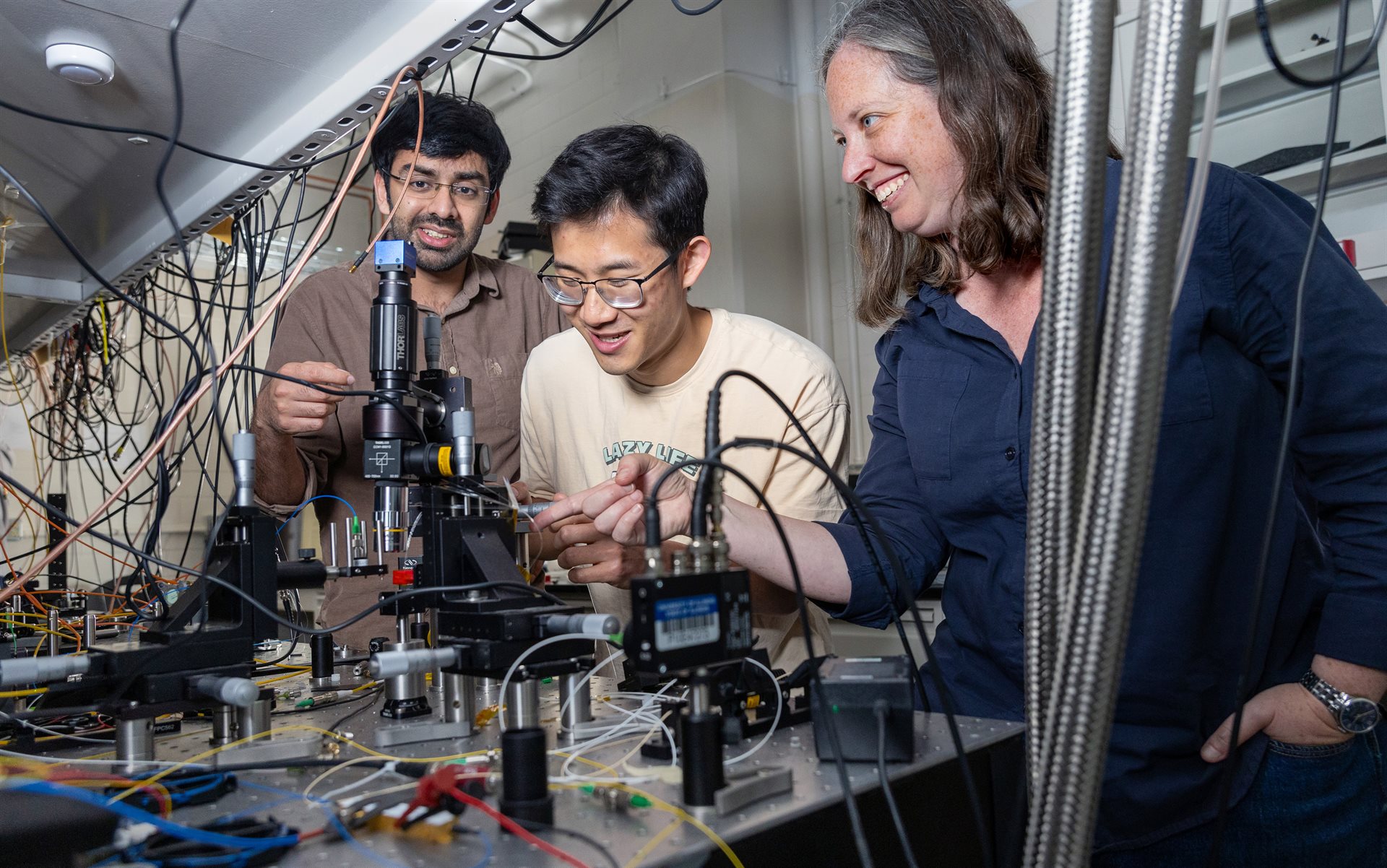
The team, from the University of Science and Technology of China, the Jinan Institute of Quantum Technology and other institutions, built the device on thin-film lithium niobate, a crystal that lets light waves of different wavelengths interact. They patterned it into a waveguide that confines and directs light. "Trapped-ion systems with dominant emission in the ultraviolet and blue spectral regions possess exceptional properties including long coherence times and high-fidelity control, making them one of the leading platforms for scalable quantum networks," said co-author Qiang Zhang. "However, for those wavelength bands, fiber attenuation is severe."
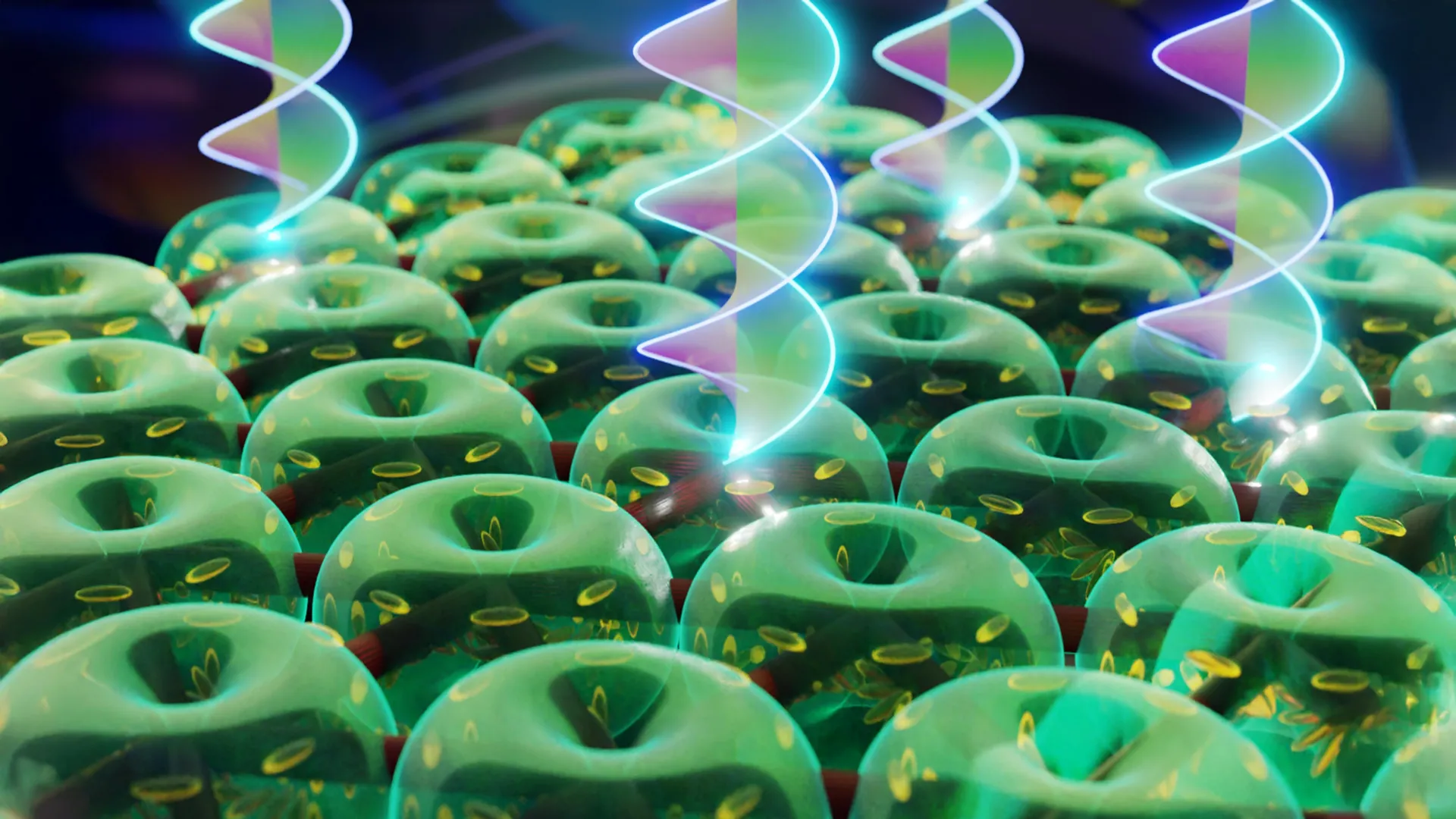
The known fix is quantum frequency conversion, which changes the frequency of a photon while preserving the quantum information it carries. Earlier converters generally suffered from low efficiency and high noise, the researchers said. In their design, an intense 527 nm pump laser drives the process. An incoming 393 nm ultraviolet photon splits into a 1550 nm telecom photon, the wavelength that travels through fiber with low loss, and a 527 nm photon. The process must happen inside a nonlinear medium, and its practicality depends on conversion efficiency and noise generated by the pump.
The group fabricated hundreds of chips and chose one of the best performers. After characterizing it with a 393 nm laser, they connected the converter to a trapped calcium-40 ion system. At extremely low excitation rates, the combined platform delivered what Zhang called an ultrahigh signal-to-noise ratio, enabling high-fidelity operations.
In the tests, the converter reached an external conversion efficiency of 28.8% after accounting for optical losses in the module, with a background noise rate of 35 counts per second. The authors also built a mathematical model that predicts how imperfections in the chip's patterned polarization regions reduce conversion efficiency. They described a new noise-control mechanism for short-wavelength pumping, which takes advantage of the different tuning behavior of the difference-frequency generation process and the pump-induced noise.
Zhang said the approach is not limited to this system. The mechanisms "are not only applicable to other QFC processes for diverse quantum systems, but they also hold significant potential to drive progress in classical and integrated nonlinear photonics."
In the future the converter could connect ultraviolet-emitting quantum devices efficiently over optical fiber and help build larger networks. The team plans two next steps. One is to find wider applications for the 393 nm interface. The other is to extend its efficiency and noise-suppression methods to other ions, including ytterbium-171, strontium-88 and barium-138, to link more types of quantum hardware.