Scientists Create 'Optical Tornadoes' with Liquid Crystal Breakthrough
Revolutionary technique uses self-organizing torons to trap and manipulate light in spiral patterns, opening new frontiers for quantum communication.
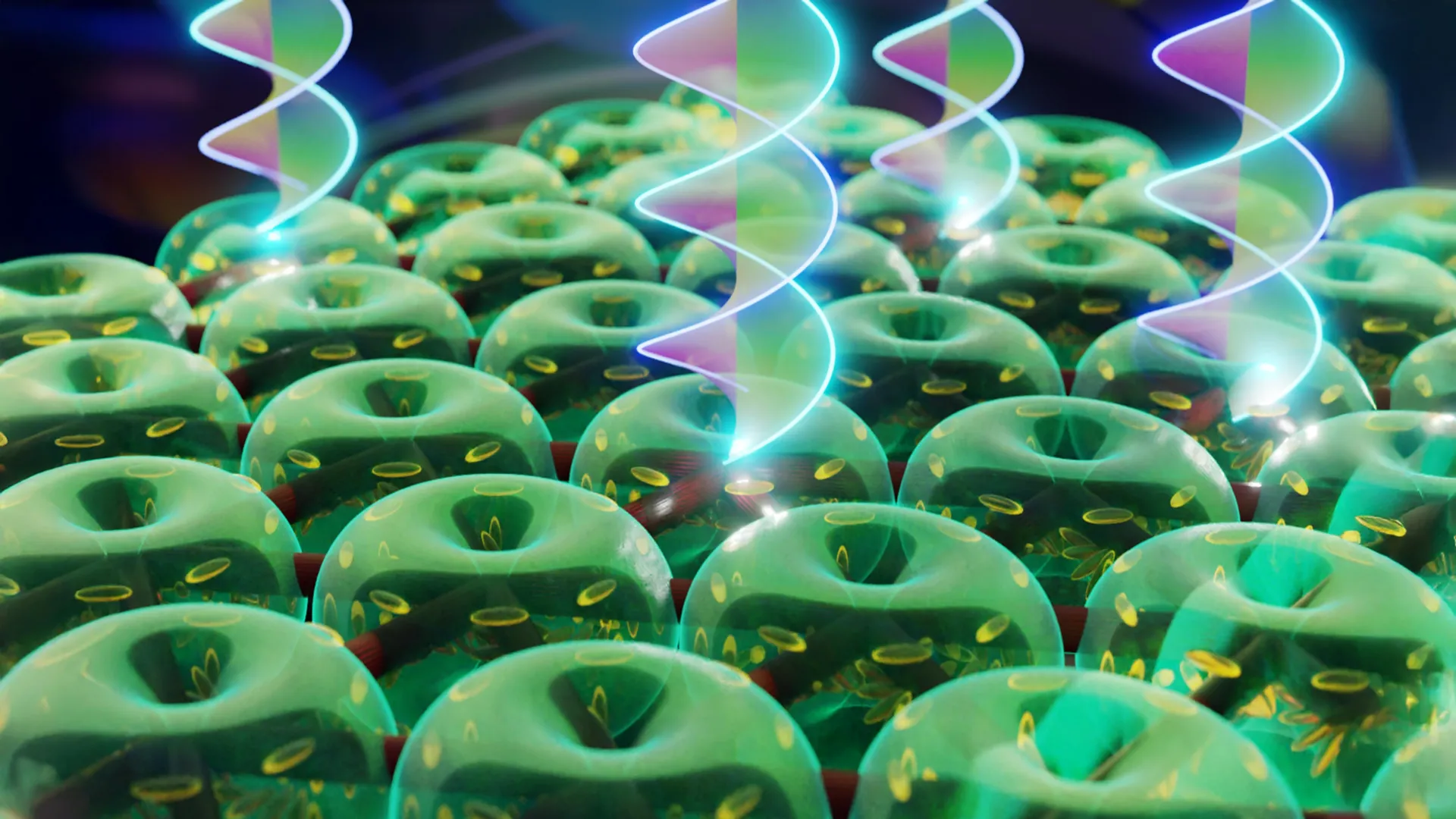
Researchers have successfully created miniature "optical tornadoes" using a surprisingly simple liquid crystal setup, marking a major breakthrough in manipulating light for quantum communication applications. The international team from the University of Warsaw, Military University of Technology, and Institut Pascal CNRS achieved this feat by harnessing self-organizing structures called torons to trap light and cause it to spiral in complex vortex patterns.
Unlike previous methods that required sophisticated nanotechnology or large experimental systems, this new approach relies on liquid crystals—materials with properties between liquids and solids that can flow while maintaining ordered molecular arrangements. Within these materials, special defects known as torons form naturally, creating tightly twisted spiral structures similar to DNA that can act as microscopic light traps.
"Our solution combines several fields of physics, from quantum mechanics, through materials engineering, to optics and solid-state physics," explained Professor Jacek Szczytko from the University of Warsaw, who led the research team. The breakthrough involves creating what researchers call a "synthetic magnetic field" for photons, achieved through spatially variable birefringence rather than actual magnetic fields, since light doesn't respond to magnetism like electrons do.
The optical vortices created by this method exhibit unique properties where the light wave twists around its axis and its phase changes in a spiral manner. Even more remarkably, the polarization—the direction of oscillation of the electric field—begins to rotate as well. These structured light states hold significant promise for quantum communication applications and could enable new methods for controlling microscopic objects with unprecedented precision.
The research represents a significant advancement toward building miniature light sources with complex shapes that could support simpler and more scalable photonic devices. By demonstrating that sophisticated optical effects can be achieved using relatively simple liquid crystal systems, the work opens new pathways for developing practical quantum technologies that could revolutionize communication and computing applications.