Scientists Create 'Optical Tornadoes' Using Simple Liquid Crystal Technology
Researchers achieve swirling light beams with complex polarization patterns using self-organizing structures called torons, potentially revolutionizing quantum communication devices.

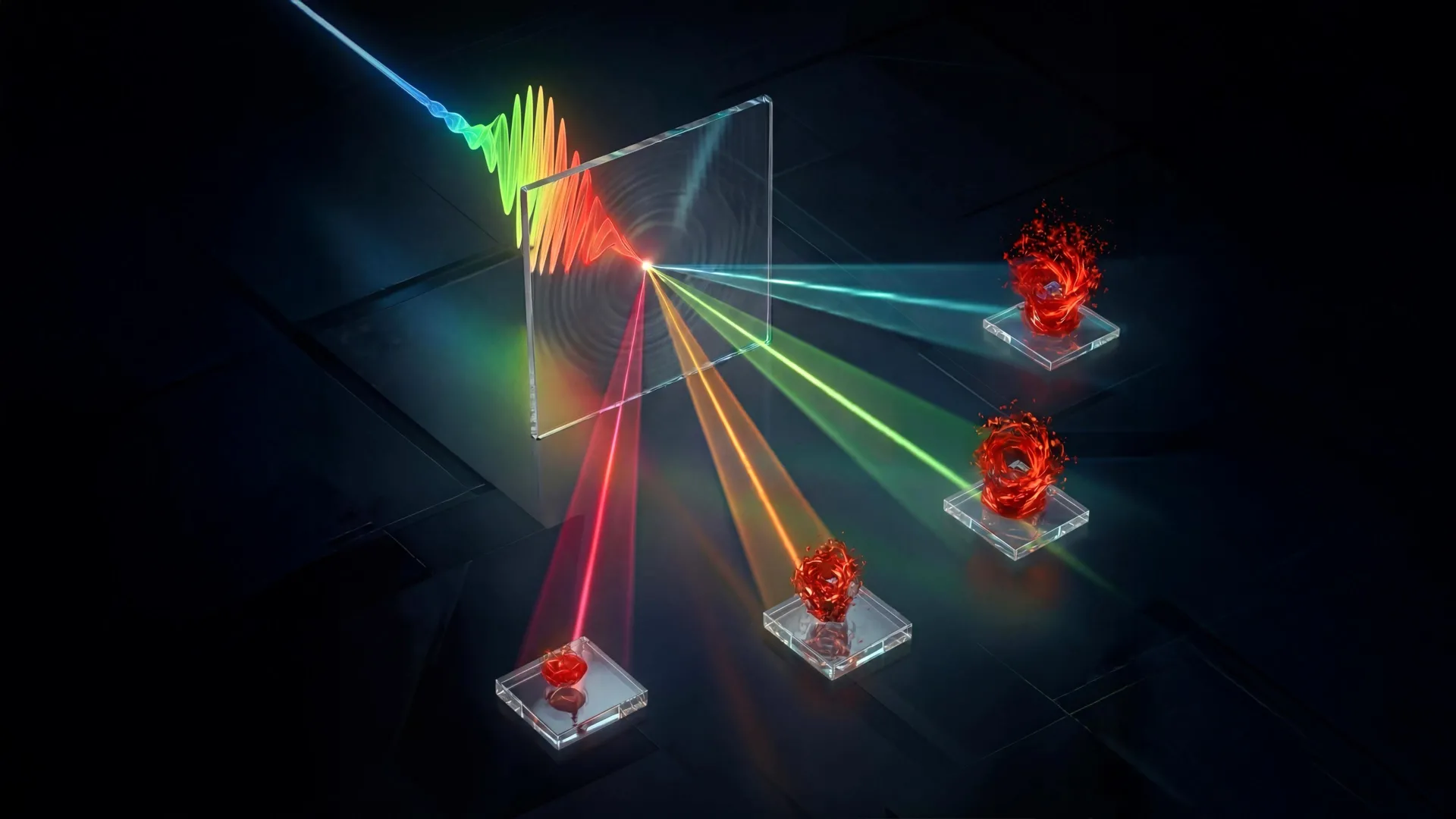
Scientists have successfully created miniature "optical tornadoes" – swirling beams of light that twist like microscopic whirlwinds – using a surprisingly simple setup based on liquid crystals and self-organizing structures called torons. This breakthrough, achieved by researchers from the University of Warsaw, the Military University of Technology, and Institut Pascal CNRS, represents a significant advance in photonics that could transform how quantum communication and optical devices are built.
The research team, led by Professor Jacek Szczytko from the Faculty of Physics at the University of Warsaw, combined multiple fields of physics to create these complex light structures. "Our solution combines several fields of physics, from quantum mechanics, through materials engineering, to optics and solid-state physics," Szczytko explained. The inspiration came from atomic physics, where electrons occupy different energy states, with optical traps playing a similar role for photons by confining light instead of electrons.
The key innovation lies in using liquid crystals, materials with properties intermediate between liquids and solids, to create special defects called torons. These structures act as microscopic traps for light, functioning like tightly twisted spirals similar to DNA. When these spirals close into ring-like structures resembling donuts, they create powerful optical vortices where light waves twist around their axis and polarization rotates continuously.
Dr. Marcin Muszyński, the study's first author, described the phenomenon: "You can think of it as an optical vortex. The light wave twists around its axis, and its phase changes in a spiral manner. Moreover, even the polarization -- the direction of oscillation of the electric field -- begins to rotate." This represents a dramatic improvement over previous methods that required complex nanostructures or large experimental systems to achieve similar effects.
The breakthrough has significant implications for quantum communication technology and microscopic object manipulation. By creating a "synthetic magnetic field" for photons using spatially variable birefringence, the researchers demonstrated that structured light states can be produced more easily and efficiently than previously thought possible. This could lead to simpler, more scalable photonic devices for applications ranging from quantum computing to advanced optical communications, potentially revolutionizing how information is transmitted and processed using light-based technologies.