Illinois Physicists Store Light on a Chip for Over a Microsecond, and Hold Several Photons at Once
Erbium atoms in thin-film lithium niobate act as a photon memory that could be manufactured at scale, researchers at Urbana-Champaign report in Nano Letters.
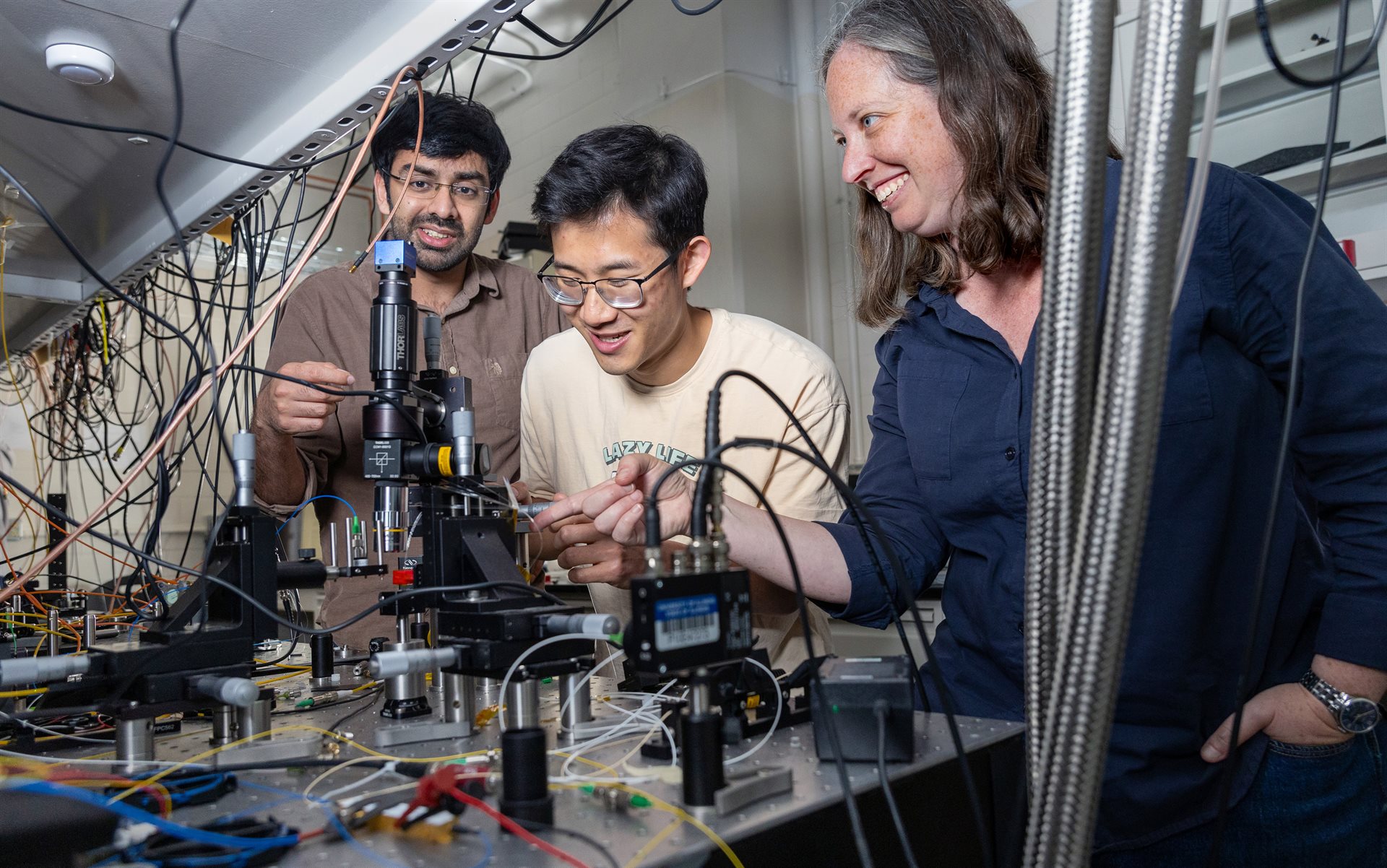
Physicists at the University of Illinois Urbana-Champaign have built a nanoscale chip that can hold photons for more than a microsecond and store several of them at the same time, a step toward the quantum memories that future chip-based computers and networks will need. The work, led by physics professor Elizabeth Goldschmidt, was published in Nano Letters.
Quantum information travels in photons, particles of light, and those photons often have to be paused while slower quantum operations catch up. That storage has to happen on microchips as small as one centimeter, a distance light crosses in a few trillionths of a second. Storing a photon for a microsecond would therefore be a large leap for chip-scale quantum hardware.
There are two broad ways to do it. Conventional photonics delays light by lengthening its path through fiber or mirrors, but photons are easily absorbed by matter, and a photon is unlikely to survive the distances needed for quantum-relevant delays. The alternative is to couple photons to highly coherent atoms, but integrating such atoms with scalable nanophotonic platforms has been largely out of reach.
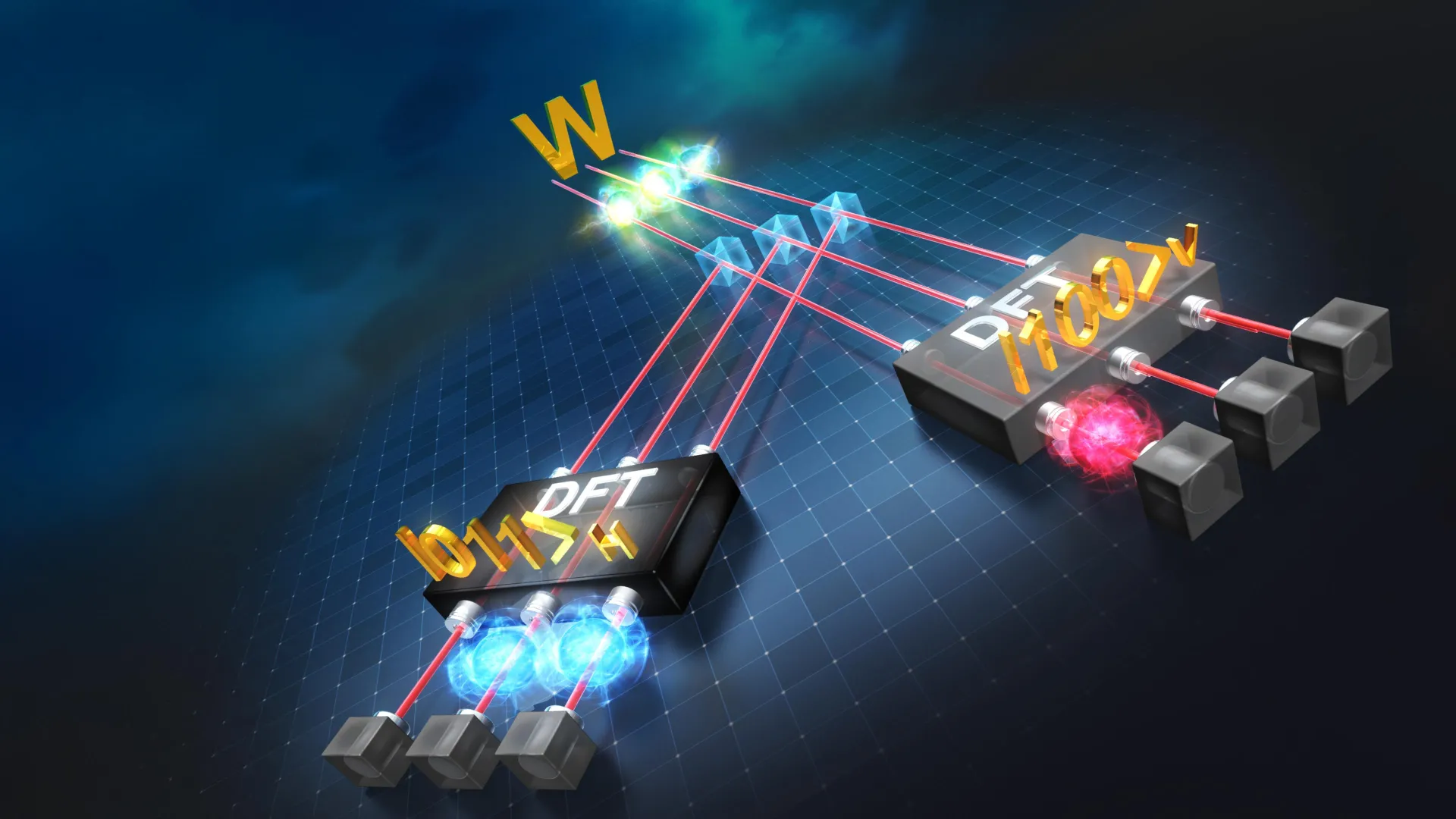
The Illinois team built a nanoscale waveguide from thin-film lithium niobate, a material known for tight light confinement, low optical loss and wafer-scale manufacturing, and doped it with erbium atoms, which have useful quantum properties. They used a tunable laser to arrange the atoms' frequencies into evenly spaced peaks, a pattern called an atomic frequency comb. That design lets the atoms catch an incoming photon and hold it for a predetermined time.
The resulting device preserved quantum information with high fidelity, with storage times beyond one microsecond and the ability to store multiple photons at once. The group built on earlier work in rare-earth-doped materials and on slow light produced by spectral hole burning.
"No one else has stored light on a chip in a platform like this, with this potential for scalability," said Priyash Barya, an electrical engineering graduate student and co-first author. "Our technique is the only way of doing this, and we're doing it on one of the leading platforms for quantum optics and quantum information systems." Daren Chen, a physics graduate student and the other co-first author, said long delays remain an outstanding problem in quantum information processing.
Goldschmidt stressed that the design is meant to be reproducible. "This is not a one-off bespoke device," she said. "Its promise is in its simplicity: we've taken something that can typically only be done in a highly specialized laboratory environment and recast it in a platform that can be made commercially at scale by people who don't know anything about quantum optics."
The team is clear that this is early. A practical version will need better retrieval efficiency, meaning more of the stored photons must come back out, and longer storage times. The group plans to improve its frequency comb and test different erbium isotopes that are less sensitive to noise. Goldschmidt said the project is one component of broader work on spectrally tailoring atomic ensembles in integrated photonics to build other quantum devices.