Physicists Discover Hidden 48-Dimensional Topology in Quantum Light, Unlocking New Quantum Alphabet
Researchers in South Africa and China found that entangled photons carry over 17,000 distinct topological signatures across 48 dimensions — a free resource sitting in standard quantum optics setups.
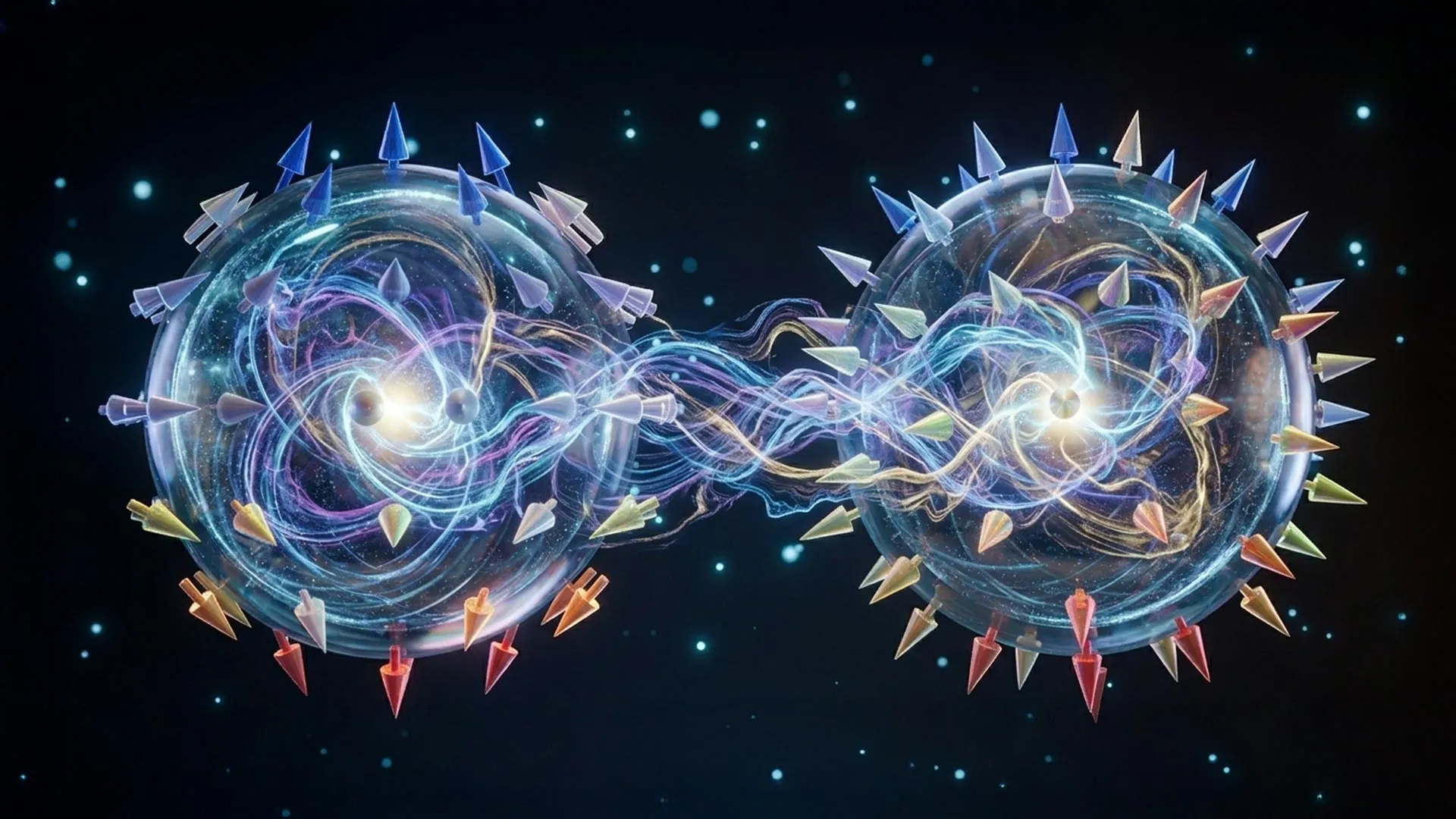
Physicists have discovered that beams of entangled light contain hidden topological structures reaching into 48 dimensions — vastly more complex than anyone previously realized — a finding that could transform how quantum information is encoded and transmitted. The research, published in Nature Communications and conducted by scientists at the University of the Witwatersrand in South Africa and Huzhou University in China, reveals that standard quantum optics experiments are generating an enormous untapped alphabet of topological states that most researchers have simply been ignoring.
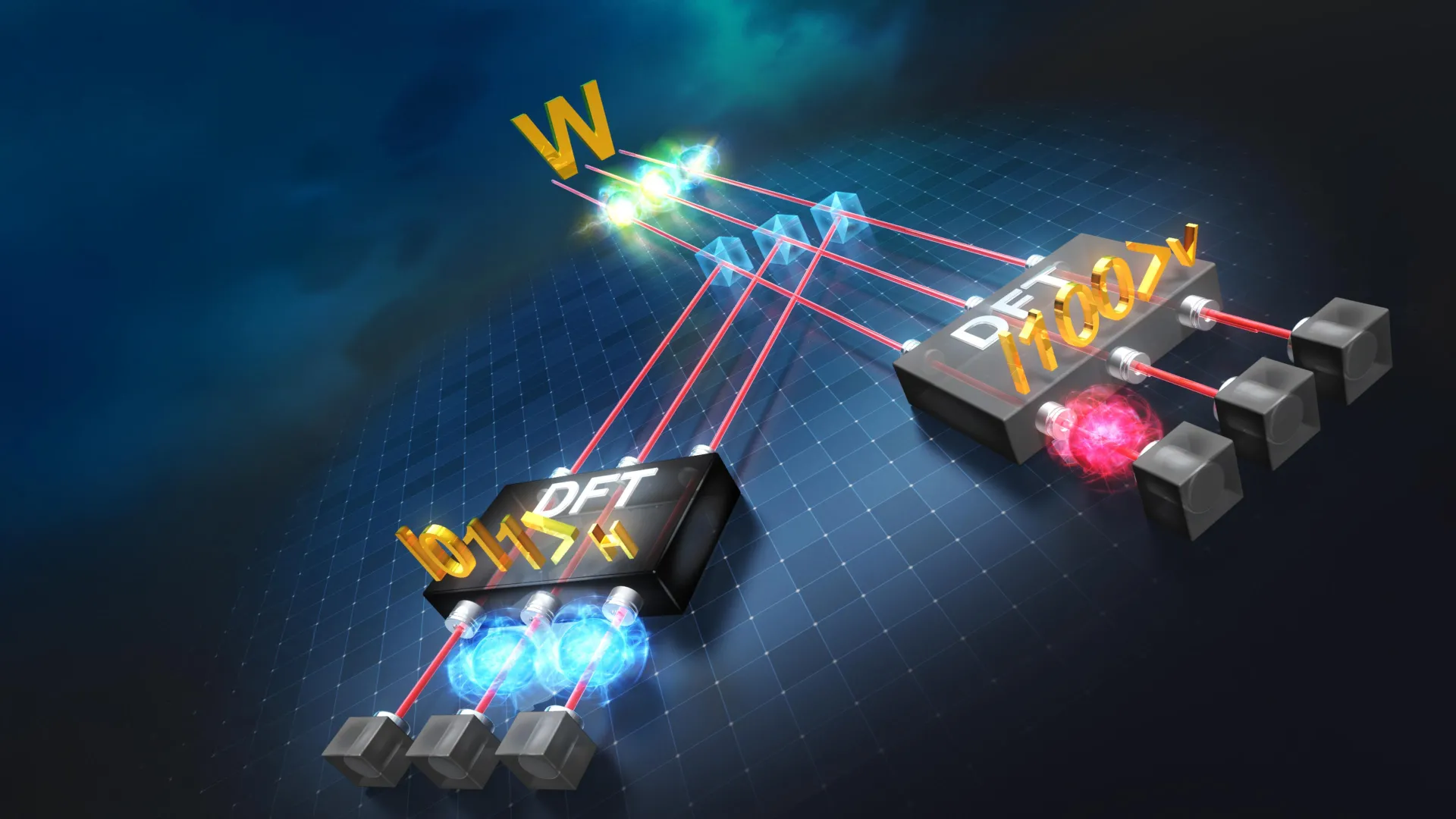
The team used a technique called spontaneous parametric downconversion, a standard method in quantum optics that splits single photons into pairs of entangled photons. By carefully measuring the orbital angular momentum — essentially the rotational component of each photon's wavefront — the researchers found that the entangled pairs carry topological signatures organized in structures spanning up to 48 dimensions, with over 17,000 distinct topological patterns identified across the dataset. What's striking is that only a single physical property of light was needed to reveal this complexity, rather than the multiple properties previously thought necessary.
The significance lies in the topology itself. Topological structures are mathematical shapes defined by their connectivity rather than their precise geometry — a coffee mug and a donut are topologically equivalent because both have exactly one hole, regardless of their detailed form. In quantum systems, topological properties are inherently robust against the small perturbations and environmental noise that typically destroy quantum states. The discovery suggests that future quantum communication systems could exploit these topological signatures as a naturally error-resistant way to encode information, much as current cryptographic systems exploit mathematical hardness but with a fundamentally different mechanism.
"You get the topology for free, from the entanglement in space," said Prof. Robert de Mello Koch, one of the lead researchers, noting that the necessary experimental resources already exist in most quantum optics laboratories around the world. The team credits abstract quantum field theory for pointing toward where these hidden structures might be found — a notable example of pure mathematical physics yielding unexpected experimental predictions. The work represents a convergence of topology, quantum optics, and information theory that researchers in all three fields have been edging toward for years.
The practical implications for quantum computing and quantum communication could be substantial. Current quantum systems struggle with decoherence — the tendency of quantum states to collapse when they interact with their environment. Topological approaches to quantum information storage have long been theorized as a solution, but most proposals require exotic materials or extreme conditions to implement. The new finding suggests that a rich topological resource is sitting in plain sight in the light beams that quantum optics experiments already produce, requiring no specialized equipment to access. Researchers say the next step is developing protocols that can selectively address individual topological states within the 48-dimensional space, a challenge that will require collaboration between experimentalists and theorists.