AI-Powered Spectrometer Chip Shrinks Lab Analysis to Size of Grain of Sand
UC Davis researchers achieve lab-quality spectral analysis using silicon sensors and machine learning, eliminating the need for bulky optical equipment.
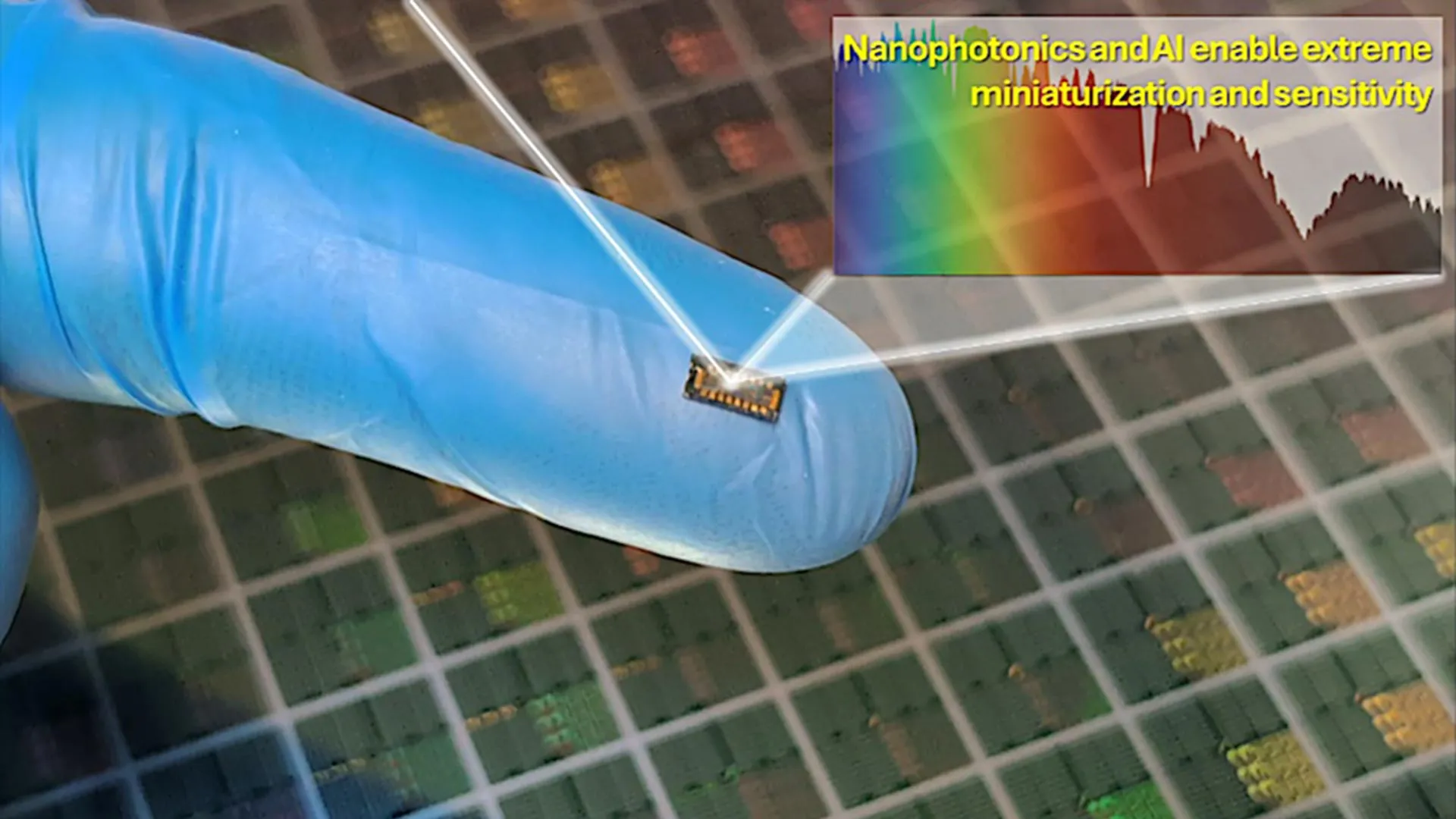
Scientists at the University of California Davis have developed a revolutionary spectrometer-on-a-chip that approaches the size of a grain of sand, representing a dramatic miniaturization of technology traditionally requiring large laboratory instruments. The breakthrough combines artificial intelligence with specially engineered silicon sensors to perform chemical analysis without the bulky optical components that have defined spectroscopy for decades.
The device abandons the conventional approach of physically separating light into its component colors using prisms or gratings. Instead, it relies on 16 unique silicon detectors, each designed to react differently to incoming light, generating encoded signals that contain hidden spectral information. A fully connected neural network, trained on thousands of examples, then reconstructs the original light spectrum from these detector signals with approximately 8 nanometer resolution accuracy.
A major breakthrough came from modifying standard silicon photodiodes with specialized photon-trapping surface textures. Silicon normally works well for visible light detection but struggles to capture near-infrared light, which is crucial for applications such as biomedical imaging because it penetrates deeper into human tissue. The engineered surface textures scatter near-infrared photons repeatedly within the silicon, dramatically increasing absorption and extending the chip's spectral sensitivity to 1100 nanometers.
The miniaturized system offers capabilities beyond simple color detection, potentially capturing ultrafast light interactions that occur over extremely brief time periods. Traditional spectrometers are used in everything from disease diagnosis and food inspection to pollution monitoring, but their size and cost have limited deployment in portable or embedded applications. The new chip-scale approach could enable spectroscopy in smartphones, wearable devices, or remote sensing applications where space and power are constrained.
Published in Advanced Photonics, the research represents a significant advance in computational spectroscopy, where AI algorithms replace physical optical components. The team's approach of using machine learning to solve the complex "inverse problem" of reconstructing spectra from encoded detector signals opens new possibilities for ultra-compact analytical instruments. As the technology matures, it could democratize access to sophisticated chemical analysis tools across industries ranging from healthcare to environmental monitoring.