Scientists Discover AI Could Miss Revolutionary Physics While Accelerating Research
Transfer learning dramatically reduces simulation costs but may struggle to recognize truly groundbreaking discoveries, new study reveals.
Artificial intelligence could revolutionize the search for new physics by making discoveries faster and cheaper, but the same technology might paradoxically miss the most groundbreaking findings, according to new research published in the Journal of Cosmology and Astroparticle Physics. Scientists found that a machine learning technique called transfer learning can slash the need for expensive simulations by more than a factor of ten, yet it can backfire when AI becomes too dependent on familiar patterns.
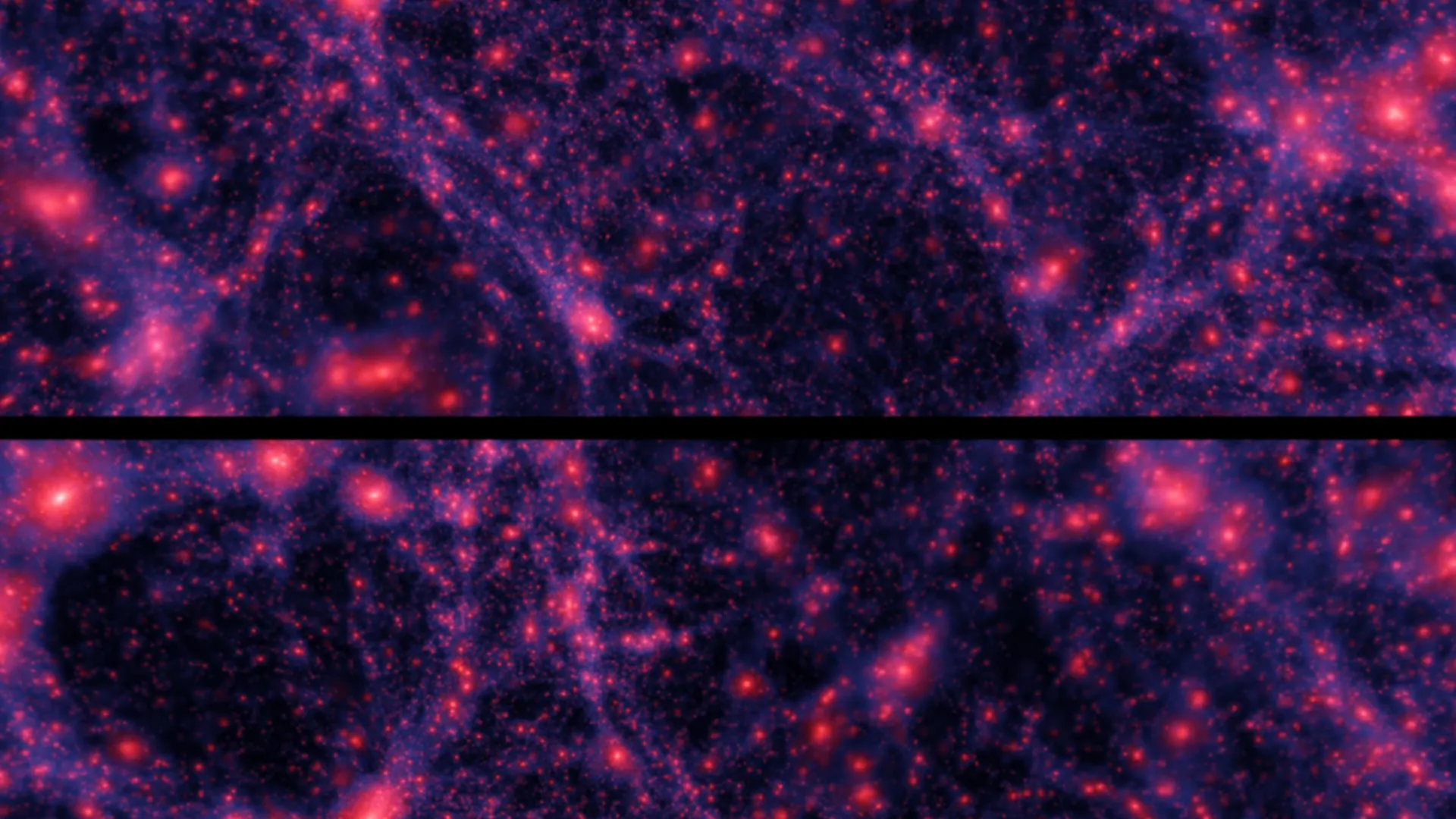
The study examined how transfer learning might help researchers investigate theories beyond the standard cosmological model, including the effects of massive neutrinos, modified gravity, and evolving dark energy. These investigations typically require enormous numbers of detailed computer simulations, each representing a virtual universe built using different physical assumptions. The computational costs have long been a major barrier to exploring new physics.
Transfer learning allows AI systems to apply knowledge gained from simpler tasks to more complex problems. Instead of training neural networks entirely on the most computationally expensive simulations, researchers first trained them on cheaper simulations based on the standard Lambda-CDM model, then moved to more sophisticated models that include potential new physics. "It's basically a shortcut," explained Adrian Bayer, a cosmologist at the Flatiron Institute and Princeton University.
The results were striking in some cases, with transfer learning reducing the number of expensive simulations required by more than ten times. However, the study also revealed a concerning phenomenon called negative transfer. The AI systems sometimes became so reliant on patterns learned during initial training that they struggled to recognize genuinely new physical phenomena that differed significantly from their prior experience.
This finding has important implications for the future of physics research. While AI can dramatically accelerate the search for new discoveries, scientists must carefully design their approaches to ensure that truly revolutionary findings aren't overlooked. The research suggests that the most transformative discoveries in physics may require AI systems specifically designed to recognize and adapt to completely unfamiliar patterns rather than building on existing knowledge.