AI Discovers Revolutionary Physics in Dusty Plasma's Fourth State of Matter
Neural network reveals hidden forces with 99% accuracy, potentially overturning fundamental assumptions about particle interactions.
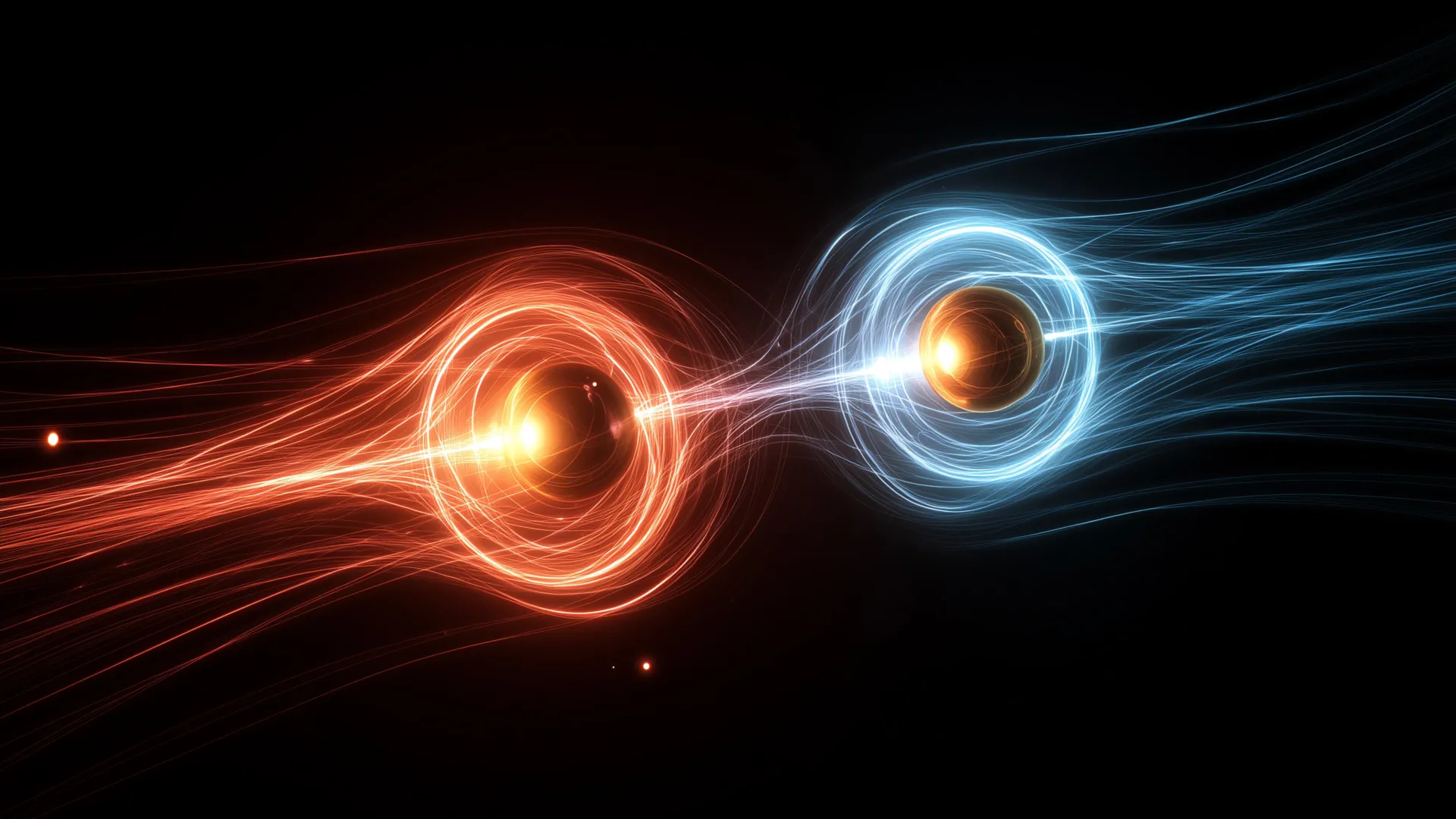
Physicists have achieved a groundbreaking milestone by using artificial intelligence to discover entirely new laws of nature hidden within dusty plasma, the mysterious "fourth state of matter" found everywhere from space to wildfires. The research team from Emory University combined a specially designed neural network with precise 3D particle tracking to reveal complex, one-way forces between particles that had previously been impossible to measure accurately. Their AI model captured these non-reciprocal forces with over 99 percent accuracy while simultaneously challenging long-held theoretical assumptions about how particles interact in plasma systems.
The study represents a significant departure from traditional AI applications in physics, moving beyond data analysis and prediction to actual discovery of physical laws. Justin Burton, an Emory professor of experimental physics and senior co-author of the research published in PNAS, emphasized that their AI method is not a "black box" but rather a transparent framework that scientists can understand and replicate. The approach combines machine learning with laboratory experiments on dusty plasma, where ionized gas contains tiny charged dust particles that interact through complex electromagnetic forces.
Non-reciprocal forces, where one particle influences another differently than it is influenced in return, represent some of the most challenging phenomena to study in physics. These forces are notoriously difficult to measure and model because they don't follow Newton's third law of equal and opposite reactions. The Emory team's AI system was able to map these interactions with unprecedented precision, revealing that some common theoretical assumptions about plasma behavior were actually incorrect. The ability to see particle interactions "in exquisite detail" allowed researchers to correct these inaccuracies for the first time.
The implications of this research extend far beyond dusty plasma physics. The universal framework developed by the team could potentially be applied to any system composed of many interacting components, from industrial materials like paint and ink to biological systems involving groups of living cells. Vyacheslav Lukin, program director for the NSF Plasma Physics program, noted that the technique might help scientists better describe, recognize, understand, and even control complex systems dominated by collective interactions.
Dusty plasma itself exists in environments ranging from planetary rings to industrial processes, making a better understanding of its behavior crucial for both fundamental physics and practical applications. The fourth state of matter forms when gas becomes so energized that electrons separate from atomic nuclei, creating a soup of charged particles. When dust grains become embedded in this plasma, they acquire electric charges and begin interacting through forces that the new AI system has now revealed in unprecedented detail. This research demonstrates how artificial intelligence can serve as a powerful tool for scientific discovery, potentially revolutionizing how physicists uncover the fundamental laws governing our universe.