Scientists Use AI to Discover New Physics Laws in Fourth State of Matter
Machine learning reveals hidden patterns in dusty plasma interactions, capturing complex forces with 99% accuracy and overturning long-held assumptions about particle behavior.
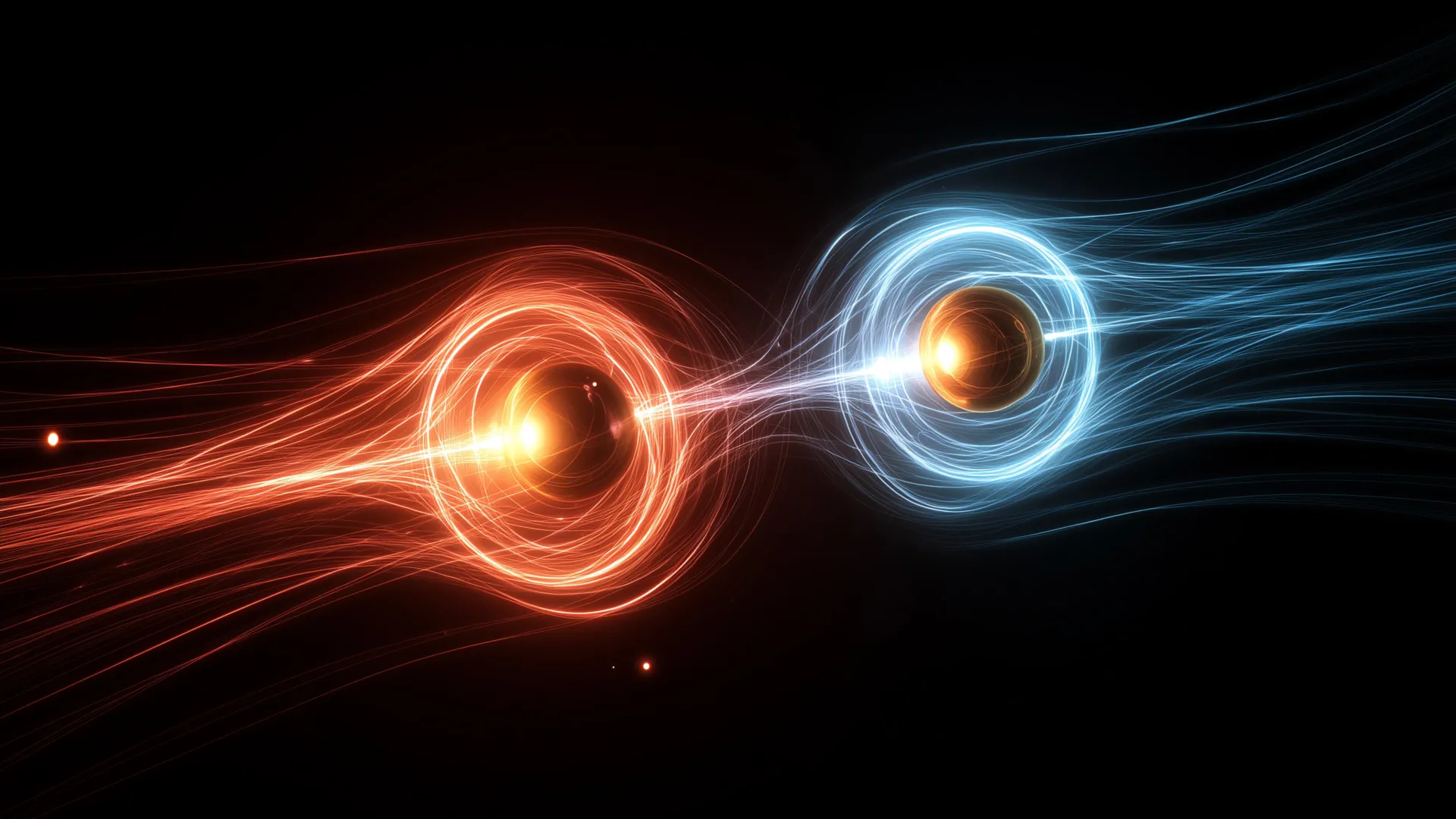
Physicists at Emory University have achieved a groundbreaking milestone by using artificial intelligence to uncover entirely new laws of physics, moving beyond traditional data analysis to reveal fundamental principles governing matter in extreme conditions. The research team, led by experimental physicist Justin Burton and theoretical physicist Ilya Nemenman, focused their investigation on dusty plasma, an exotic "fourth state of matter" found in environments ranging from space to wildfires. By combining a specially designed neural network with precise three-dimensional tracking of particles, they discovered hidden patterns in non-reciprocal forces where particles influence each other asymmetrically, challenging conventional understanding of particle interactions.
The breakthrough centers on dusty plasma, a system consisting of ionized gas filled with tiny charged dust particles that creates conditions impossible to replicate under normal terrestrial circumstances. Using their AI model, the researchers achieved remarkable precision in describing these complex interactions, capturing non-reciprocal forces with over 99% accuracy. These forces are notoriously difficult to measure and model because they violate Newton's third law of equal and opposite reactions, creating scenarios where one particle can influence another more strongly than it receives influence in return. The team's neural network approach proved capable of detecting and quantifying these subtle asymmetries with unprecedented detail.
What makes this research particularly significant is the AI system's ability to correct long-standing theoretical assumptions about how these forces behave in complex systems. "We can describe these forces with an accuracy of more than 99%," explained Nemenman. "What's even more interesting is that we show that some common theoretical assumptions about these forces are not quite accurate." The machine learning framework revealed that previous models had oversimplified the intricate relationships between particles, leading to incomplete understanding of fundamental physical processes that govern matter under extreme conditions.
The implications extend far beyond academic physics, as the universal framework could potentially be applied to any system composed of many interacting components. Industrial applications include improving formulations of paints and inks, while biological applications could enhance understanding of cellular interactions and tissue formation. The National Science Foundation's Vyacheslav Lukin noted that the research serves as "a great example of an interdisciplinary collaboration where the development of new knowledge in plasma physics and AI may lead to further advances in the study of living systems."
This achievement represents a fundamental shift in how scientists approach discovery, demonstrating that AI can serve as more than just a computational tool for analyzing existing data. Instead, machine learning systems can actively participate in uncovering new physical laws that govern the natural world. The research team emphasizes that their AI method is not a "black box" but rather a transparent system whose operations can be understood and verified. This transparency is crucial for scientific acceptance and opens possibilities for applying similar techniques to other complex physical systems where traditional analytical methods have reached their limits.