AI Breakthrough Reveals Hidden Physics in Fourth State of Matter
Scientists have used machine learning to uncover entirely new laws of nature in dusty plasma, achieving over 99% accuracy in modeling complex particle interactions.
Physicists at Emory University have achieved a groundbreaking milestone by using artificial intelligence to discover previously unknown physical laws governing the behavior of dusty plasma, often called the fourth state of matter. The research team, led by experimental physicist Justin Burton and theoretical physicist Ilya Nemenman, combined a specially designed neural network with precise three-dimensional particle tracking to reveal hidden patterns in how particles interact within this exotic state of matter. Their findings, published in the Proceedings of the National Academy of Sciences, represent the first time AI has been used not just to analyze existing data, but to uncover fundamental new principles of physics.
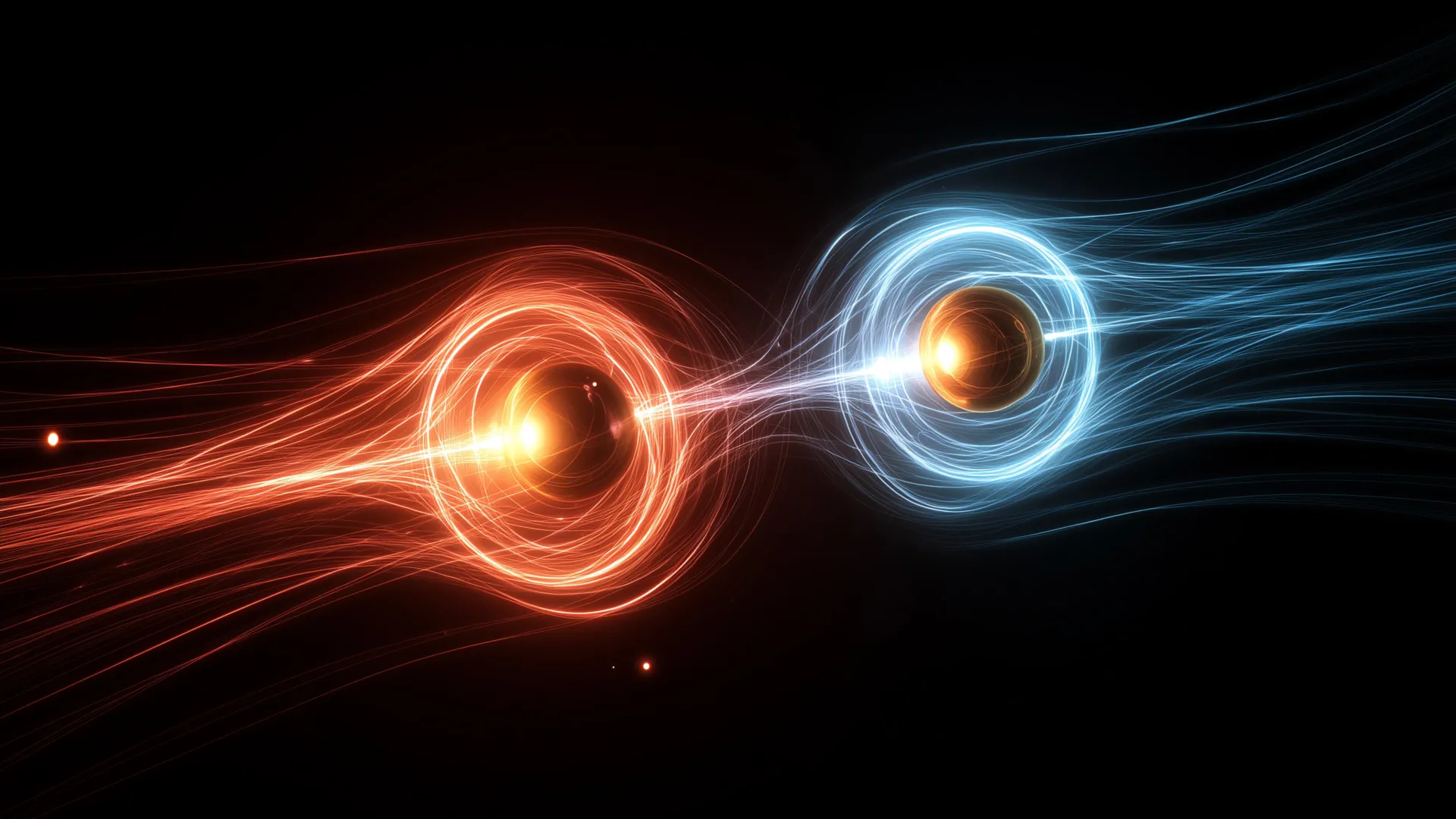
The study focuses on non-reciprocal forces, where one particle influences another differently than it is influenced in return—a phenomenon that has long puzzled scientists due to its complexity and difficulty in measurement. Using their innovative AI model, the researchers achieved an unprecedented level of accuracy in describing these forces, exceeding 99% precision in their calculations. This breakthrough overturned long-standing theoretical assumptions about how these forces behave, providing corrections to scientific understanding that had persisted for decades.
Dusty plasma consists of ionized gas filled with interacting charged particles, including tiny grains of dust, and exists in environments ranging from space to wildfires on Earth. The extreme conditions and complex interactions within this state of matter make it an ideal testing ground for advanced physics research. The team's AI framework successfully captured the intricate dynamics of particle behavior that traditional analytical methods had failed to fully describe, opening new avenues for understanding complex physical systems.
The implications of this research extend far beyond dusty plasma, as the AI methodology could potentially be applied to other many-body systems throughout physics and materials science. "Our AI method is not a black box: we understand how and why it works," explained Burton. "The framework it provides is also universal. It could potentially be applied to other many-body systems to open new routes to discovery." The technique shows promise for studying industrial materials like paint and ink, as well as biological systems involving groups of living cells.
This work represents a significant advancement in the intersection of artificial intelligence and fundamental physics research, demonstrating that machine learning can serve as a powerful tool for scientific discovery rather than merely data analysis. The National Science Foundation and Simons Foundation supported this research, which exemplifies the potential for AI to accelerate our understanding of the natural world. As scientists continue to refine these techniques, they may unlock new insights into the fundamental forces that govern matter and energy throughout the universe.