Forgotten Heavy Neutrino May Explain Why Matter Beat Antimatter, Physicists Say
A Southampton and IIT Kanpur team argues a long-ignored 'decoupled' heavy neutrino could have briefly dominated the early universe and shaped the matter-antimatter imbalance.

Physicists at the University of Southampton and the Indian Institute of Technology Kanpur have proposed a new theory of how the early universe came to be made of matter, pointing to a particle that has been overlooked for decades.
The work targets one of the biggest puzzles in physics: why matter won out over antimatter after the Big Bang. According to current theories, the two should have annihilated each other in equal measure, leaving an empty universe of pure energy. The fact that galaxies, stars and people exist means some asymmetry arose. The new idea finds a clue in the neutrino, one of the lightest known particles.
The team says an often-ignored relative of the neutrino, a "decoupled" heavy neutrino, could have tipped the balance toward matter. Dr. Rishav Roshan of Southampton said the particle "has long been dismissed as an irrelevant background detail in particle physics." Most explanations of the imbalance ignored it because experts judged it too weak to affect other particles.
Roshan said the particle decays incredibly slowly. As the cosmos cooled after the Big Bang, it lived long enough that it temporarily took over the energy density of the universe and triggered a matter-dominated period. That, in turn, changed the temperature at which fundamental particles such as electrons and other leptons interacted with their antiparticles with the help of the Standard Model Higgs boson. "This temperature acts like a switch that shapes how the matter-antimatter imbalance was built up," he said. "The fact that we are here at all proves that an asymmetry between matter and antimatter occurred."
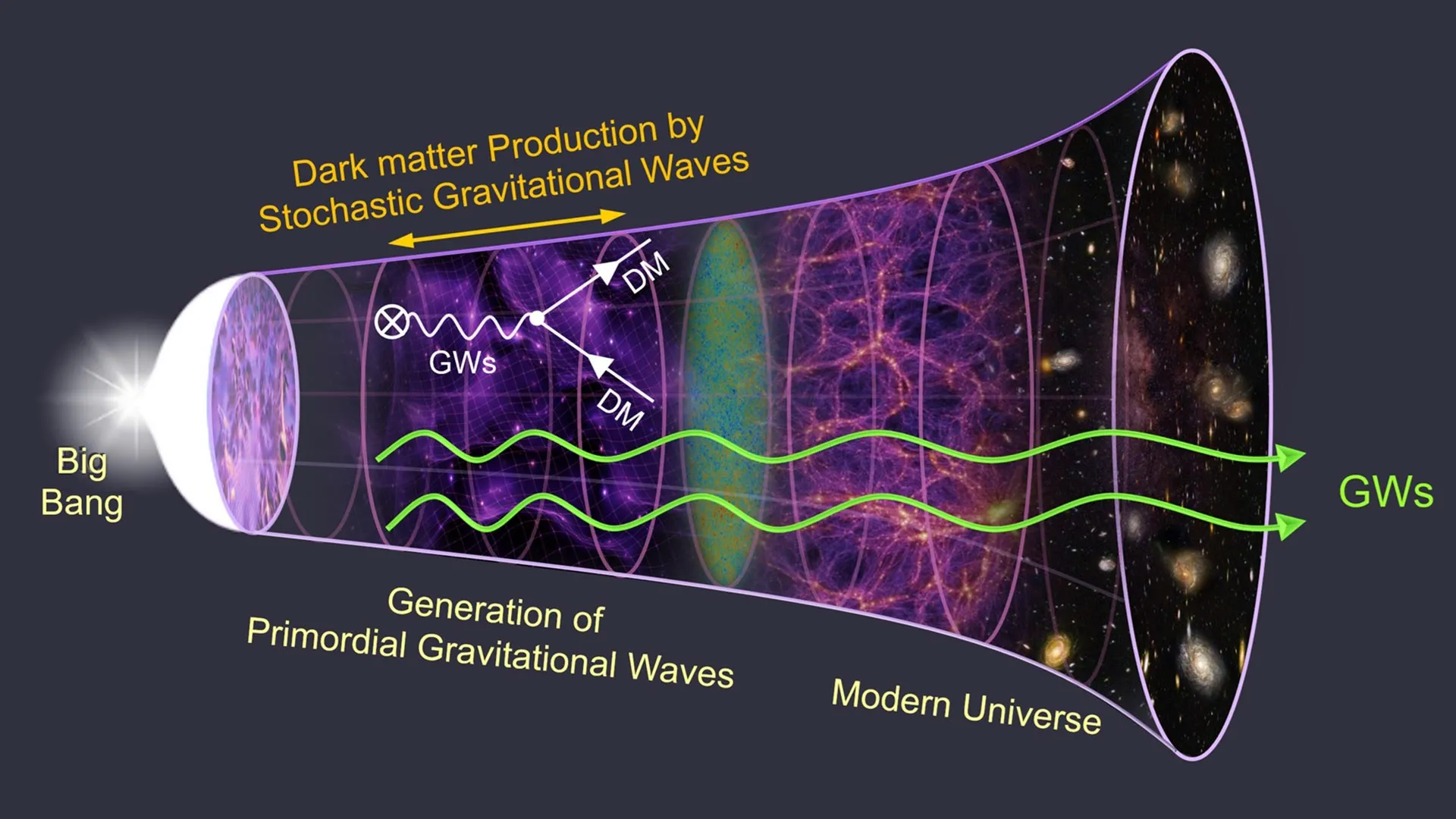
Paper co-author Dr. Sudipta Show of IIT Kanpur said the findings change how researchers understand the rapid expansion of the early universe after the Big Bang. The dramatic shift in expansion leaves distinct but detectable imprints, he said, for example on primordial gravitational waves. "These gravitational wave signatures open up new avenues for us to unravel the evolution of the early universe after the Big Bang," Show said.
That last point gives the idea a way to be tested. Most theories of the matter-antimatter asymmetry are hard to check because they involve processes at energies far beyond what colliders can reach. A theory that predicts a signal in primordial gravitational waves can, in principle, be confirmed or ruled out by future detectors sensitive to that background, though no such measurement exists yet.
The proposal does not claim the heavy neutrino has been observed. It is a theoretical result showing that a particle many models had set aside can change the calculation in a meaningful way. The researchers say it shifts the temperature at which the imbalance is generated, and that shift changes how much matter survives.
For now the particle remains hypothetical. But the study adds to a broader push to treat the tiny masses and odd behavior of neutrinos as a window into the first moments of the universe, and it argues that the pieces earlier models left out may matter most.