Scientists Create Ancient Dark Matter Using Gravitational Wave Breakthrough
Researchers discover that spacetime ripples from the Big Bang may have transformed into particles that became the invisible substance shaping galaxies today.
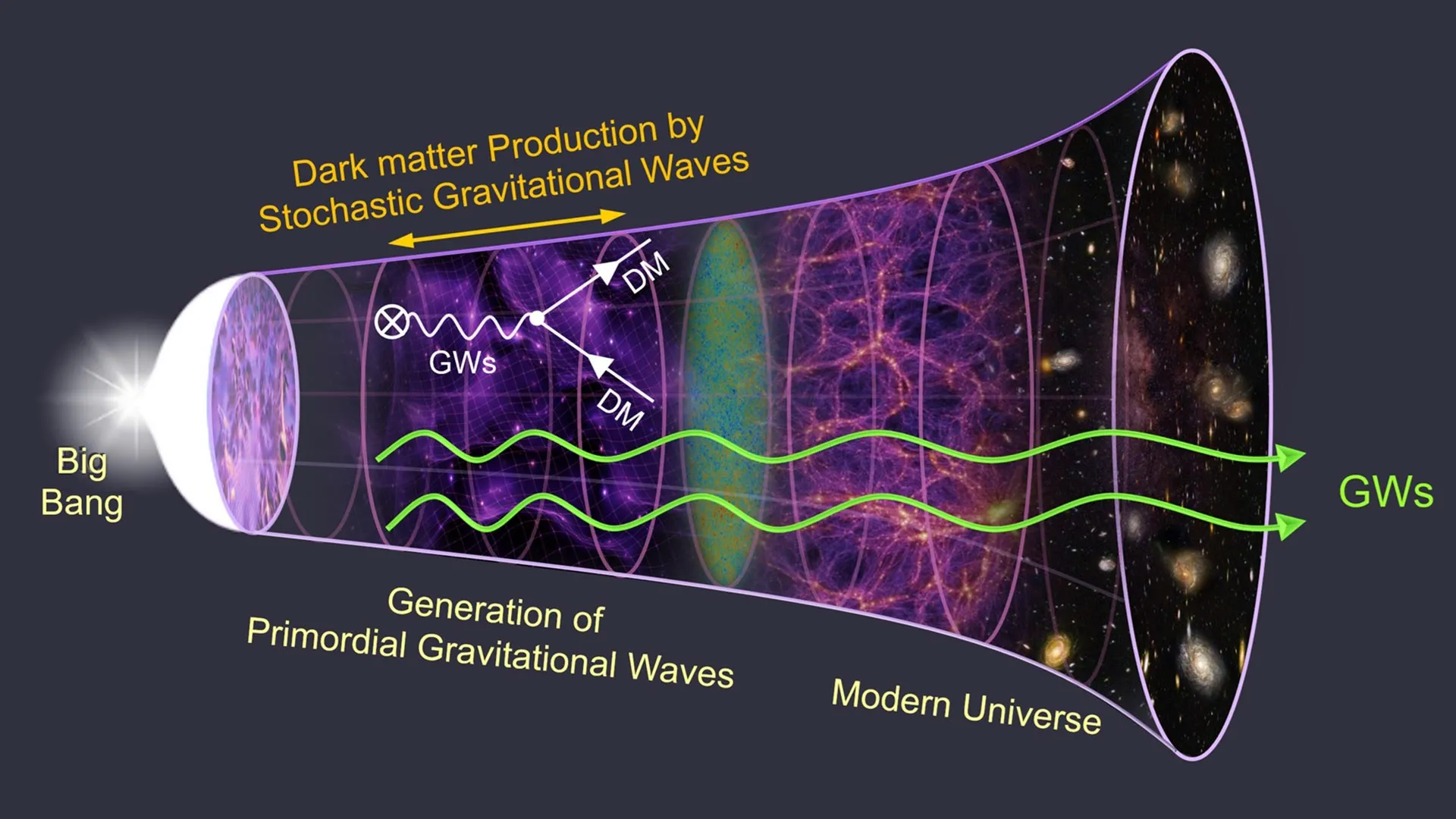
Gravitational waves may have played a crucial role in creating dark matter during the universe's earliest moments, according to groundbreaking research by Professor Joachim Kopp of Johannes Gutenberg University Mainz and Dr. Azadeh Maleknejad from Swansea University. Published in Physical Review Letters, their work introduces revolutionary calculations suggesting that stochastic gravitational waves could have given rise to the mysterious substance that comprises roughly 23 percent of the universe. This discovery addresses one of the biggest unanswered questions in particle physics about the origin of the invisible matter that shapes cosmic structure.
The research focuses on a special type of gravitational waves called stochastic waves, which differ dramatically from those produced by dramatic cosmic events like black hole collisions. These ancient waves formed part of the background signal filling the universe and may have been generated during key moments in cosmic history, including phase transitions as the universe cooled or from primordial magnetic fields. Unlike the more familiar gravitational waves detected from massive object collisions, stochastic waves arise from a range of processes and represent much weaker ripples in spacetime that have persisted since the Big Bang.
According to the new theory, these early gravitational waves could have produced fermions that initially had little or no mass. Fermions represent a broad class of particles that includes familiar examples such as electrons, protons, and neutrons. The researchers propose that these early massless fermions later gained mass and evolved into the dark matter particles that exist throughout the cosmos today. This process would have occurred during the chaotic first moments after the Big Bang when spacetime ripples could have transformed into particles through previously unexplored mechanisms.
The implications of this discovery extend far beyond theoretical physics, potentially revolutionizing our understanding of how the universe's invisible architecture came to exist. Dark matter's enormous influence on galaxy formation and the largest cosmic structures has been well-documented through observations, yet scientists have remained baffled about its fundamental nature. The new research suggests that the very fabric of spacetime itself may have been responsible for creating the particles that would later shape the cosmic web of galaxies and galaxy clusters.
Professor Kopp emphasized that this work represents just the beginning of a new research direction, noting that the next steps involve conducting numerical calculations to improve the accuracy of their predictions. The team also plans to investigate additional possible effects of gravitational waves in the early universe, potentially uncovering more connections between spacetime dynamics and particle creation. This breakthrough opens an entirely new avenue for understanding dark matter's origins while providing fresh insights into the fundamental processes that governed the universe's first moments.