Gravitational Waves May Have Created Dark Matter in Early Universe
New research suggests ancient ripples in spacetime could have transformed into the invisible particles that shape galaxies today.
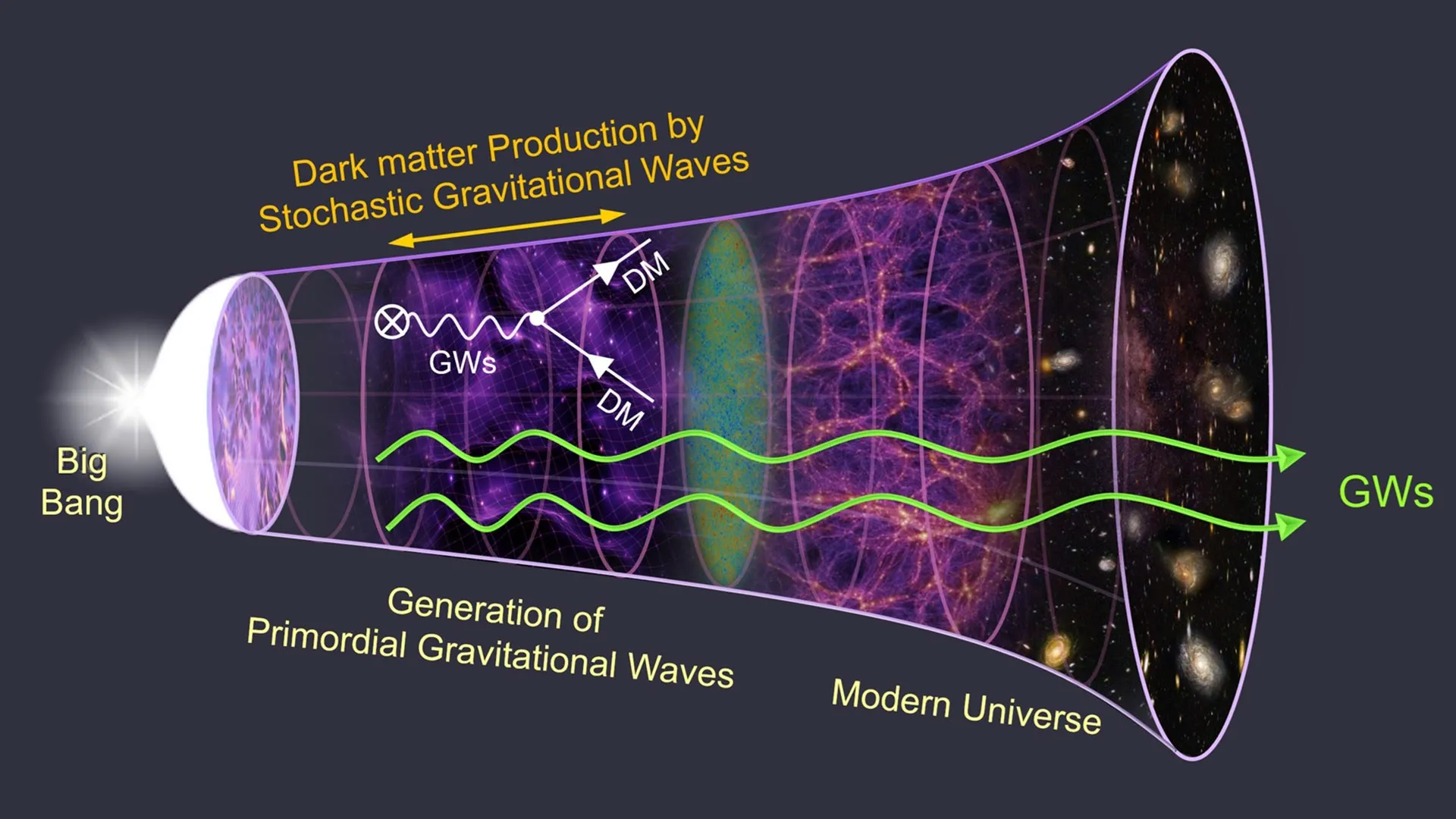
Gravitational waves may have played a crucial role in creating dark matter during the universe's earliest moments, according to groundbreaking research by Professor Joachim Kopp of Johannes Gutenberg University Mainz and Dr. Azadeh Maleknejad from Swansea University. Published in Physical Review Letters, the study introduces fresh calculations pointing to a previously unexplored process in which stochastic gravitational waves could give rise to dark matter particles.
This research addresses one of particle physics' most pressing mysteries. While everything visible in the universe—planets, stars, and life on Earth—accounts for only about four percent of cosmic matter, dark matter alone represents roughly 23 percent of the universe. Despite its enormous influence on galactic formation and cosmic structure, scientists still don't understand what dark matter actually consists of, making this theoretical breakthrough particularly significant.
The study focuses on stochastic gravitational waves, which differ from the dramatic ripples produced by black hole or neutron star collisions. These weaker background waves fill the universe and date back to the earliest phases after the Big Bang, potentially arising from phase transitions as the cosmos cooled or from primordial magnetic fields. According to the researchers, these ancient waves could have produced fermions—a class of particles including electrons, protons, and neutrons—that initially had little or no mass.
Kopp explained the revolutionary concept: "In this article, we investigate the possibility of gravitational waves—which are believed to have been ubiquitous in the early universe—being partially converted into dark matter particles. This leads to a new mechanism of dark matter production that has not been researched before." The process suggests these early fermions may have later gained mass and evolved into the dark matter particles that exist today.
The next phase of research will move beyond analytical estimates to conduct numerical calculations that improve prediction accuracy. Scientists also plan to investigate additional possible effects of gravitational waves in the early universe. This work could fundamentally reshape our understanding of how the universe's invisible majority came to exist, potentially solving one of cosmology's greatest puzzles through an entirely new mechanism involving the fabric of spacetime itself.