Gravitational Waves From the Big Bang May Have Created All of the Dark Matter in the Universe
A new paper in Physical Review Letters proposes that stochastic gravitational waves generated in the first moments after the Big Bang could have been converted into dark matter particles — a mechanism never before proposed that could solve one of physics' most fundamental mysteries.

Two physicists have proposed a novel mechanism by which the mysterious ripples of space-time known as gravitational waves — specifically those generated in the chaotic moments shortly after the Big Bang — could have been converted into the dark matter that constitutes roughly 23% of everything in the observable universe, according to a new paper published in Physical Review Letters.
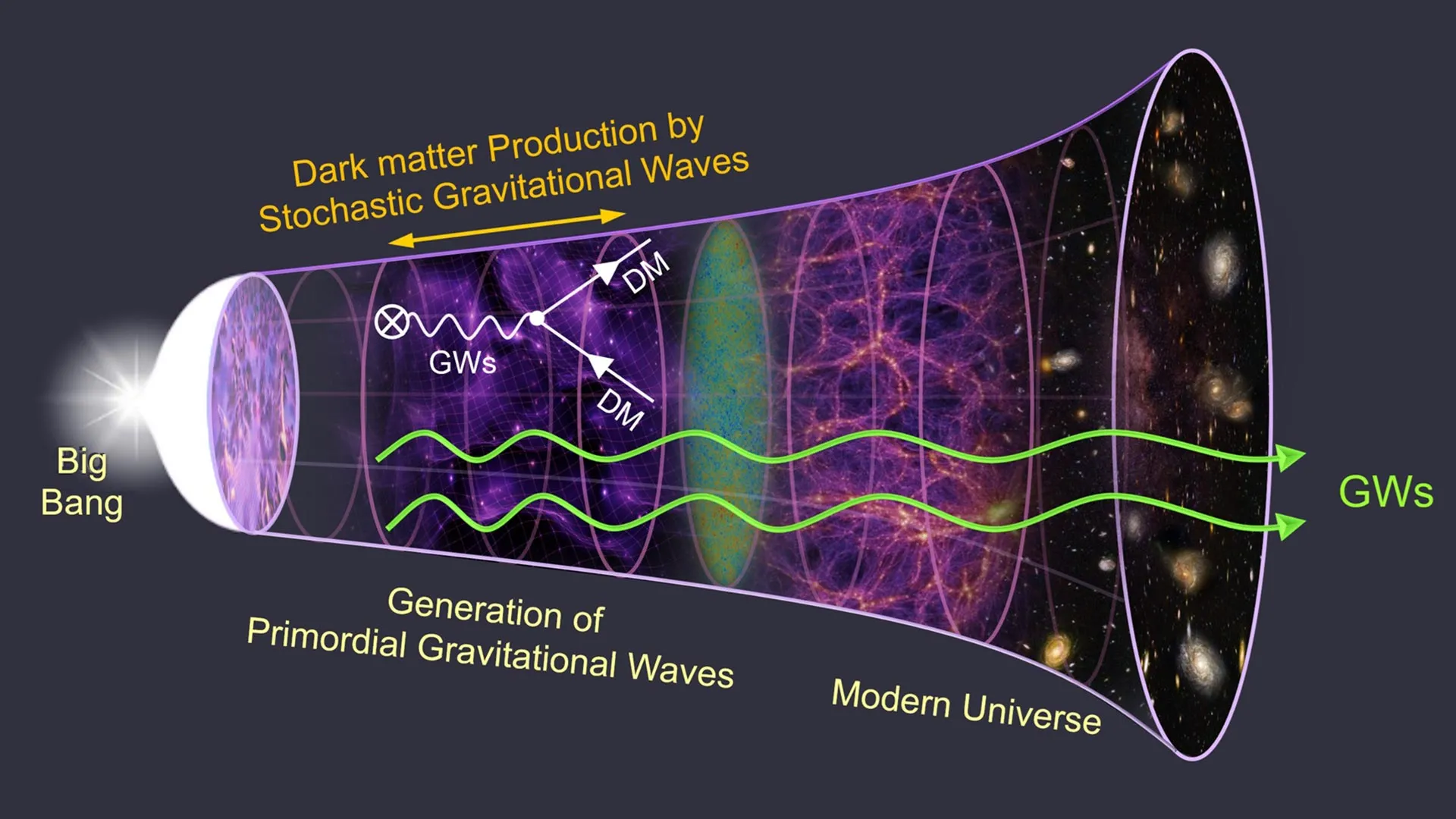
The research, authored by Professor Joachim Kopp of Johannes Gutenberg University Mainz and the PRISMA+ Cluster of Excellence in Germany, and Dr. Azadeh Maleknejad of Swansea University in the United Kingdom, proposes that a stochastic background of gravitational waves from early-universe events — such as phase transitions, cosmic strings, or symmetry-breaking processes — could have undergone conversion into dark matter particles through a mechanism the authors describe as entirely uncharted territory in cosmological physics.
Specifically, Kopp and Maleknejad propose that primordial gravitational waves transformed into massless or nearly massless fermions — fundamental particles — which later acquired mass and became the dark matter now observed through its gravitational effects on galaxies, galaxy clusters, and the large-scale structure of the universe. "This is a new mechanism of dark matter production that has not been researched before," the authors write in the paper.
Dark matter remains one of the most profound open questions in all of physics. Despite comprising roughly a quarter of the universe's total energy content, dark matter has never been directly detected by any particle physics experiment. Astronomers infer its existence from the gravitational effects it exerts on visible matter — galaxies rotate at speeds that cannot be explained by their luminous mass alone, and galaxy clusters bend light passing nearby in ways that require far more total mass than is visible. The leading candidate particles — including WIMPs (weakly interacting massive particles) and axions — have been hunted for decades in underground laboratories and collider experiments without a confirmed detection.
The gravitational wave mechanism Kopp and Maleknejad describe would connect two of the largest puzzles in modern cosmology: the origin of dark matter and the physics of the very early universe, when temperatures were so extreme that the familiar forces of nature may have behaved very differently than they do today. Primordial gravitational waves from this era — distinct from the gravitational waves detected by the LIGO and Virgo observatories from merging black holes and neutron stars — form a stochastic background spread uniformly across the cosmos, generated by processes occurring in the first fractions of a second after the Big Bang.
The paper arrives during a period of exceptional activity in gravitational wave science. Pulsar timing arrays operated by the NANOGrav collaboration and several international partners announced in 2023 strong statistical evidence for a stochastic gravitational wave background — precisely the kind of signal that would be consistent with early-universe sources. Future space-based detectors, particularly the European Space Agency's LISA mission expected to launch in the early 2030s, will be capable of probing the frequency ranges most directly relevant to early-universe gravitational wave production.
Kopp and Maleknejad are careful to characterize their results as analytical estimates requiring verification through detailed numerical calculations beyond current methodological capabilities. The team also indicated plans to explore whether the proposed mechanism could shed light on another fundamental mystery: the matter-antimatter asymmetry of the universe — the as-yet-unexplained reason why matter, rather than antimatter, dominates the cosmos after the Big Bang produced both in seemingly equal quantities.
The theory is not immediately testable with existing detectors but generates predictions that future gravitational wave observatories and dark matter experiments could potentially probe over the coming decade. If confirmed, it would represent one of the most significant theoretical connections drawn in modern cosmology — a single early-universe process responsible both for the gravitational wave background humming through the cosmos and for the dark matter permeating every galaxy in the observable universe.