Gravitational Waves May Have Created Dark Matter in Universe's First Moments
New research suggests ancient ripples in spacetime could have transformed into particles that became the invisible substance shaping galaxies today.
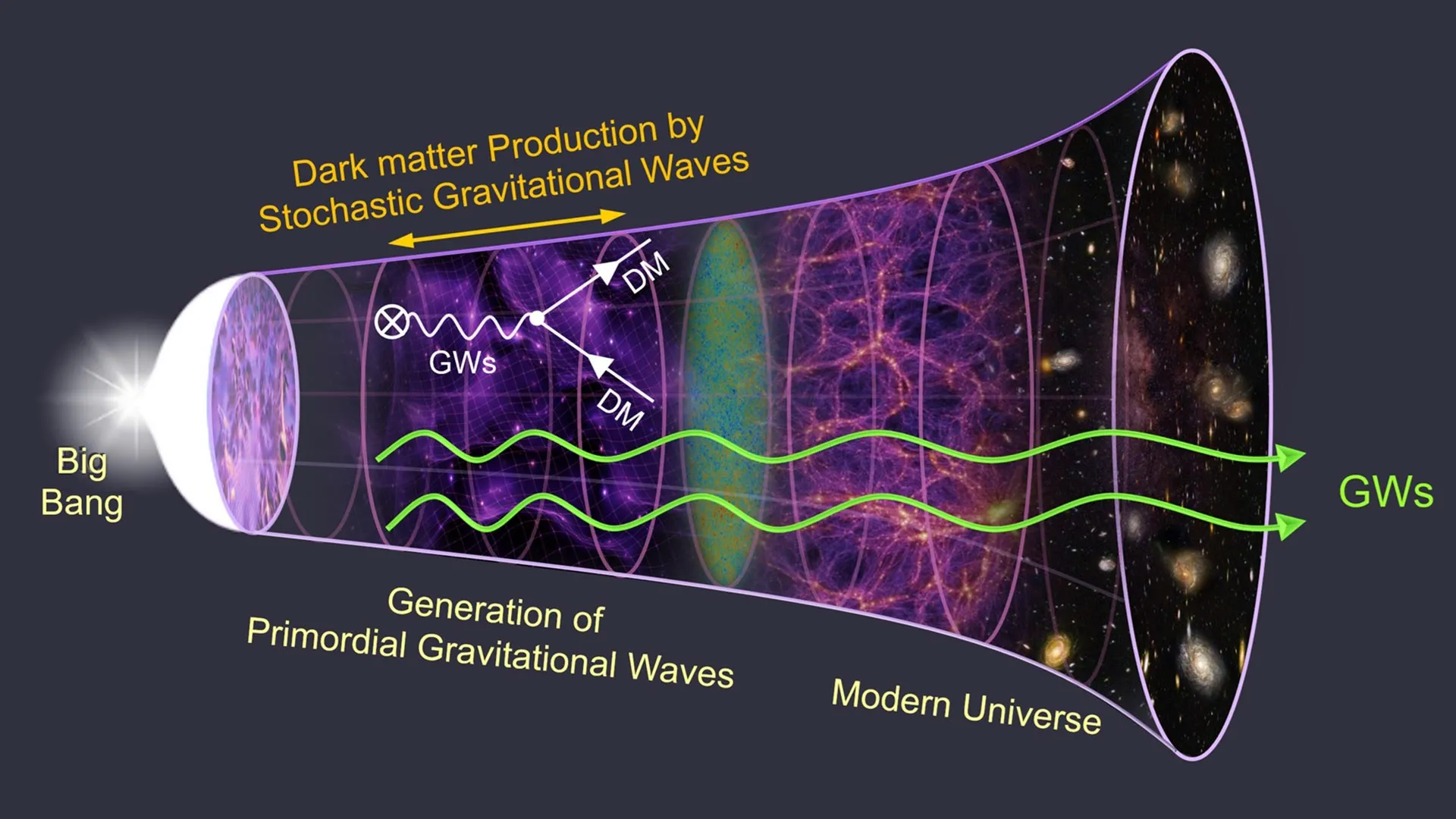
Gravitational waves from the chaotic first moments after the Big Bang may have played a crucial role in creating dark matter, according to groundbreaking new research published in Physical Review Letters. Professor Joachim Kopp of Johannes Gutenberg University Mainz and Dr. Azadeh Maleknejad from Swansea University propose that stochastic gravitational waves could have given rise to the mysterious substance that makes up roughly 23 percent of the universe.
The study addresses one of physics' most perplexing mysteries: while everything we can observe—planets, stars, and life itself—constitutes only about four percent of the universe, the vast majority remains invisible as dark matter and dark energy. Despite dark matter's enormous influence in shaping galaxies and the largest cosmic structures, scientists still do not understand what it is made of or how it formed in the early universe.
Unlike the dramatic gravitational waves produced by colliding black holes or neutron stars, stochastic gravitational waves arise from a variety of processes and form part of the universe's background signal. Many of these ancient waves date back to the earliest phases after the Big Bang, potentially generated during phase transitions as the universe cooled or from primordial magnetic fields that existed in those first moments.
The researchers propose that these early gravitational waves could have produced fermions—particles that include familiar examples like electrons, protons, and neutrons—that initially had little or no mass. According to their calculations, these primordial fermions may have later gained mass through various mechanisms and evolved into the dark matter particles that exist throughout the cosmos today.
"In this article, we investigate the possibility of gravitational waves—which are believed to have been ubiquitous in the early universe—being partially converted into dark matter particles," Kopp explained. "This leads to a new mechanism of dark matter production that has not been researched before." The team's next steps involve conducting more precise numerical calculations to improve their predictions and investigating additional possible effects of gravitational waves in the early universe, potentially opening new avenues for understanding how the cosmos evolved from its earliest moments.