Scientists Create Revolutionary Water Filter Using Perfectly Uniform Nanometer Pores
Nature-inspired membrane technology could transform industries by dramatically reducing energy consumption while achieving unprecedented molecular separation precision.
An international team of researchers has developed a groundbreaking water filtration technology that uses perfectly uniform one-nanometer pores to separate molecules with remarkable precision, potentially revolutionizing industries from pharmaceuticals to textiles. The nature-inspired membrane technology promises to significantly reduce energy consumption while improving water reuse capabilities and delivering separation performance far beyond current filtration systems.
The new filtration approach addresses a critical industrial challenge, as separation processes currently account for roughly 40% to 50% of global industrial energy consumption. Many manufacturing facilities still rely on energy-intensive methods such as distillation and evaporation, which require large amounts of energy and contribute significantly to carbon emissions. While membrane-based filtration offers a cleaner alternative, conventional polymer membranes suffer from uneven pore sizes and degradation over time, limiting their effectiveness in demanding industrial environments.
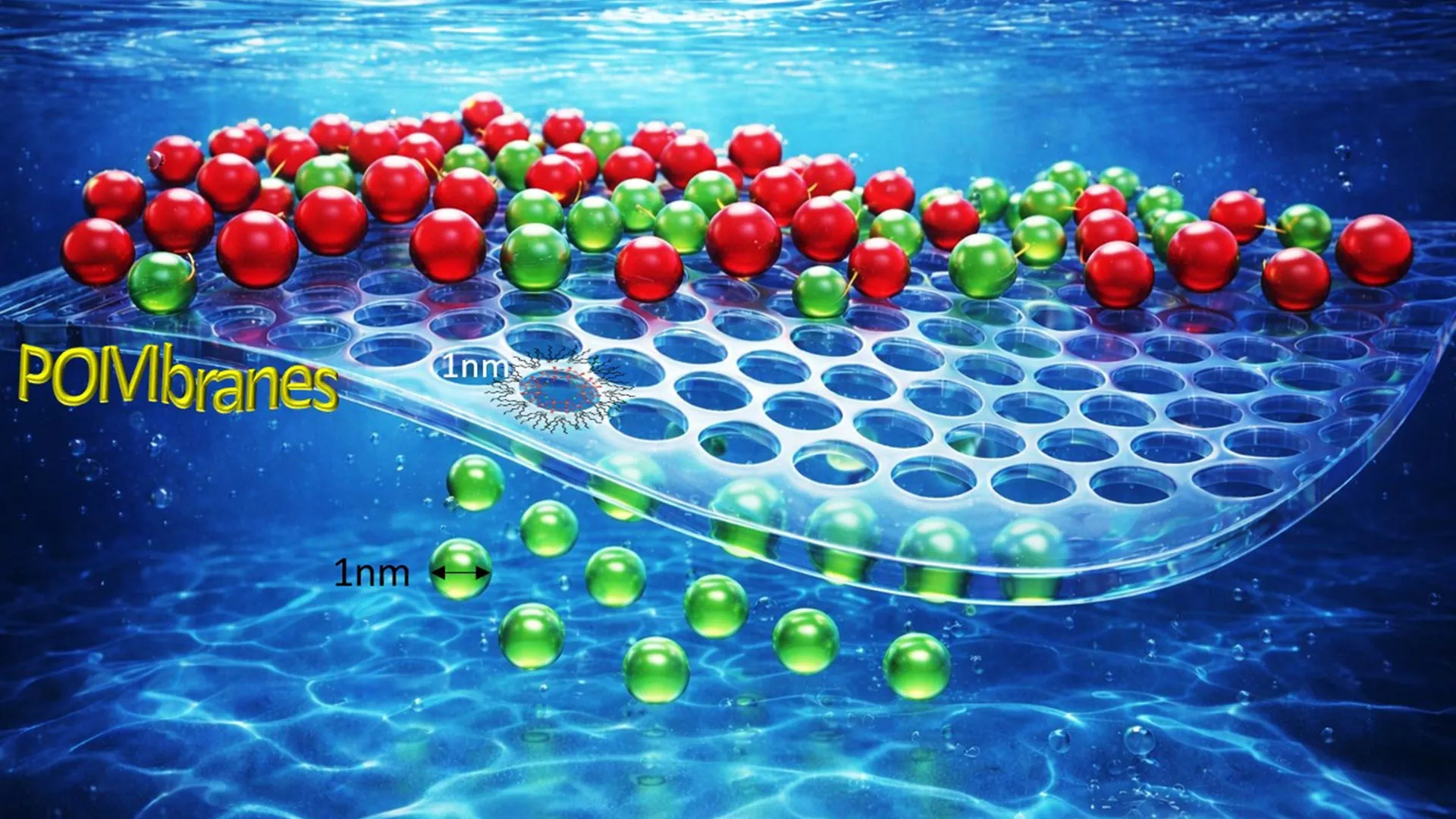
To overcome these limitations, researchers from CSIR-Central Salt and Marine Chemicals Research Institute, Indian Institute of Technology Gandhinagar, Nanyang Technological University, and S N Bose National Centre for Basic Sciences engineered a new class of crystalline membranes called "POMbranes." These membranes contain pores that are exactly one nanometer wide—thousands of times thinner than a human hair—and remain permanently stable without changing shape or degrading.
The breakthrough draws inspiration from biological systems such as aquaporins, which regulate molecular movement through precisely sized channels in living cells. The researchers achieved this level of control using polyoxometalate (POM) clusters, each containing a naturally occurring opening that is exactly one nanometer wide. By attaching flexible chemical chains to these crown-shaped metal clusters and arranging them into continuous, defect-free layers, the team created membranes that force molecules to pass only through the uniform nanometer-sized openings.
The technology could transform multiple industries by enabling more efficient drug purification, textile dye treatment, and food production processes. The precisely controlled pore size allows the membranes to separate molecules based on size with unprecedented accuracy, while the crystalline structure ensures long-term stability and consistent performance. Researchers believe this advancement represents a significant step toward more sustainable industrial processes that require substantially less energy while achieving superior separation results.