Revolutionary Water Filter Uses Perfect One-Nanometer Pores for Molecular Precision
Nature-inspired membrane technology could transform industries by dramatically reducing energy consumption while improving separation performance beyond current capabilities.
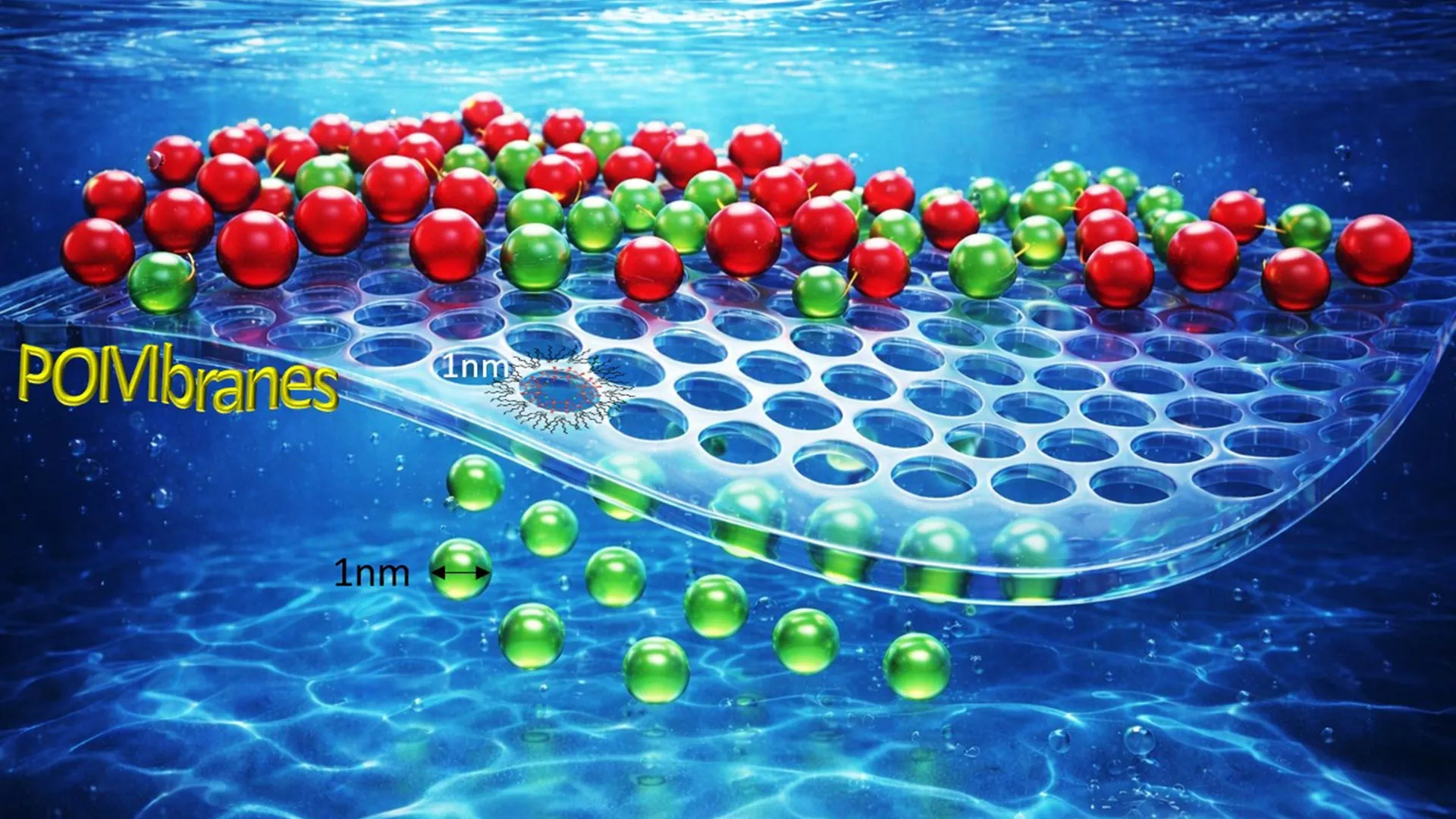
A team of international researchers has developed a revolutionary filtration membrane that uses perfectly uniform one-nanometer pores to separate molecules with unprecedented precision, potentially transforming industries from pharmaceuticals to textiles by dramatically reducing energy consumption and improving water reuse capabilities. The breakthrough technology, published in the Journal of the American Chemical Society, addresses a critical challenge facing manufacturing industries where separation processes account for roughly 40 to 50 percent of global industrial energy consumption. The new approach could help facilities move away from energy-intensive methods like distillation and evaporation while achieving separation performance far beyond what current polymer membranes can deliver.
The research team, comprising scientists from the CSIR-Central Salt and Marine Chemicals Research Institute, the Indian Institute of Technology Gandhinagar, Nanyang Technological University in Singapore, and the S N Bose National Centre for Basic Sciences, drew inspiration from biological systems such as aquaporins, which regulate molecular movement through precisely sized channels in living organisms. Their innovation centers on polyoxometalate clusters, tiny crown-shaped metal structures that contain naturally occurring openings exactly one nanometer wide that remain permanently stable. Unlike conventional polymer membranes with uneven pore sizes that can degrade over time, these engineered clusters maintain their perfect geometry indefinitely.
"These POMs are tiny, crown-shaped metal clusters that have a permanent, perfect hole in their centre that does not change or lose shape, which is the biggest hurdle with traditional plastic filters," explains Ms Priyanka Dobariya, a research scholar and co-first author of the study. Creating a practical membrane required arranging billions of these microscopic ring-like structures into a continuous, defect-free layer. The researchers accomplished this by attaching flexible chemical chains to the clusters, which allowed them to self-organize into large-area ultrathin films when placed on water. By adjusting the length of these attached chains, the team could precisely control how closely the clusters packed together.
The resulting membrane forces molecules to pass through only the one-nanometer holes built into each cluster, creating an ultrathin molecular sieve with extraordinary selectivity. This level of precision enables the technology to separate molecules that differ by tiny amounts while maintaining high flow rates. Dr. Shilpi Kushwaha, Senior Scientist at CSMCRI, notes that this addresses fundamental limitations in current industrial separation technologies: "To address these limitations, we engineered a new class of ultra-selective, crystalline membranes called 'POMbranes,' which contain pores that are about one nanometer wide, thousands of times thinner than a human hair."
The potential applications for this technology extend across multiple industries where precise molecular separation is crucial. In pharmaceutical manufacturing, the membranes could enable more efficient purification of drugs and active compounds while reducing waste and energy consumption. Textile producers could use the technology to better manage dye treatment processes and water recycling. Food and beverage industries could benefit from improved filtration capabilities that maintain product quality while reducing environmental impact. The researchers believe their nature-inspired approach represents a significant step toward more sustainable industrial processes that deliver superior performance while dramatically reducing the energy requirements that currently make many separation processes prohibitively expensive.