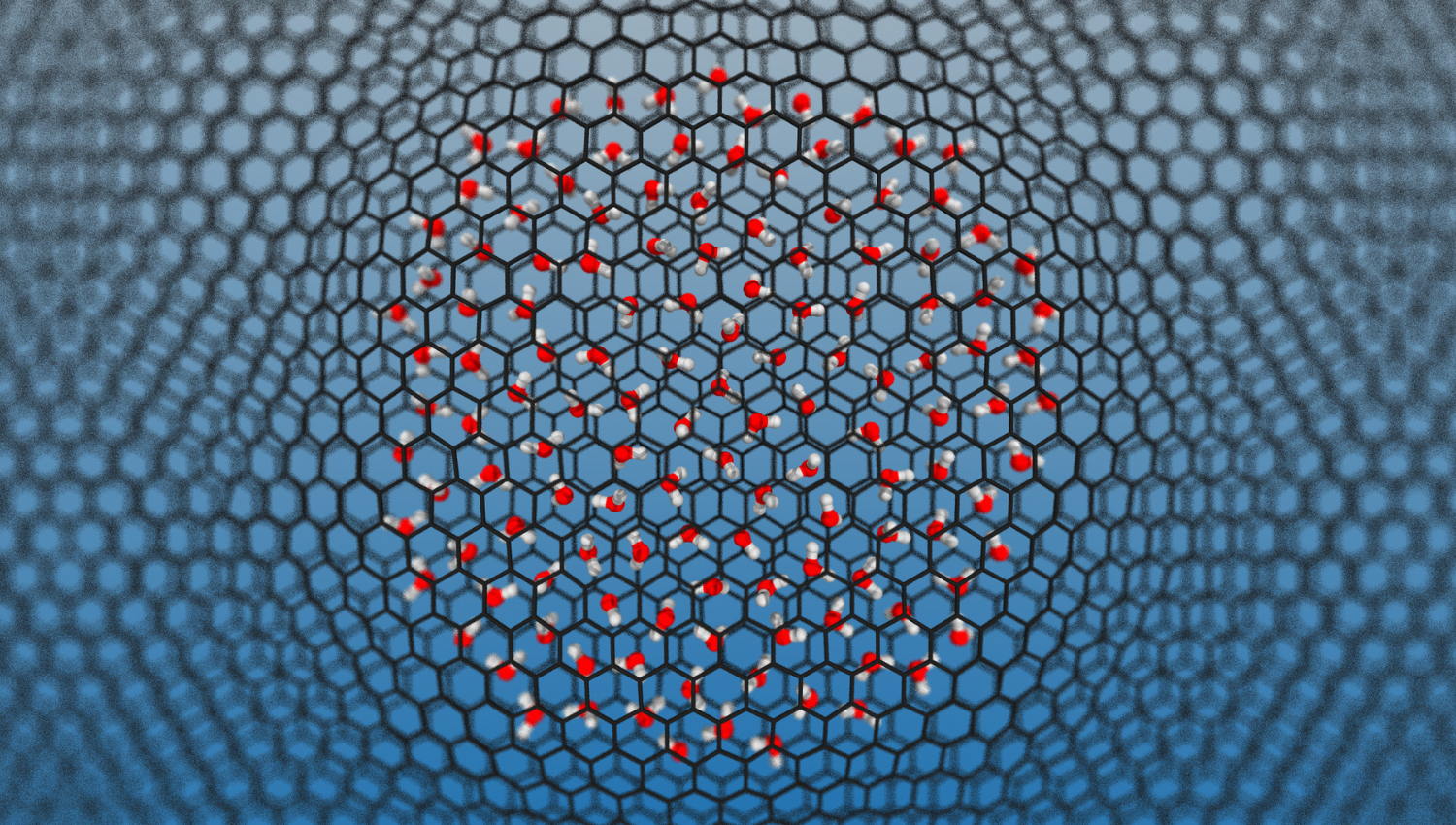
IIT Bombay Theory: Squeezed Light on Graphene Could Expose Quantum Noise via 'Forbidden' Harmonics
Normally banned colors of light appear when the driving laser is in a squeezed quantum state, offering a new probe of quantum noise at attosecond speed.

Physicists at the Indian Institute of Technology Bombay have worked out a way to read the quantum fluctuations of light by watching colors that graphene is supposed to be unable to emit. The theoretical study, by Kartik Prabhu and Professor Gopal Dixit, appears in Physical Review B under the title "Sensing quantum fluctuations via forbidden harmonics in quantum materials."
The setup shines light onto graphene with two circularly polarized components that rotate in opposite directions, one at twice the frequency of the other. The interaction generates high-harmonic light, meaning light at frequencies several times that of the incoming beam. Because of the symmetry of the arrangement, harmonics at integer multiples of three times the fundamental frequency are forbidden when the driving light is an ordinary classical laser.
The researchers show that those forbidden harmonics switch on when the driving light is in a squeezed quantum state, one in which uncertainty in one property is reduced at the expense of another. The fluctuations also change the polarization of the emitted light. By analyzing the forbidden components, an experimenter could extract the intensity and polarization of the incoming light's quantum fluctuations, which become an observable detection signal.
The process is extremely fast, unfolding within a fraction of one optical cycle and producing pulses on attosecond scales. An attosecond is a billionth of a billionth of a second.
"Our study brings together, for the first time, quantum light, a quantum material and high-harmonic generation," Dixit said, noting the work operates in the extreme ultraviolet range.
Squeezed light is already a staple of precision measurement, but reading out how much quantum noise a beam carries usually requires dedicated detectors. This proposal turns a solid material into the detector: the graphene's own response to the light carries the fingerprint, which could make the quantum character of intense light easier to check at extreme-ultraviolet frequencies.
High-harmonic generation, the underlying process, is how researchers make the shortest light pulses ever produced. A strong laser drives electrons in a material back and forth, and they radiate light at multiples of the laser's frequency. The pattern of which harmonics appear and which do not is controlled by symmetry, so a harmonic that is supposed to be absent is an unusually clean signal when it shows up.
Graphene is a natural test bed because it is a single sheet of carbon atoms with a highly symmetric structure, and that symmetry is what forbids the harmonics in the first place.
The result is purely theoretical, and the Phys.org report describes no experimental test and gives no figures for sensitivity or efficiency. Dixit said his group plans to study other quantum materials, generate datasets to train machine-learning models, and use AI to generalize the idea. The paper's DOI is 10.1103/v886-ypf7.