Lasers and a Sheet of Graphene Accelerated Protons to a Record 132 MeV, Nearly Half Light Speed
Osaka physicists made protons 'surf' a moving electric wave, and used a neural network with 99.2% precision to find the rare high-energy signals in millions of detector images.

Researchers at the University of Osaka have accelerated protons to a record energy of 132 megaelectronvolts, close to half the speed of light, using a long-pulse laser fired at graphene layers only nanometers thick. The result, published in Progress of Theoretical and Experimental Physics, shows that longer laser pulses can push protons to higher energies than the shorter pulses typically used in this field.
The goal is to find an alternative to conventional particle accelerators, which are kilometers long and cost billions of dollars. Laser-driven acceleration uses the enormous electric fields that a high-intensity laser creates inside a plasma, which can be far stronger than anything a metal accelerator cavity can sustain. In principle the same energy could be reached over a much shorter distance. The difficulty is in the target. Experiments need extremely thin foils to work, and those foils are vulnerable to a weak prepulse that arrives just before the main laser pulse and can destroy the target before the real shot arrives.
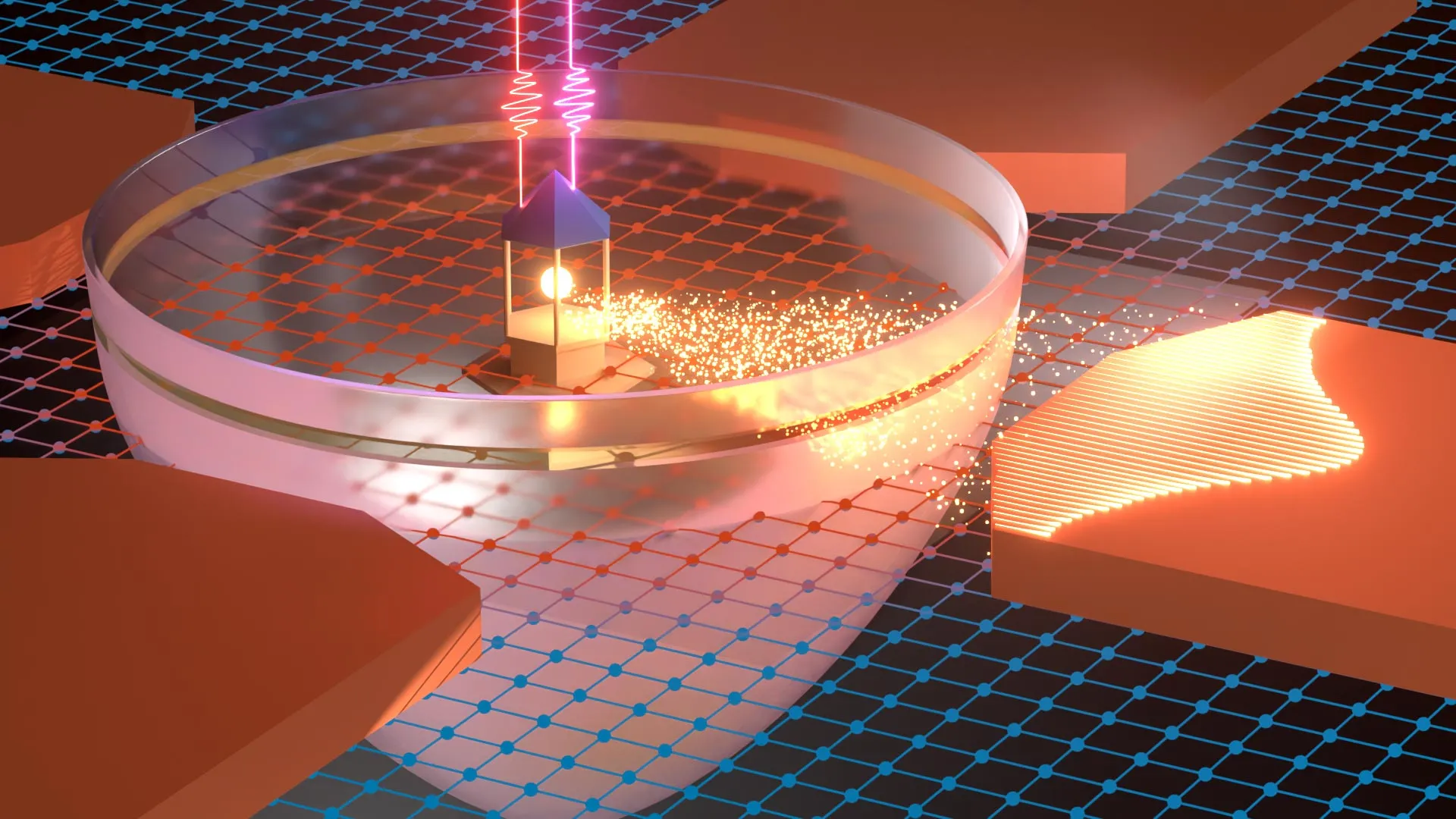
Graphene turned out to be a solution. The team used ultrathin graphene targets that withstood the prepulse and stayed intact until the main pulse hit. Simulations showed that the laser then produced an electrostatic wave that moved through the plasma, generating an accelerating field. Protons rode that wave forward for several picoseconds, gaining energy the entire time, much like a surfer holding on to a wave. "By using ultrathin graphene layers and a relatively long laser pulse, we are able to accelerate protons for an extended period and reach a record energy of 132 MeV," said lead author Takumi Minami. "Our results show that long-duration acceleration can push proton energies beyond those typically achieved with shorter laser pulses."
Finding the signal was its own problem. High-energy protons are rare, and each leaves a faint mark in the detector. "We need to search millions of detector images for signals left by individual ions and distinguish the highest-energy protons from background noise," said senior author Yasuhiro Kuramitsu. To handle that, the team trained a convolutional neural network to search for proton tracks. The network achieved 99.2% precision in one high-energy measurement and allowed the team to confirm the presence of protons at 132 MeV.
The combination points toward a different style of experiment. The researchers say that further work is underway on real-time, online ion detectors. If a detector can feed its results to an AI system as shots are fired, a laser experiment could in principle analyze its own output and adjust its settings, getting the field closer to autonomous laser systems. That would be a change from the current practice, in which scientists collect data for hours and analyze it afterward.
A proton at 132 MeV is energetic enough to be of interest for several uses. Beams in that range are the kind used in proton therapy for cancer, which today requires large and expensive machines. A compact laser-driven source could eventually lower that cost, though the team's paper is a physics demonstration, not a medical device, and a gap remains between a record shot and a reliable clinical beam.
The study also shows the value of treating the target itself as a design variable. Switching to a more durable, ultrathin material let the researchers use a longer pulse and hold on to the accelerating wave for longer, and that was the difference between an ordinary result and a record.