Physicists Braided Laser Beams Into Trefoil Knots on a Chip — Something That Only Happens Where Energy Leaks Out
By tuning gain and detuning on an integrated photonic chip, a team watched laser frequencies wind around each other into Hopf links and Solomon links, making an abstract piece of non-Hermitian topology directly visible.
Physicists have taken one of the stranger predictions in modern optics — that the light in a laser can be made to trace out knots and links, mathematically identical to the ones in a piece of rope — and watched it happen on a chip the size of a fingernail.
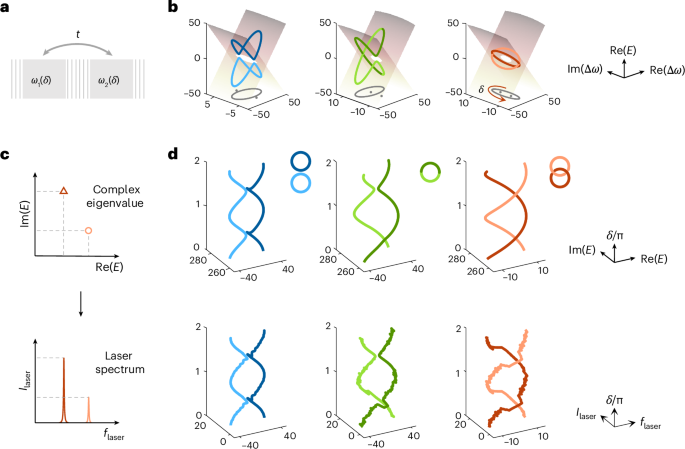
The result, reported in Nature Physics by Wenbo Mao, Bofeng Zhu, Qian Zhang and colleagues, with senior authors including Qi Jie Wang, Y. D. Chong and Lan Yang, is an experimental demonstration of non-Hermitian braiding of laser modes on an integrated photonic platform. The team reported observing Hopf links, trefoil knots and Solomon links — three specific topological structures that had been predicted on paper but never before assembled and directly visualized in a controllable device.
The physics rests on a distinction that took decades to become respectable. Standard quantum mechanics is built on Hermitian systems, where energy is conserved and the numbers that describe a system's states — its eigenvalues — are real. Real devices leak. A laser pumps energy in and radiates it out, which makes it non-Hermitian, and in a non-Hermitian system those eigenvalues become complex numbers, with both a frequency part and a gain-or-loss part. Complex numbers live on a plane rather than a line, and that extra dimension is what makes braiding possible: as you slowly change the knobs on the system, the eigenvalues can wind around one another instead of merely sliding past.
The winding is organized by features called exceptional points — parameter settings where two modes of the laser collapse into a single one, sharing not just the same frequency but the same state entirely. Steer the system on a closed loop around an exceptional point and the modes do not return to where they started; they swap, or rotate into each other. Repeat that with several modes and different loop shapes and the trajectories trace out genuine mathematical knots. The classification of those knots is topological, which is the practical payoff: a trefoil is a trefoil no matter how much you jiggle the chip, so information encoded in the braid survives fabrication noise and drift.
Getting there required active rather than passive control. The team steered the parametric trajectories for gain and for detuning — how hard each section of the chip is pumped, and how far its resonance sits from its neighbor's — and then read out the braid directly from the evolving laser frequencies and intensities. Earlier demonstrations of non-Hermitian topology had generally inferred the structure from indirect measurements or worked in bulky table-top setups. Here the braiding is programmable and it is legible in the output light.
The authors argue the platform is a test bed as much as a device. Because the chip is integrated and scalable, the same architecture could host synthetic topological structures far more elaborate than a trefoil, and could be used for robust light manipulation and reconfigurable lasing — a laser whose output state is protected by topology rather than by careful stabilization. A companion piece in the same journal, titled "Braids of light," framed the achievement in blunter terms: eigenvalue braiding has been theoretically rich and experimentally out of reach, and this puts it on a chip you can program.