
Physics
Two Nature Studies Show Topology Can Survive Where the Energy Gap Closes
Acoustic-metamaterial experiments in Singapore and China confirm a long-theorized idea that robust topological states can coexist with a quantum critical point.
Topic
10 stories from Planck Standard. Latest: October 9, 2026.
Acoustic-metamaterial experiments in Singapore and China confirm a long-theorized idea that robust topological states can coexist with a quantum critical point.

Illinois physicists found that vortices on a grid with wraparound edges act as hidden clocks, letting predictability emerge in a system machine learning could not forecast.
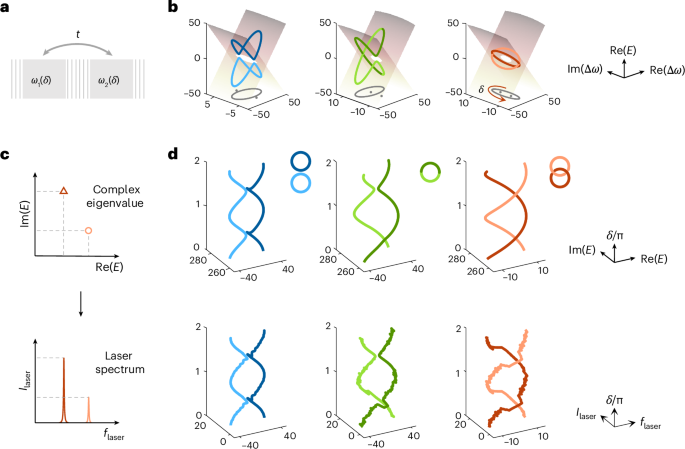
By tuning gain and detuning on an integrated photonic chip, a team watched laser frequencies wind around each other into Hopf links and Solomon links, making an abstract piece of non-Hermitian topology directly visible.

In a potassium-tantalate-niobate crystal, electric dipoles turned out to be interlacing over and under each other in three dimensions — a structure nobody had ever seen form spontaneously in a solid.

A Cal Poly team shows that periodically driving a material with shifting magnetic fields can create quantum phases that have no equivalent in any static material — and may bolster quantum computers.
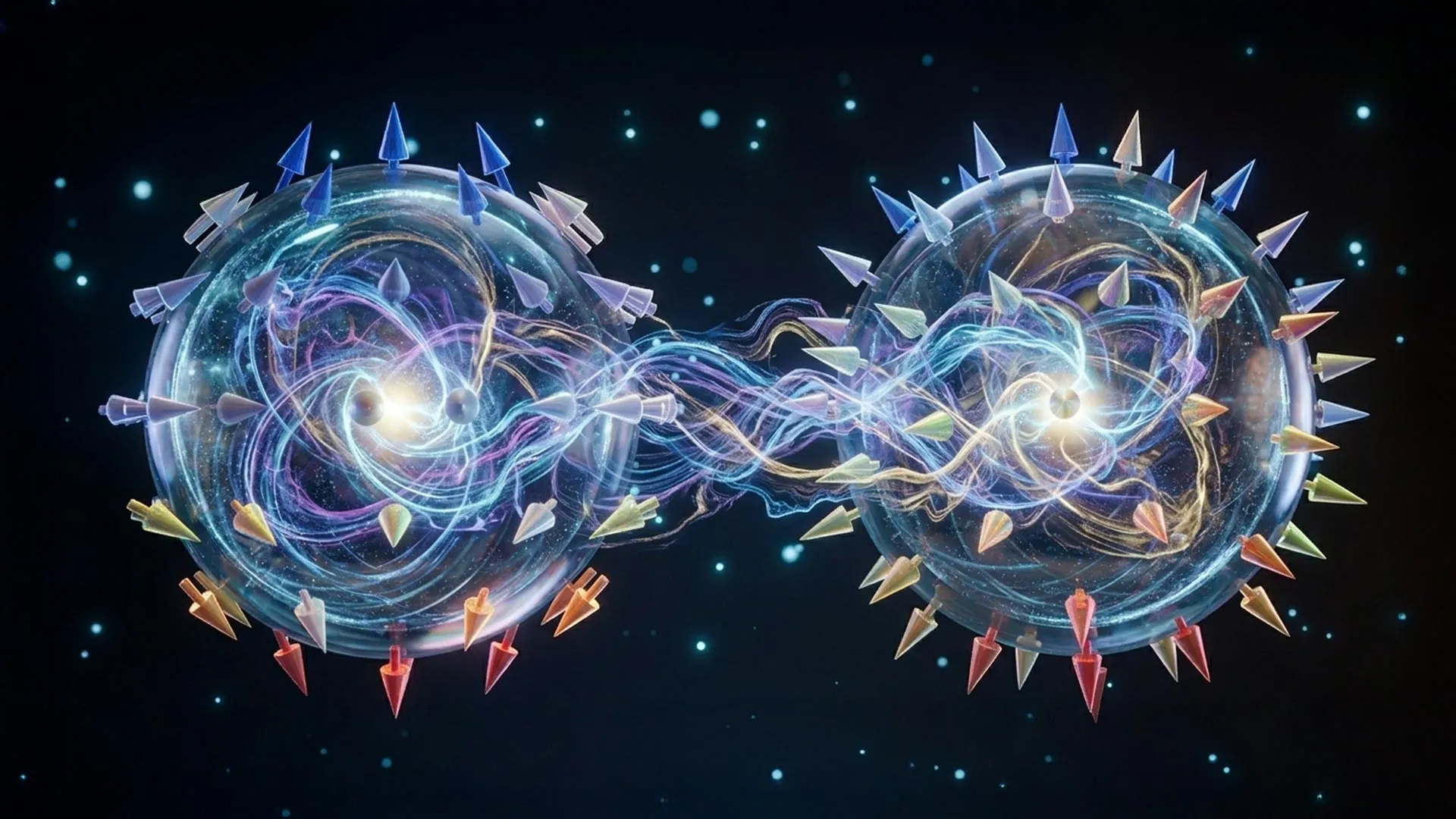
Researchers in South Africa and China found that entangled photons carry over 17,000 distinct topological signatures across 48 dimensions — a free resource sitting in standard quantum optics setups.

Electrons in the exotic C₁₃Cl₂ molecule travel in a corkscrew pattern requiring four loops to return to their starting phase — a quantum behavior only a quantum computer could simulate.

A study in Nature Physics reveals that strong electron interactions can produce topological behavior — bridging two previously separate fields of quantum physics in a finding with implications for quantum computing and sensing.

A collaboration between Rice University and the Vienna University of Technology identified a quantum phase that simultaneously exhibits topological protection and quantum criticality — properties physicists had assumed were mutually exclusive.

An international team using IBM's atom-manipulation tools has built and verified a molecule with never-before-seen electronic topology, confirming a theoretical prediction and using quantum computing simulation to prove its exotic nature.