Physicists Used Crossed Laser Beams to Push Electrons Into Quantum States Never Seen in a Lab
Oldenburg researchers overlapped two femtosecond laser pulses of different colors to build three-dimensional light fields, then used them to excite electrons in potassium atoms.

A team of physicists at the University of Oldenburg in Germany has shown that two ultrashort laser pulses, crossed at an angle, can create light whose electric field oscillates in all three spatial directions at once. By using that light to excite electrons, they produced quantum states that had been described in theory but never before created in an experiment. The work was published in the journal Physical Review Research.
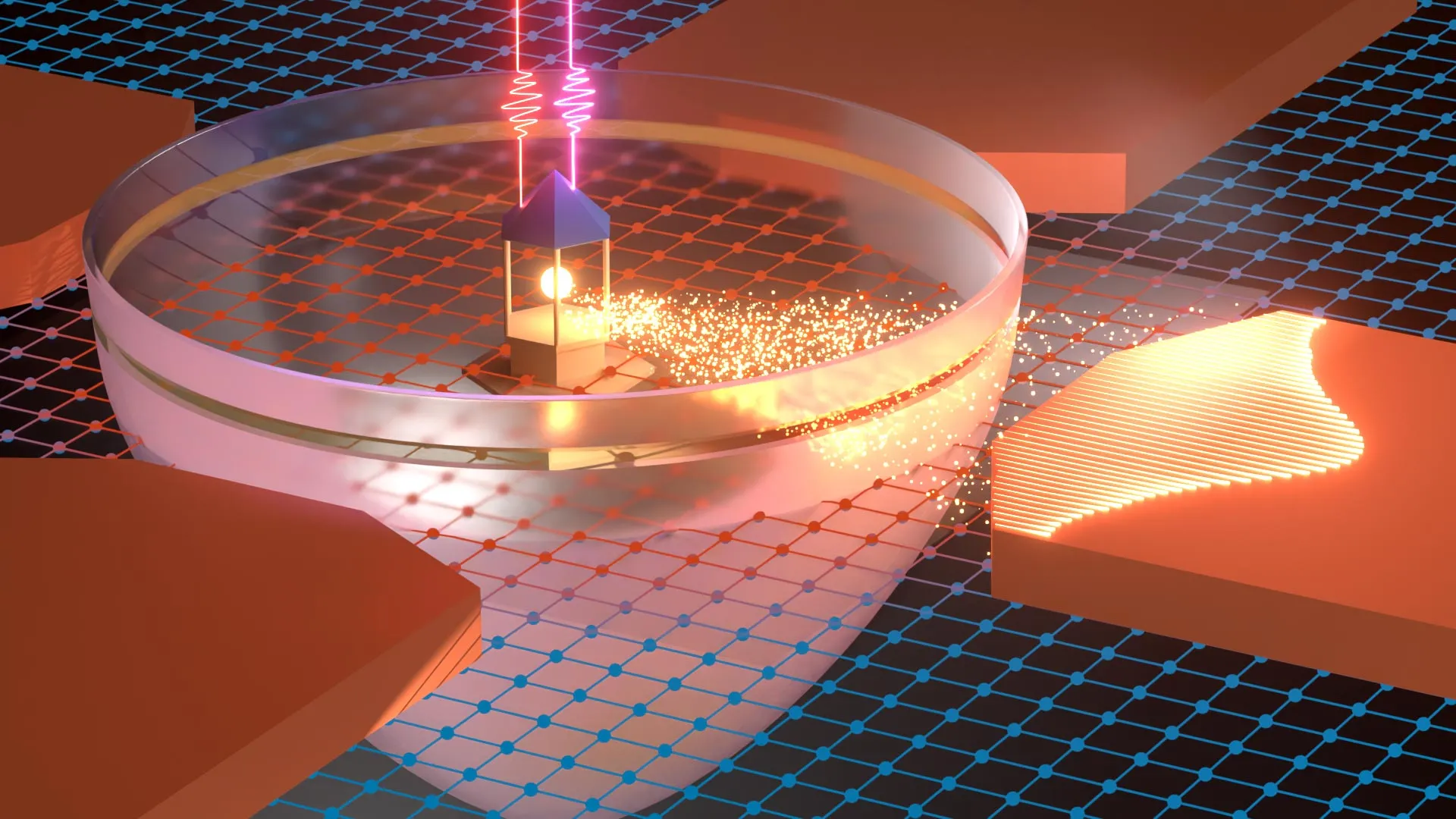
Ordinary laser light is effectively two-dimensional. Its electric field oscillates in a plane perpendicular to the direction the beam travels, and even sophisticated pulse shaping usually works within that constraint. The Oldenburg group, led by Dr. Matthias Wollenhaupt, split laser light into two beams of different colors using an interferometer, then sent them into a vacuum chamber so they crossed at a single point. Where the beams overlap, the combined field takes on a shape that the researchers can control, and it points in three directions instead of two.
The pulses were femtosecond bursts, lasting a few millionths of a billionth of a second. The team shaped them carefully so that their combined field had the structure needed to reach specific electron states. "With our method, we can generate electronic quantum states that have previously only been described theoretically and also make them spatially visible," Wollenhaupt said. "We have thus expanded the experimental optics toolkit to include a new class of three-dimensional light fields."
To prove it worked, the researchers used the light to excite electrons in potassium atoms into higher-energy states and then knock them out of the atoms. By watching the freed electrons, they could see the shape of the quantum state that had produced them. They also observed how those states changed over short intervals. Darius Köhnke, a doctoral student in the group's Ultrafast Coherent Dynamics research group and one of the two lead authors, said the fields oscillate in all three spatial directions, which opens new ways to study and steer how light interacts with matter. The method functioned like a stroboscopic ultrahigh-speed camera for quantum processes, capturing the successive stages of the different electron states and assembling them into a movie of their evolution.
The most immediate application the team points to is chirality. Many molecules, including a great many drugs, come in two mirror-image forms that are chemically identical in most respects but can act very differently in the body. Telling them apart is a long-running problem in chemistry and pharmaceuticals. Light that has a three-dimensional structure can respond differently to a left-handed and a right-handed molecule, which suggests it could serve as a tool for identifying them.
There is a basic-science payoff as well. Electronic quantum states that exist only on paper are, by definition, untested. Producing them in a laboratory lets physicists check whether the theory that predicted them is correct, and it gives them a new set of building blocks for controlling matter with light. The same approach could be used to prepare specific electronic states on demand, a capability that matters for quantum technologies in which the precise state of a particle is the information being carried.
The experiment used potassium atoms, a simple system well suited to a clean demonstration. Whether the technique can be extended to more complicated atoms and molecules is the obvious next question, and it is one the researchers say they are interested in answering.