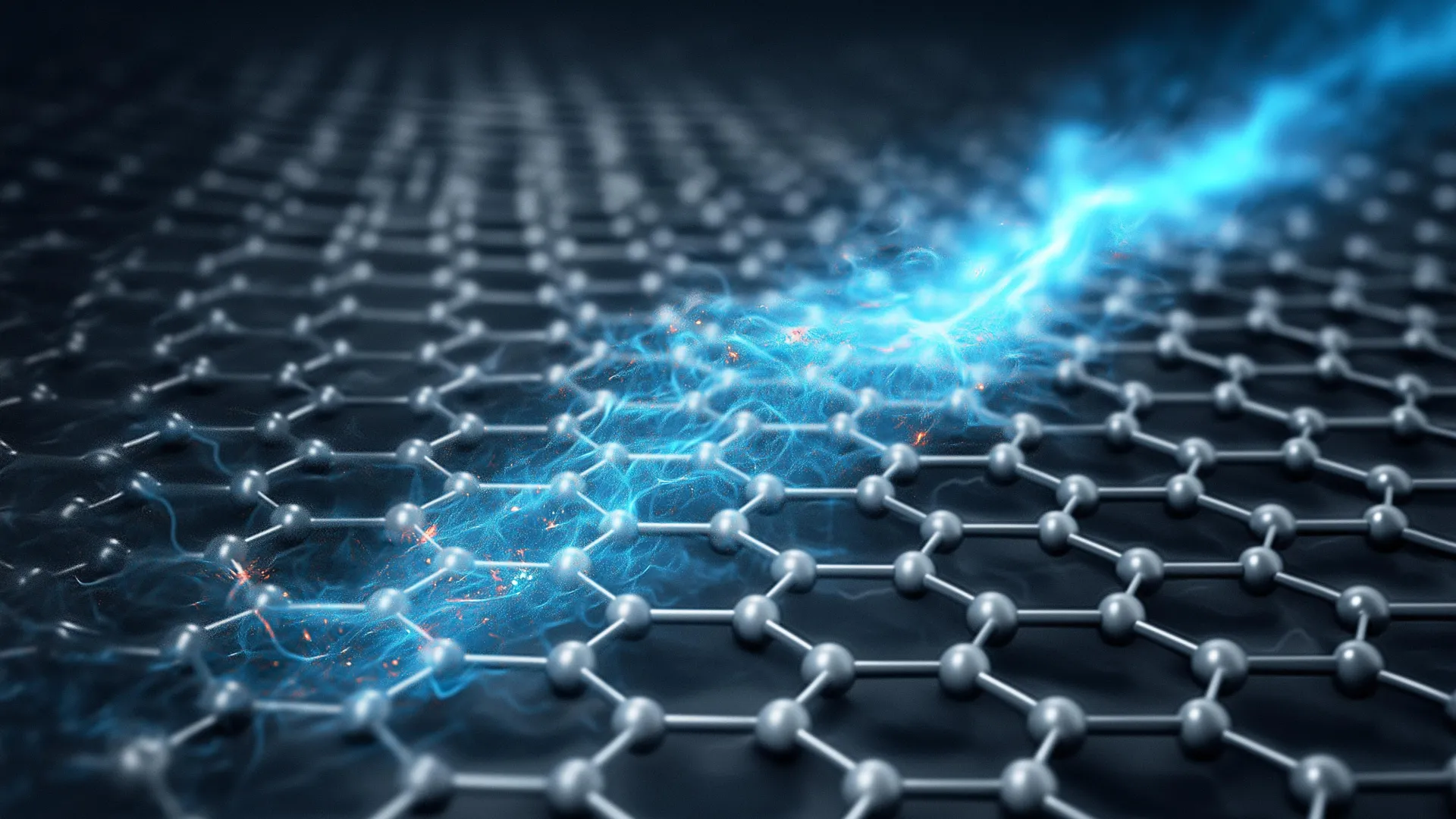
Graphene Defies Fundamental Physics Law as Electrons Flow Like Frictionless Liquid
Scientists observe exotic quantum state where electrons move collectively, breaking the Wiedemann-Franz law by more than 200 times.

Scientists at the Indian Institute of Science have achieved a major breakthrough in quantum physics, observing electrons in graphene flowing like a nearly frictionless liquid in direct violation of a fundamental law of physics. The discovery, published in Nature Physics, represents the first experimental observation of electrons behaving collectively as a "Dirac fluid" at room temperature, opening new possibilities for quantum technologies and our understanding of matter's most exotic states.
The research team, led by Professor Arindam Ghosh, created exceptionally pure graphene samples and measured their electrical and thermal conductivity simultaneously. In a startling deviation from established physics, they found that as electrical conductivity increased, thermal conductivity decreased—a result that contradicts the Wiedemann-Franz law by more than 200 times. This century-old principle states that electrical and thermal conduction in metals should be proportional, making the graphene results unprecedented.
"It is amazing that there is so much to do on just a single layer of graphene even after 20 years of discovery," said Ghosh, one of the study's corresponding authors. The violation occurs at graphene's "Dirac point," a special quantum state where the material balances between being a metal and an insulator. At this precise condition, electrons abandon their individual particle behavior and begin moving collectively like a fluid with virtually no resistance.
This exotic quantum state, known as a Dirac fluid, mimics the quark-gluon plasma observed in particle accelerators at CERN—a soup of highly energetic subatomic particles that existed moments after the Big Bang. The discovery provides scientists with an accessible platform to study quantum phenomena that were previously limited to extreme experimental conditions costing billions of dollars to recreate.
The implications extend far beyond academic curiosity. The ability to control how electrons flow collectively could revolutionize quantum computing, where maintaining delicate quantum states is crucial for processing information. The research also demonstrates that despite decades of study, single-layer carbon materials continue to surprise physicists with new quantum behaviors that could enable technologies not yet imagined.