MIT Watched Electrons Reorganize Inside a Crystal
One Phase Grew Smoothly. The Other Froze in Spreading Pockets, Like Ice.
Two laser pulses — one to scramble the electrons, one to read them out — settled a long-running argument about how a second charge pattern forms in erbium tritelluride.

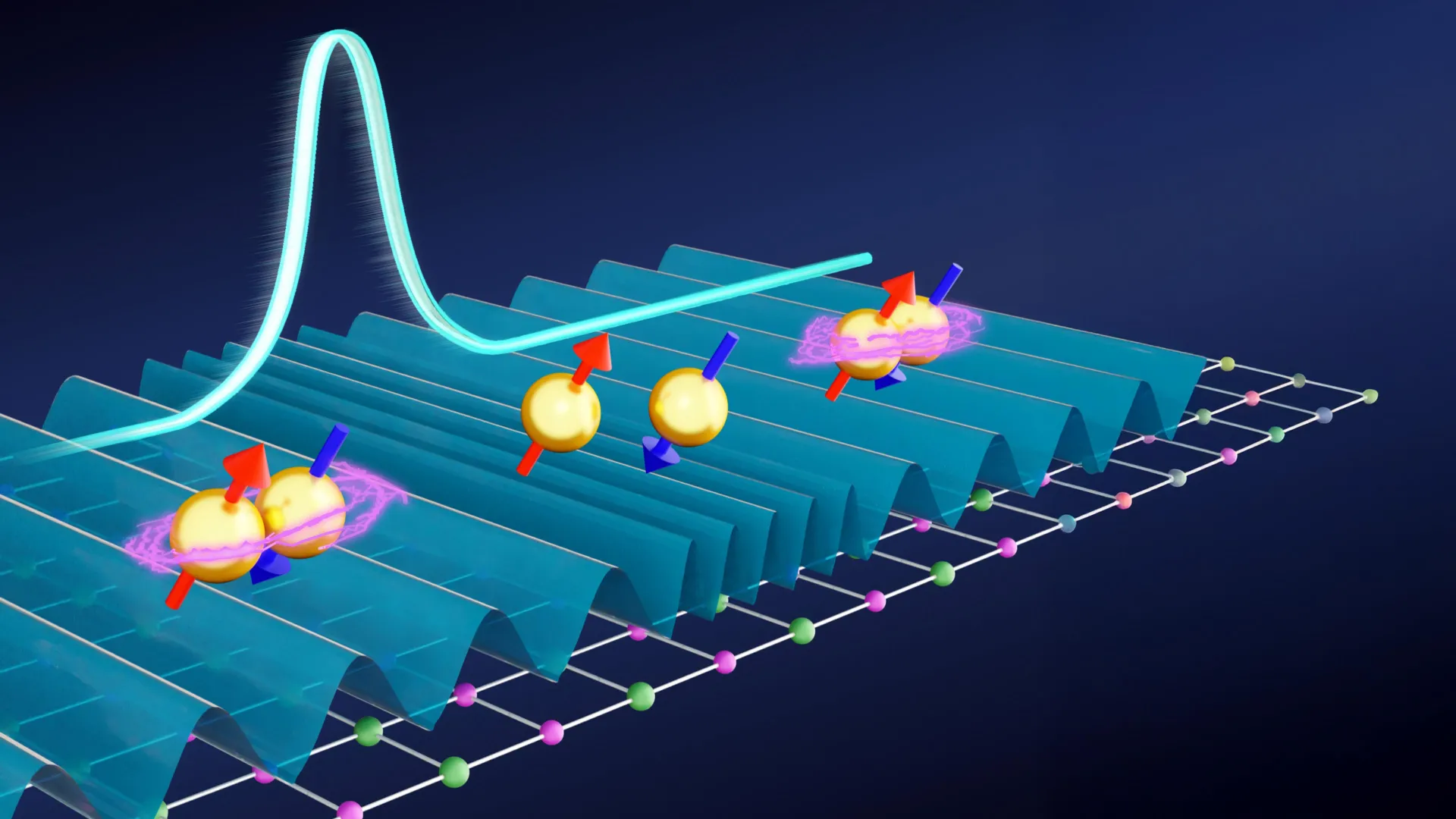
In most materials the electrons behave like a crowd — too many of them, moving too fast, to organize into anything. In a small class of quantum materials they do organize, arranging themselves into standing patterns of density called charge density waves. Two such patterns can exist in the same crystal at the same time, and physicists have argued for years about how the second one forms. MIT researchers report in Nature Physics that they have now watched it happen.
The material is erbium tritelluride, a rare-earth compound the group grew in atomically thin sheets. It hosts two charge density waves. The dominant one appears as the crystal is cooled to about minus 8 degrees Celsius and runs in a single direction, like ripples on a pond. The second, weaker one appears only when the material is cooled much further, to around minus 113 degrees Celsius, and runs perpendicular to the first — the two together making a checkerboard.
The experiment, led by Nuh Gedik with first author Yifan Su and collaborator Alfred Zong, now at Stanford, used a pump-probe technique. A first laser pulse hits the sample and scrambles the electronic order. A second, higher-energy pulse arrives a controlled instant later and knocks electrons out of the material, where a detector records their energy and momentum. Repeating that with different delays between the two pulses builds a stop-motion film of the electrons putting themselves back together.
The two phases recovered in visibly different ways. The dominant wave came back smoothly and everywhere at once, its amplitude rising continuously from zero — the signature of a second-order phase transition, the kind physicists usually assume. The subdominant wave did not. It reappeared in isolated pockets that then grew outward and merged, the way liquid water freezes: nucleation first, then expansion. That is a first-order transition, and it is not what most models of the material predicted.
"The mechanism responsible for the emergence of this second phase has long been debated," Gedik said, "and our approach provides a powerful new way to uncover the hidden physics behind phase transitions in quantum materials." The distinction is not cosmetic. A second-order transition is continuous and reversible in a straightforward way; a first-order one involves coexisting regions, latent heat and hysteresis, and it responds very differently to strain, doping and applied fields.
That matters because charge density waves are rarely alone. In cuprate and iron-based superconductors, charge order, magnetism and superconductivity all appear in overlapping regions of the phase diagram, competing for the same electrons. As Gedik noted, multiple phases — magnetism, superconductivity, charge density waves — commonly exist together in complex materials, and which one wins in a given patch of the crystal determines what the material actually does.
The broader contribution is the measurement itself. Knocking a material out of equilibrium and watching which order returns first, and in what shape, separates phases that look identical in a static experiment. Applied to a superconductor, the same trick could show whether the competing order forms uniformly or in pockets — and pockets are something an engineer can push around with strain or a gate voltage. The work was funded by the Department of Energy, the National Science Foundation and the Gordon and Betty Moore Foundation.