Scientists Directly Observe Floquet States in Graphene for the First Time, Unlocking 'On-Demand' Quantum Materials
Using ultrafast laser pulses, physicists captured graphene's electrons reshaping into entirely new quantum states in real time — confirming a two-decade-old theoretical prediction and opening a path to reconfigurable quantum devices.
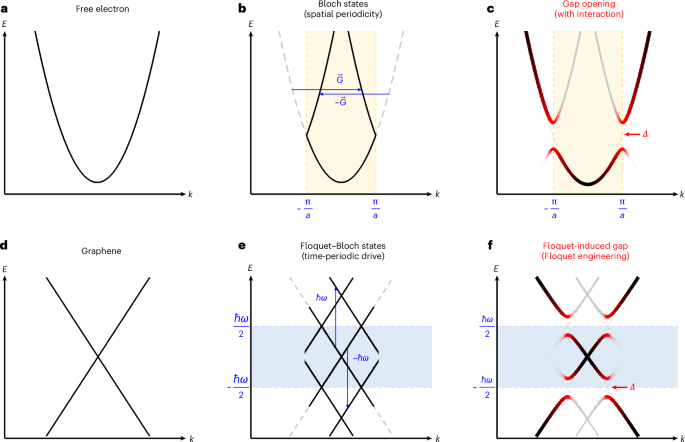
Physicists have directly observed Floquet states in graphene for the first time, settling a long-running debate in condensed matter physics and opening what researchers are calling a new era of "on-demand" quantum materials engineering. The breakthrough, published in Nature Physics, used ultrafast laser pulses combined with time-resolved angle-resolved photoemission spectroscopy — a technique that photographs the energy and momentum of electrons as they are kicked out of a material by light — to capture the momentary changes in graphene's electronic structure as it was illuminated. The results showed that graphene's band structure, which normally makes it a conductor with no energy gap, could be temporarily reshaped by the light pulses into a state with tunable properties, including the opening of gaps that would transform it from a conductor into something approaching a semiconductor or topological insulator.
Floquet engineering is based on a theoretical prediction that materials illuminated by periodic light can develop entirely new quantum properties not present in the unilluminated material — a phenomenon rooted in Floquet's theorem, a mathematical result about periodic differential equations that has found unexpected application in quantum physics. For two decades, theorists have predicted that graphene, with its extraordinary electrical properties and atomically thin structure, should be an ideal candidate for Floquet manipulation, with calculations suggesting that circularly polarized light could open a topological gap in the material and generate exotic quantum states. The experimental observation of these states has proven extraordinarily difficult because they exist only for extremely short periods — lasting mere femtoseconds while the light pulse is present — and because thermal effects and electron-electron interactions can blur the signature before it can be measured.
The research team, which included physicists from multiple institutions in Germany, the United States, and Japan, developed a femtosecond momentum microscopy technique that allowed them to simultaneously track the positions and energies of electrons across the entire Brillouin zone — the mathematical space describing all possible electron states in the crystal — as the material was being illuminated. By taking essentially ultrafast snapshots of graphene's electronic structure during the laser pulse, they could observe the Floquet sidebands — copies of the material's original electronic bands displaced in energy by multiples of the photon energy — that are the theoretical hallmark of the Floquet effect. Critically, they also observed the gap opening at the Dirac point that is graphene's most distinctive feature, confirming that the light was genuinely reshaping the material's topology rather than simply heating it.
The practical implications extend beyond graphene itself. The ability to switch a material's electronic properties almost instantaneously using light — without physically changing its structure, temperature, or chemical composition — suggests a new paradigm for creating reconfigurable electronic devices. A component that behaves as a conductor in the absence of illumination and a topological insulator under a laser pulse could form the basis of an entirely new class of ultrafast optical switches, with potential applications in computing, quantum communication, and sensing. The topological nature of the Floquet states is particularly significant because topological insulators carry electricity only on their edges and are immune to certain types of disruption, making them candidates for components in fault-tolerant quantum computers.
The result also validates the broader field of Floquet engineering in metallic and semi-metallic materials, which had been theoretically controversial — some physicists doubted that the effect could survive in materials with itinerant electrons that quickly dissipate energy. The graphene measurements demonstrated not only that Floquet states appear but that they can be observed clearly enough to measure their properties in detail, establishing a methodological foundation that the research community expects to apply to a wide range of other quantum materials including topological semimetals, superconductors, and two-dimensional materials beyond graphene.