A Quantum State Physicists Have Argued About Since 1988 Was Just Photographed for the First Time
Tsinghua researchers imaged individual Zhang-Rice singlets in a copper-oxide crystal, then watched them merge into larger structures as they added charge — the missing step between a single hole and superconductivity.

Physicists have spent nearly four decades treating the Zhang-Rice singlet as the basic building block of copper-oxide superconductivity without ever seeing one. A team from Tsinghua University and the Chinese Academy of Sciences has now imaged them directly, and published a map of what happens as you crowd more of them together.
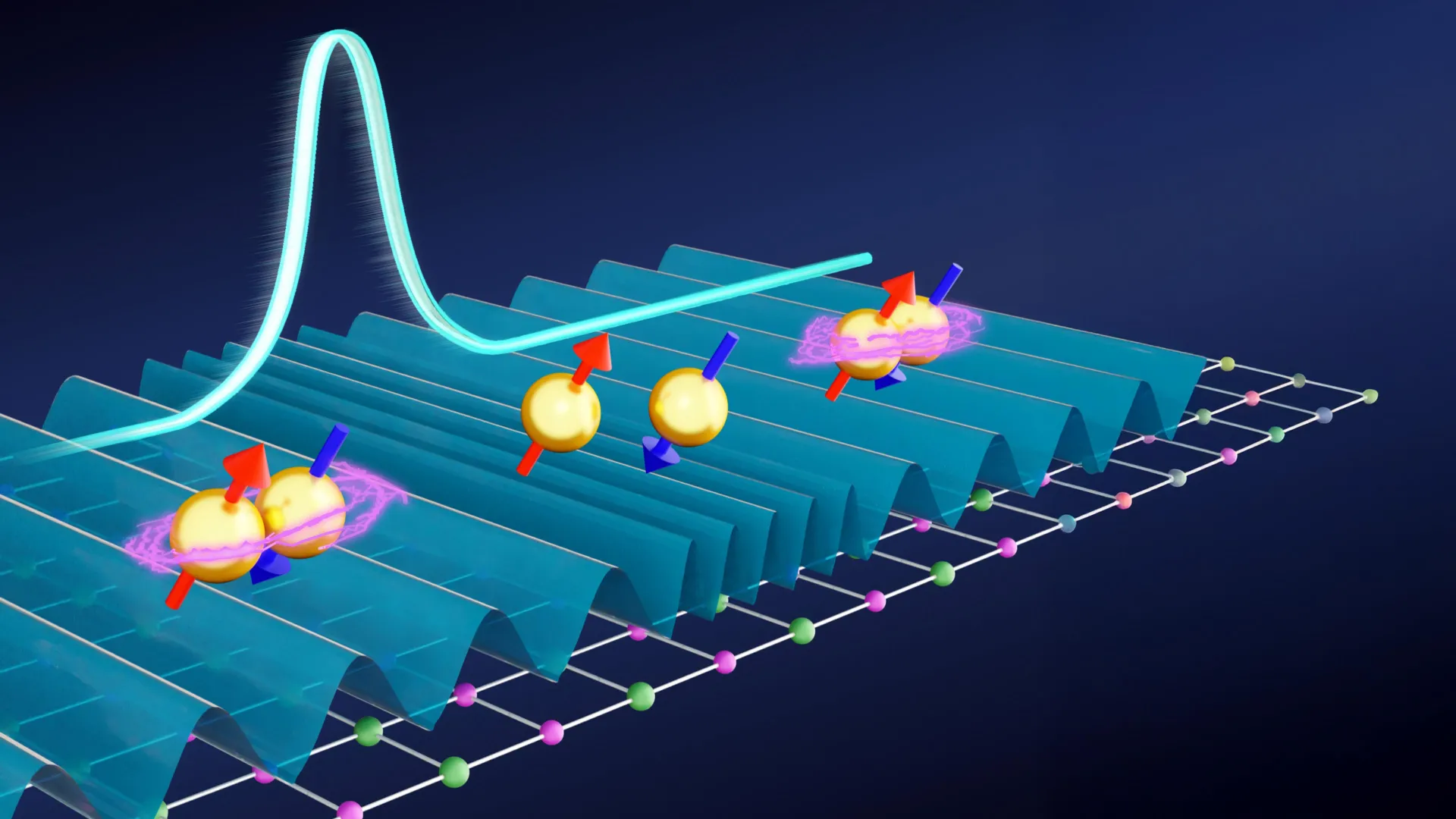
The material is Ca2CuO2Cl2, a cuprate, and the experiment works by removing electrons from it. Take an electron out of the copper-oxygen layer and you leave a hole, and that hole does not sit still on one atom. It spreads across the four oxygen atoms surrounding a copper site and pairs up with the copper's own spin into a single combined quantum object with zero net spin. That object is the Zhang-Rice singlet, named for the 1988 paper by Fu-Chun Zhang and T. Maurice Rice that proposed it.
"Although the Zhang-Rice singlet has been a cornerstone of cuprate physics for decades, its real-space electronic structure had never been directly observed experimentally," said Yayu Wang, the study's senior author. The question driving the work, he said, is the one the field has never closed: how does superconductivity emerge when holes are doped into an antiferromagnetic Mott insulator?
The team used high-resolution, large-area atomic-scale imaging to map the electronic states, and they built a series of samples by substituting sodium for some of the calcium, which controls how many holes go into the layer. That let them start with a crystal so lightly doped that individual singlets sat isolated and visible, then walk the doping up step by step into the superconducting regime, watching the same region of the map change.
What they saw was assembly. Isolated singlets did not simply pile up. They merged spontaneously into what the authors describe as electronic molecules — plaquette structures roughly four lattice constants across, carrying stripe-like orbital patterns. As doping increased further, those plaquettes linked to one another, and the connected network is what evolves into the superconducting state.
That sequence is the part the field did not have. Theory has long described the singlet at one end and superconductivity at the other, with the intervening organization inferred rather than observed. The images supply the middle: a specific size, a specific shape, and a specific merging behavior that any successful theory of high-temperature superconductivity now has to reproduce.
The work appears in Nature Physics, with Shusen Ye as first author, under DOI 10.1038/s41567-026-03375-4. It does not explain why cuprates superconduct at temperatures far above what conventional theory allows. It does narrow the space of explanations that can survive contact with a picture.