Light Pulse Shows Pseudogap and Superconductivity Compete in Cuprates, Quebec Team Finds
INRS researchers briefly switched off superconductivity with a laser and watched the pseudogap appear in its place, challenging the idea that it is a stepping stone to superconductivity.

A team at Quebec's Institut national de la recherche scientifique (INRS) reports new evidence that two of the strangest quantum states in copper-based superconductors are rivals, not partners. The study appears in Nature Physics.
Superconductivity is the ability of a material to carry electricity without losing any energy. Cuprates, a family of copper-based compounds discovered in 1986, superconduct at relatively high temperatures. Their discoverers, Bednorz and Müller, won the Nobel Prize in Physics the following year. Nearly 40 years later, physicists still do not agree on how cuprates manage it. Understanding them could one day help make power grids more efficient, improve medical technology and support quantum computing.
At the center of the puzzle is the pseudogap, a mysterious quantum state in which the energy states electrons can occupy are partly missing. Some scientists think it helps superconductivity emerge. Others think it competes with it. "The pseudogap is one of the greatest mysteries in condensed-matter physics," said INRS professor Fabio Boschini, who led the work. "Understanding how it interacts with superconductivity is essential if we want to explain why these materials can carry electricity without energy loss at unusually high temperatures."
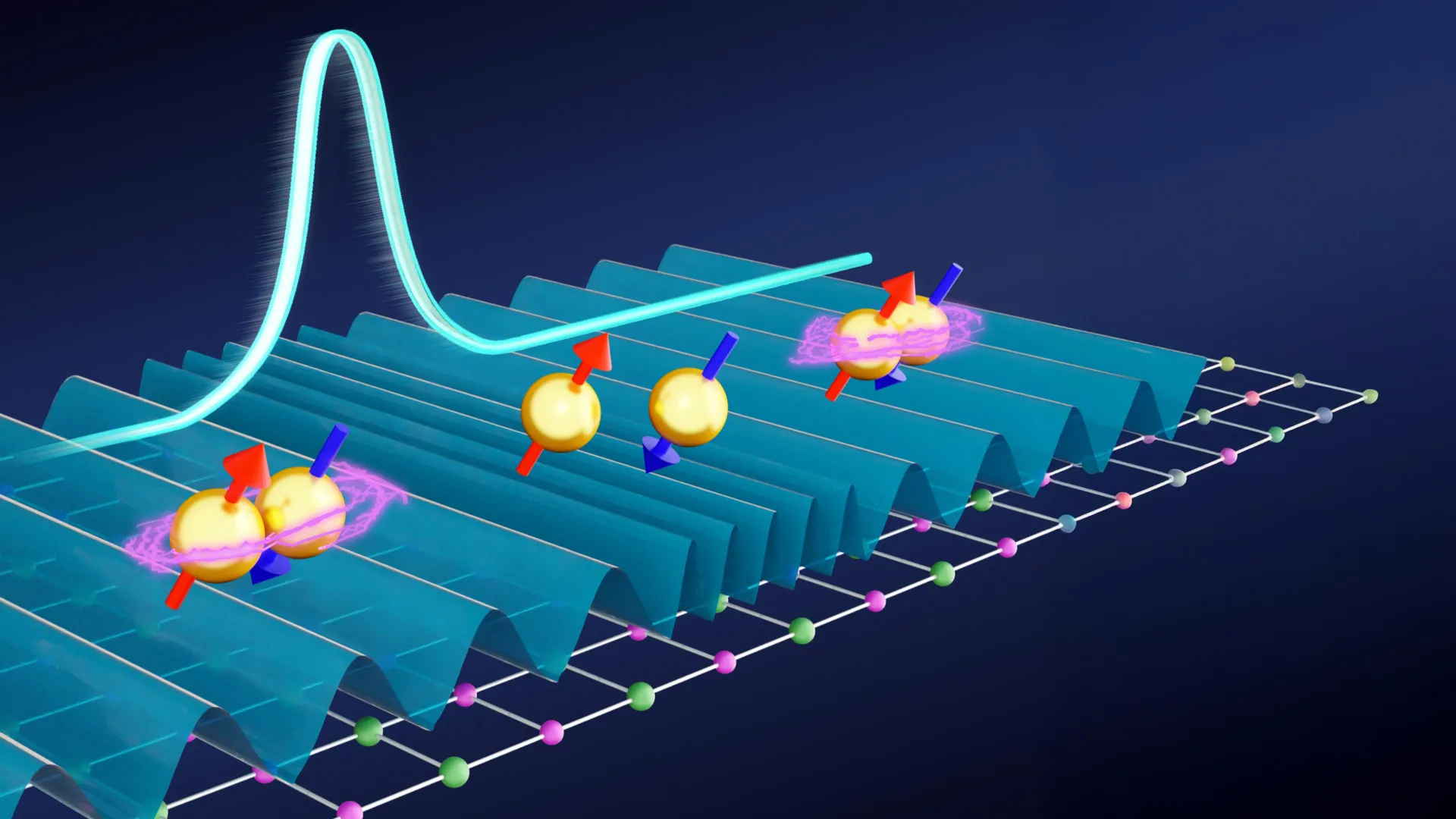
To test the question, the team used a pulse of light to temporarily suppress superconductivity and then watched how the material responded in real time. They used time- and angle-resolved photoemission spectroscopy, which tracks the energies and momenta of electrons ejected from a material, at the Advanced Laser Light Source facility at INRS. Partners included the Center for Computational Quantum Physics at the Flatiron Institute in New York.
The result was clear. When superconductivity was knocked out, the pseudogap appeared in its place. As superconductivity returned, the pseudogap faded. The experiment let the team observe a light-induced transient pseudogap for the first time and reach electronic states that standard techniques cannot see. "It is a bit like uncovering missing frames from a film that scientists have been trying to piece together for decades," said Dario Armanno, a Ph.D. student at INRS and first author of the paper.
The findings suggest the two states compete rather than cooperate, which challenges the long-standing hypothesis that the pseudogap is a precursor to superconductivity. Olivier Gingras, an associate research scientist at the Flatiron Institute, noted that the pseudogap and superconducting states are among the hardest phenomena in cuprates to reproduce in theory. "Our study reveals that they compete with one another and provides new insight into their behavior when both are excited simultaneously," he said.
The paper is titled "Light-induced asymmetric pseudogap below the critical temperature in cuprates." The authors describe it as fundamental research, but an important step toward understanding a phenomenon that could shape the design of next-generation superconductors and, in the longer run, more energy-efficient technology.
François Légaré, director of the INRS Énergie Matériaux Télécommunications Research Center, said the work contributes to training highly qualified personnel in a field critical to Canada's technological sovereignty and the implementation of its National Quantum Strategy.