Euclid, a Galaxy-Mapping Telescope, Finds Its First New Comet 810 Million Miles Out
A Helsinki researcher's streak-hunting software caught C/2026 S1 (Euclid) in five image sets, and the Minor Planet Center confirmed it on Oct. 8.

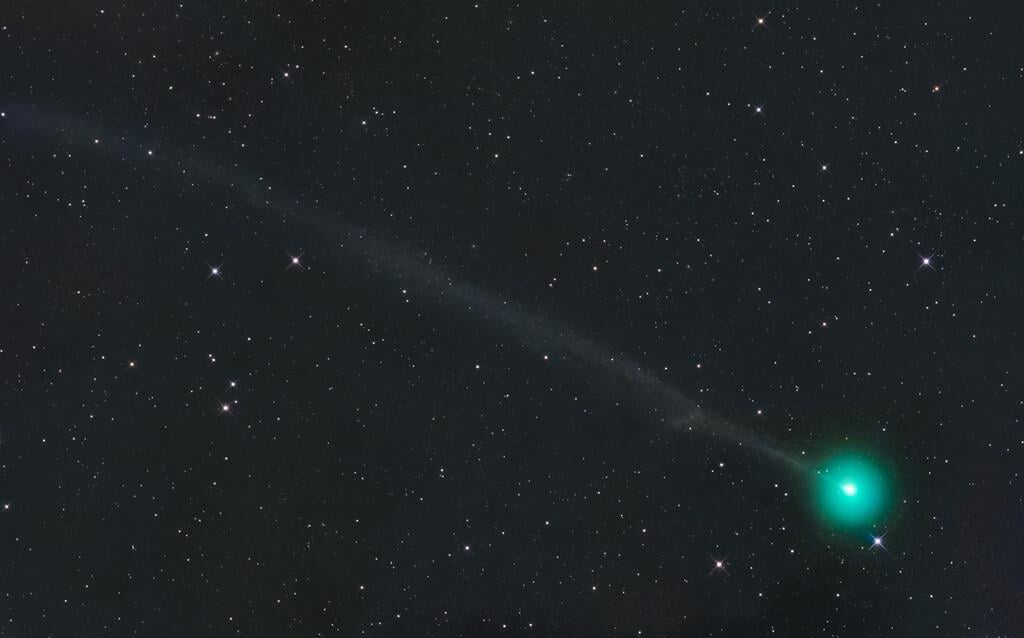
The European Space Agency's Euclid space telescope has discovered a comet nobody had seen before, the first such find for a mission built to map distant galaxies. The object turned up in images Euclid took between Sept. 16 and 24, 2026.
Euclid is designed to take deep, steady pictures of the faraway universe, not to chase fast-moving objects in our own solar system. That makes the discovery notable. It also shows that Euclid can pick out new comets while they are still relatively far from the sun, which could eventually help find a target for ESA's future Comet Interceptor mission.
Mikko Pöntinen of the University of Helsinki, working with the Solar System Objects Science Working Group of the Euclid Consortium, made the find using moving-object detection software he developed to monitor small solar system bodies in Euclid's images. "I was excited to see my software flag a 'streak' smeared across several images—the result of a fast-moving object," he said. By predicting where the object would be, he found it in five image sets in total. A closer look showed a fuzzy cloud around it, a sign of an active object shedding dust and gas, which is what a comet does.
Checks against catalogs of known comets and asteroids turned up no match. Pöntinen reported the observations to the International Astronomical Union's Minor Planet Center as a new comet, which alerted ground-based astronomers who could add follow-up observations. The center confirmed it as a comet on Oct. 8. It is now named C/2026 S1 (Euclid).
The comet sits about 1.3 billion kilometers, or 810 million miles, from Earth. That is roughly the distance from the sun to a point between the orbits of Jupiter and Saturn. It does not lie in the flat plane where the planets orbit. From the sun's point of view it is currently "straight up," arcing over the solar system on an orbit that will take thousands of years to complete.
Finding comets was never the mission's job, and the telescope is set up to avoid them. Euclid deliberately stays away from the band of sky along the plane of the solar system, which is rich in asteroids and comets, to cut down on glare from dust that would interfere with deep-sky imaging. Its "step-and-stare" strategy also visits each patch of sky typically only once, so a comet cannot be revisited on demand to check its properties.
Even so, tracking solar system objects matters for the mission. Moving comet trails and stray light have to be identified and removed from Euclid's images so they do not contaminate its precision mapping of galaxies.
"Very few comets are expected to be discovered by Euclid, so it was a happy coincidence that the combination of the comet's orbit and Euclid's scanning over those days captured the object in multiple images," said Bruno Altieri, a Euclid archive scientist on the discovery team.
C/2026 S1 is not a suitable target for Comet Interceptor. Valeria Pettorino, the Euclid project scientist, said the discovery and alert still gave the two mission teams a real test of how they will coordinate in the future. "We are of course happy to have discovered a previously unknown comet for the solar system community to follow up on," she said.