Euclid Telescope Spots a Mysterious 'Gap' of Missing Stars in an Ancient Cluster for the First Time
Astronomers found a thin band of absent red dwarfs in the globular cluster NGC 6397 — a feature never before seen in such a dense, old stellar swarm.

Astronomers using Europe's Euclid space telescope have detected a subtle but striking absence in one of the Milky Way's oldest star clusters: a thin "gap" where a particular class of small stars should be, but mysteriously thins out. It is the first time the feature has been seen inside a globular cluster.
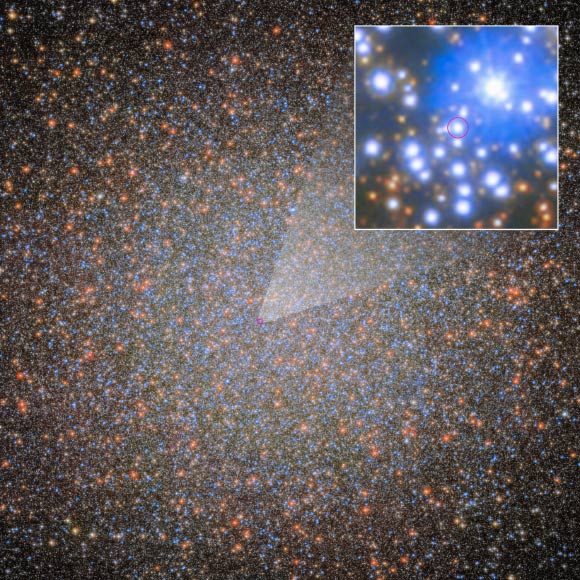
The discovery, reported in the journal Astronomy & Astrophysics on June 3 by a team at the Space Telescope Science Institute in Baltimore, emerged from observations of NGC 6397, one of the closest globular clusters to Earth. When the researchers sorted the cluster's stars by brightness and color, they found a narrow under-density — a shortage of expected stars — clustered around a stellar mass of roughly 0.35 times that of the Sun, detected with more than 5-sigma statistical confidence.
"The discovery was serendipitous," said Andrea Bellini, one of the study's authors. "We were not looking for the gap, but we found it." The principal author, Massimo Griggio, led the analysis along with colleagues including Russell Ryan and Mattia Libralato, drawing on Euclid's wide, sharp view to resolve hundreds of thousands of faint, crowded stars.
The stars in question are red dwarfs, the small, cool, long-lived stars that vastly outnumber Sun-like stars in the galaxy. Astronomers think the gap arises from a brief internal transition: as certain red dwarfs in a narrow mass range of about 0.34 to 0.36 solar masses evolve, fuel accumulates in their cores and triggers bursts that make their interiors unstable. Those bursts subtly change each star's size, temperature and brightness, so fewer stars are found at the precise brightness levels on either side — leaving an observable notch in the cluster's stellar census.
A similar gap was first identified in 2018 by the European Space Agency's Gaia observatory, which mapped roughly 250,000 nearby stars scattered across the galaxy. But finding the same signature inside a globular cluster — a tightly bound, ancient swarm of hundreds of thousands of stars all born around the same time — is new, and it offers a powerful test of how well astronomers understand the inner workings of the galaxy's most common stars.
Because all the stars in a globular cluster share roughly the same age and chemical makeup, such clusters serve as natural laboratories for stellar physics. The Euclid result suggests the brightness gap is a universal feature of red-dwarf evolution rather than a quirk of the local neighborhood, and it showcases the telescope's potential to reveal fine details in the crowded hearts of star clusters that earlier instruments could not resolve.