Scientists Discover a Continent-Scale 'Fan' of 30 Hidden Basins Beneath East Antarctica's Ice
Buried under ice up to three kilometers thick, the newly mapped structure radiates from a single point near the South Pole and may shape how the ice sheet responds to warming.
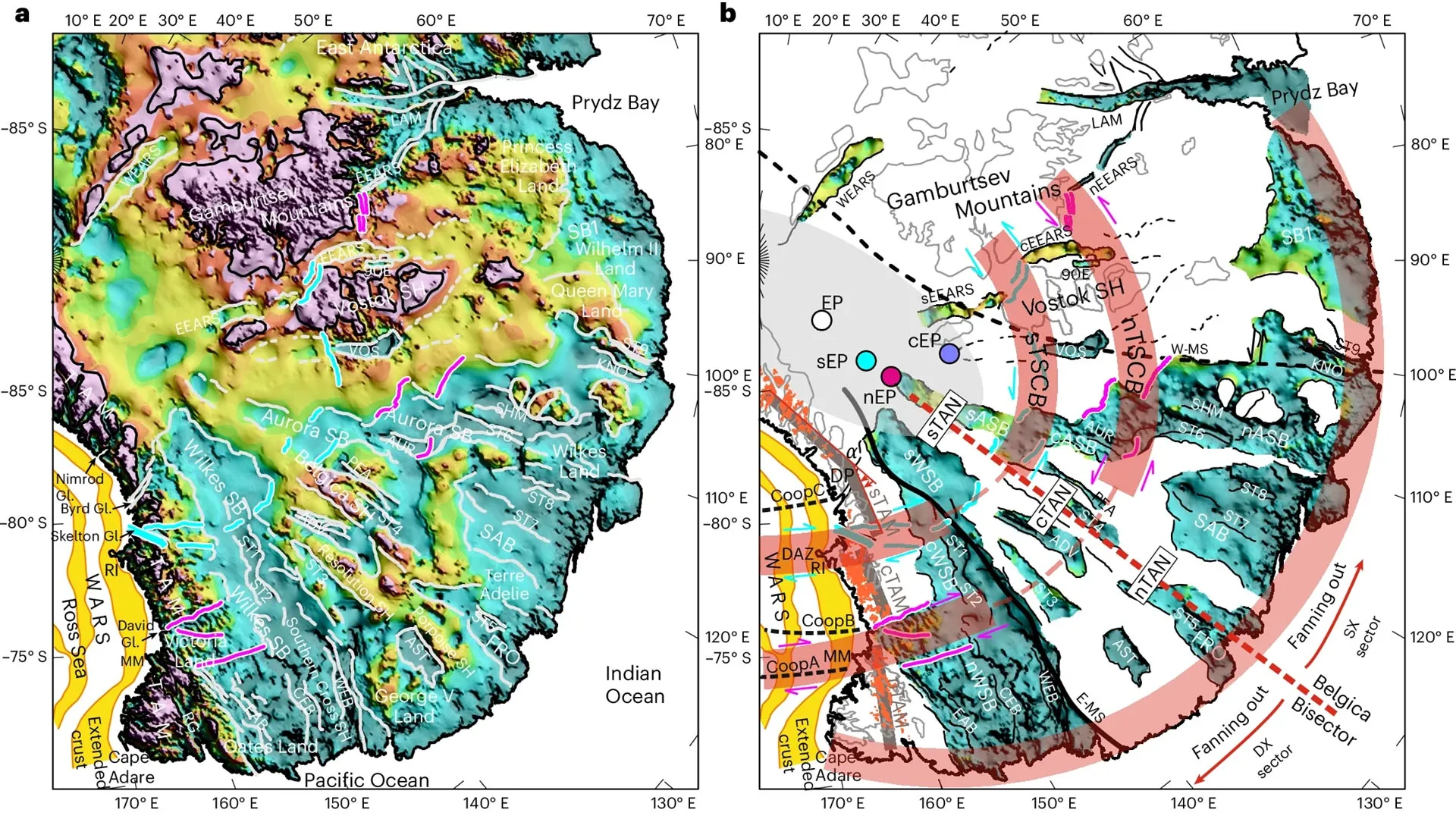
Scientists have identified one of the largest geological structures on Earth hiding in plain sight — a continent-scale fan of buried basins sprawling beneath the ice of East Antarctica, a discovery that rewrites the map of the frozen continent's hidden bedrock.
In a study published in Nature Geoscience, an international team led by Dr. Egidio Armadillo of the University of Genoa, with Dr. Guy Paxman of Durham University among the collaborators, described what they have named the East Antarctic Fan-shaped Basin Province. The structure comprises some 30 individual subglacial basins, buried under ice more than three kilometers thick in places, that together radiate outward from a single pivot point near the South Pole to form an enormous fan.
Remarkably, several of the most famous features of Antarctica's subglacial landscape turn out to be pieces of this one vast formation. The province encompasses the Wilkes and Aurora basins, as well as the basin that cradles Lake Vostok, the largest known subglacial lake on the planet. What had been studied as separate landmarks are, in the new analysis, components of a single coherent system.
The researchers propose the fan was carved by "distributed rotational extension," a tectonic process in which the continental crust gradually spreads outward from a fixed point — a pattern the team likens to fingers fanning out from the base of a thumb, with triangular basins opening in the gaps between. They believe it formed over multiple tectonic phases tied to the breakup of the ancient supercontinent Gondwana and the later separation of Antarctica from Australia, a history stretching back more than 100 million years.
The finding is more than a geological curiosity. The shape of the bedrock beneath the ice continues to steer how ice flows across the continent today, channeling glaciers and governing where subglacial lakes and basins form. That makes the hidden topography directly relevant to one of the most pressing questions in climate science: how stable the East Antarctic Ice Sheet will remain as the planet warms.
Because the basins sit in regions considered vulnerable to climate change, understanding their structure could sharpen projections of future sea-level rise. To detect a landscape entombed under kilometers of ice, the researchers combined airborne radar soundings, satellite gravity measurements and magnetic surveys, stitching together decades of data to reconstruct the contours of the bedrock below. The team says further surveys could refine the fan's boundaries and reveal whether similar structures lie hidden elsewhere beneath the ice.