Scientists Discover the 'Master Clock' That Times Every Stage of an Animal's Development
In a tiny worm, two proteins form a feedback loop that fires bursts of genes in precise, never-repeating order — the first non-repeating biological clock ever found.
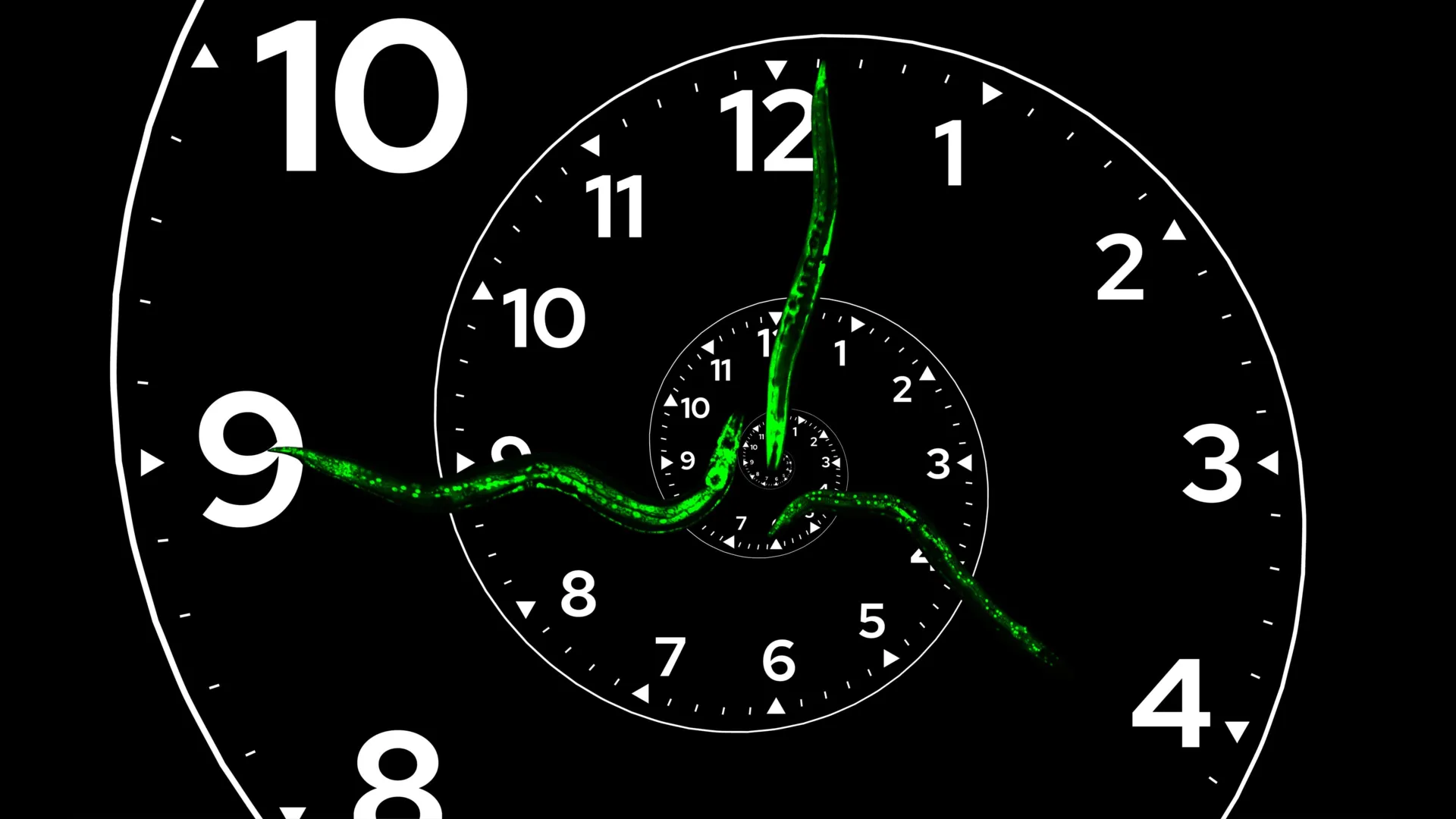
Scientists have identified a genetic "master clock" that orchestrates the precise timing of an animal's development, a discovery that could reshape how researchers understand growth disorders and developmental disease.
The clock, described by a team at Cold Spring Harbor Laboratory, governs development in the roundworm Caenorhabditis elegans, a workhorse of biology whose cells and genes are mapped in extraordinary detail. At its core are two proteins, MYRF-1 and LIN-42, that form a feedback circuit acting as the genome's central developmental timekeeper, determining when each pulse of gene activity begins and how long it lasts.
What makes the system remarkable is that it never repeats. The worm passes through four distinct larval stages, and the clock ensures each one starts exactly when it should, lasts precisely as long as needed, and then gives way to the next — without ever cycling back. That sets it apart from familiar biological rhythms like the circadian clock, which repeats roughly every 24 hours. "This is the first non-repeating biological clock of its kind ever found," the researchers report.
The work, led by Cold Spring Harbor Laboratory Professor Christopher Hammell and his team, shows that the two proteins do not simply switch genes on and off but encode timing itself — translating a steady molecular feedback loop into a sequence of sharply defined developmental windows. When the researchers disrupted the circuit, development stalled, the orderly progression of larval stages broke down, and the animal failed to mature properly.
That failure mode is precisely what makes the finding medically intriguing. Development in animals, including humans, depends on genes firing in the right order at the right moments; mistimed activity is thought to underlie a range of growth-related disorders and developmental diseases. By mapping a master coordinate system for developmental timing in a simple organism, the scientists provide a framework for asking how analogous timing failures might arise — and potentially be corrected — in more complex creatures.
C. elegans has repeatedly served as a gateway to discoveries that generalize across the animal kingdom; research on the worm has yielded multiple Nobel Prizes for insights into programmed cell death, gene regulation and RNA interference. The proteins at the heart of the newly described clock have counterparts in other species, raising the possibility that similar timing circuits help govern development far beyond the worm.
The researchers caution that translating the findings to human biology will take years of further work. But by revealing that development is steered by a definable, non-repeating molecular clock — rather than a vague cascade of signals — the study hands biologists a concrete new target as they try to decode how living things build themselves on schedule.