Comet 220P/McNaught Erupts in Rare Outburst, Brightening Thousands of Times for Dawn Skywatchers
An icy visitor brightened by roughly nine magnitudes in half a day, its most dramatic flare-up since Comet Holmes stunned observers in 2007, and it is now within reach of binoculars before perihelion.
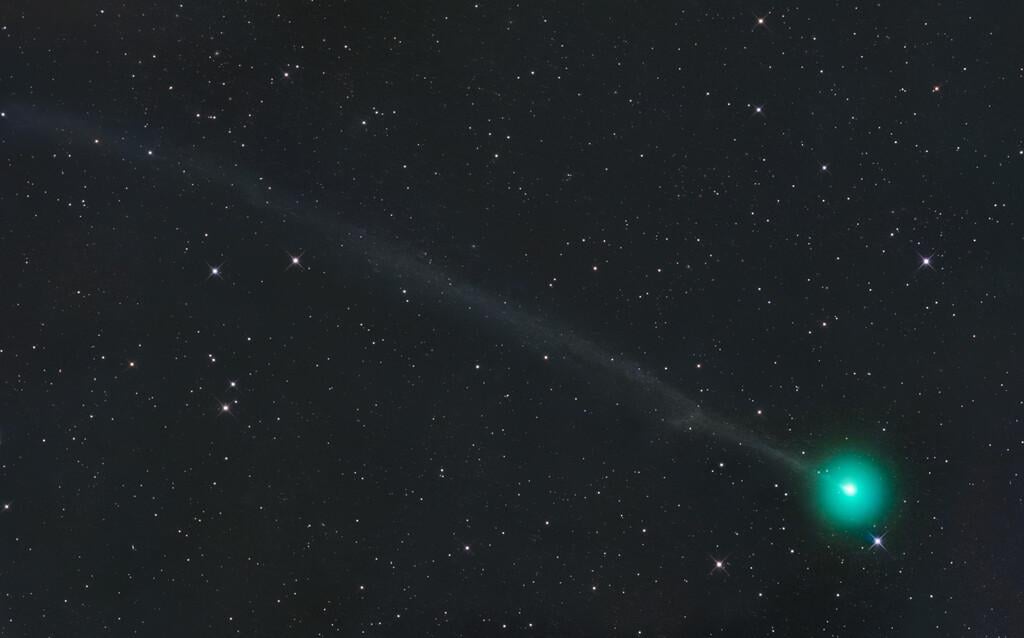
A normally faint and unremarkable comet has staged one of the most spectacular brightening events in nearly two decades, erupting so suddenly that it leaped from the reach of only large research telescopes into the range of ordinary binoculars in a matter of hours.
The comet, designated 220P/McNaught, underwent a major outburst at the end of May, astronomers reported. According to an alert from Mike Kelley, the comet brightened by roughly seven magnitudes, surging from about magnitude 18 to magnitude 11, a more than 600-fold jump in brightness, within a window of just 13 hours and 32 minutes between May 30 and May 31. Some observers reported it climbing even higher, to around magnitude 8.2, which would represent a staggering increase of roughly 8,000 times its quiescent glow.
Outbursts like this occur when a comet, essentially a fragile ball of ice, dust and frozen gases, suddenly releases a large cloud of material. The exact trigger is not always clear, but researchers suspect that pockets of volatile ice beneath the surface can flash into gas as the comet warms, or that a portion of the crust collapses, exposing fresh ice to sunlight. The result is an expanding shell of debris that reflects far more light, causing the object to flare dramatically before slowly fading.
The scale of the event places it in rare company. The jump of more than nine magnitudes in total brightness edges out the 2013 outburst of Comet 289P/Blanpain and ranks as the biggest and most abrupt cometary outburst since Comet 17P/Holmes astonished the world in 2007, when that object briefly became visible to the naked eye after brightening nearly a millionfold. For amateur astronomers, such flare-ups are prized precisely because they are so unpredictable.
Skywatchers willing to rise before dawn now have a chance to catch the comet for themselves. Comet 220P/McNaught is currently low in the eastern sky at first light, within range of binoculars or a small telescope. It is heading toward perihelion, its closest approach to the Sun, which it reaches on June 14 at a distance of about 1.6 astronomical units, just outside the orbit of Mars.
Whether the comet holds its enhanced brightness or fades quickly as the ejected material disperses is impossible to predict, which is part of the appeal. Observers are encouraged to look soon, while the outburst is fresh, scanning the low eastern horizon in the pre-dawn darkness for a fuzzy patch of light that, only days ago, was thousands of times too dim for the eye to see.