Mars' Strangest Cloud Appears to Form by Physics Never Seen Before
Modeling of the 1,800-km Arsia Mons cloud suggests water vapor freezes directly into ice without dust, a process never before observed in any planetary atmosphere.

Scientists using the European Space Agency's Mars Express orbiter, combined with a state-of-the-art meteorological model of the Red Planet, have found that exotic physics may lie behind Mars' most curious cloud. The paper, "Homogeneous ice Nucleation from Water Vapour Suggested by Elongated Clouds on Mars," is published in Nature Geoscience.
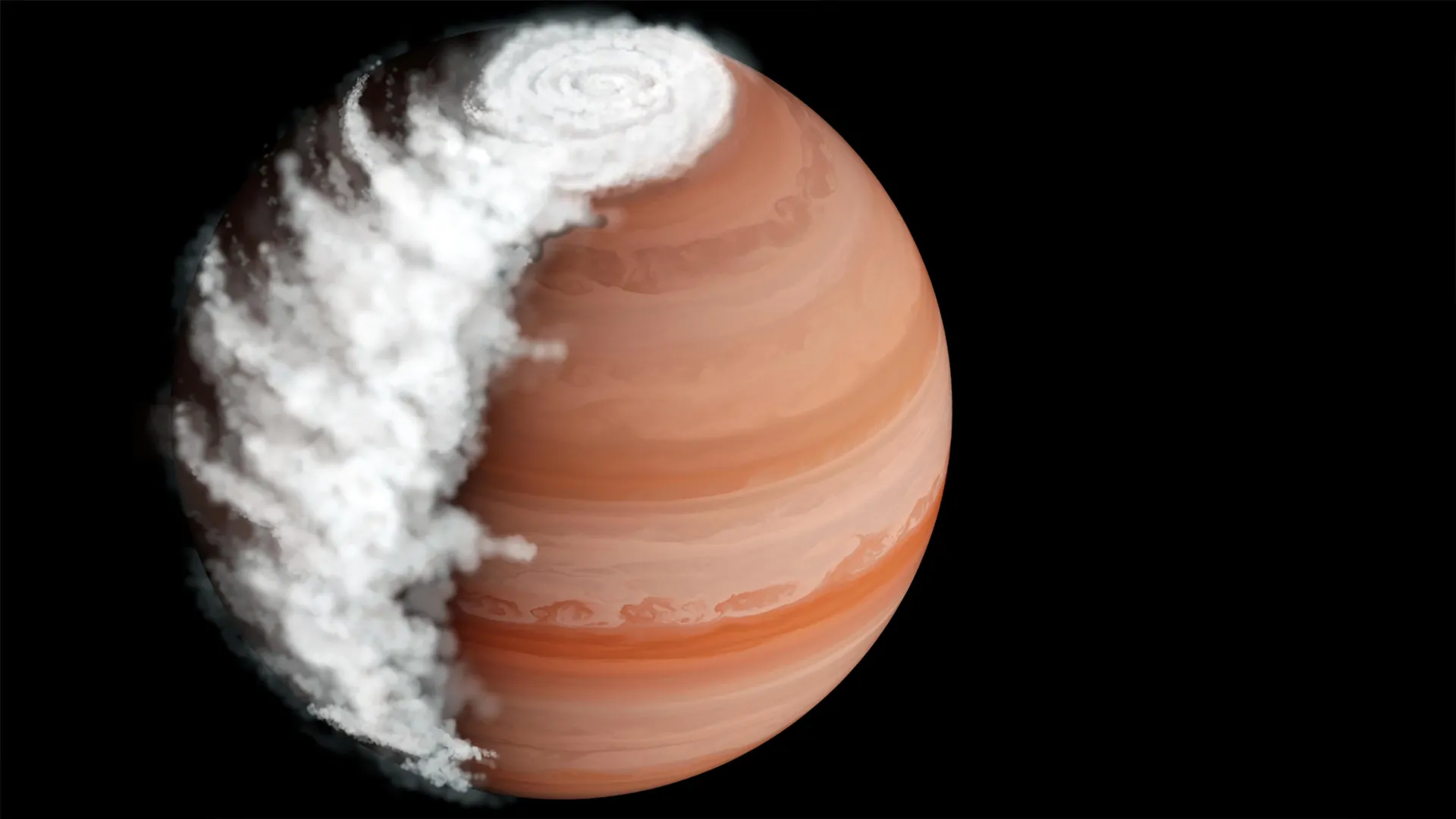
Every spring and summer in Mars' southern hemisphere, during the dusty season, the Arsia Mons Elongated Cloud emerges downwind of the 20-kilometer-tall volcano. The white wisp of water ice forms, grows and fades daily, stretching up to 1,800 kilometers, nearly twice the length of the United Kingdom, before quickly evaporating. The cycle repeats every morning for several months. Mars Express first revealed the cloud in 2018 and has viewed it repeatedly since.
Researchers had identified it as an orographic cloud, the type that forms on Earth when wind flows past a volcano or mountain. But simulations of how it springs to life never matched the images. "To create the AMEC in our modeling, we found that we needed to include some exotic physics… physics that, while included in textbooks, is treated as theoretical and usually thought not to happen in nature," said lead author Jorge Hernández-Bernal of LMD/CNRS/Sorbonne Université in Paris. "It certainly hasn't been seen in action before." Once the physics went in, he said, the cloud emerged "just as we hoped."
On Earth and elsewhere, clouds usually form when moist air cools and water vapor condenses onto specks of other material, such as salt, pollen, soot or dust. The process is called heterogeneous nucleation. On Mars, dust is thought to play that role. "For the AMEC, it seems that cloud formation takes place without needing any of this 'stuff,'" Hernández-Bernal said. "Water vapor turns directly into icy cloud particles without any middle step. It's akin to droplets of condensation appearing in the middle of a room, rather than on a window."
That process is called homogeneous nucleation, and it has never been observed in a planetary atmosphere. Scientists had suggested it might occur in the upper atmospheres of Earth and Venus, but it has not been spotted. It requires extreme conditions, with relative humidity more than 100,000 times what people usually experience on Earth. "We've not seen these conditions on Mars before," Hernández-Bernal said, "but our finding now strongly suggests that the planet's humidity can indeed reach these extreme levels."
The researchers found that the cloud sits at a spot where Mars' thin atmosphere and the towering height of Arsia Mons combine to create those conditions. As wind flows past the volcano, its bulk triggers a powerful wave that lifts moist parcels of air several kilometers in a few minutes. That cools the air rapidly, with temperatures dropping by 30 degrees in just 10 minutes and humidity spiking. Water vapor then freezes spontaneously into cloud particles.
The modeling used data from three cameras aboard Mars Express: the Visual Monitoring Camera, the High Resolution Stereo Camera and OMEGA. Some aspects of the modeled cloud still do not match observations, but Hernández-Bernal called the result "remarkable" given how little is known about Mars' atmosphere compared with Earth's. Mars Express is one of few orbiters able to observe in the morning hours when the cloud is present. Project scientist Colin Wilson said the work shows that unlikely processes should not be discounted on other worlds, including exoplanets. "Understanding this exotic Martian cloud required exotic physics," he said, "and this may be true elsewhere in the cosmos."