Greenland and Antarctica Have Lost 12.5 Trillion Tons of Ice Since 1979, Enough to Bury the Lower 48 Five Feet Deep. Five-Sixths of It Melted From Below, and the Jakobshavn Glacier Is Now Retreating 164 Feet a Day.
An ESA-led team stitched together 45 surveys from 27 satellites to push the record back to the 1970s. The ice sheets were stable through the 1990s, then 'it really kicked in during the 2010s.' A brief pause from 2020 to 2023 is over.
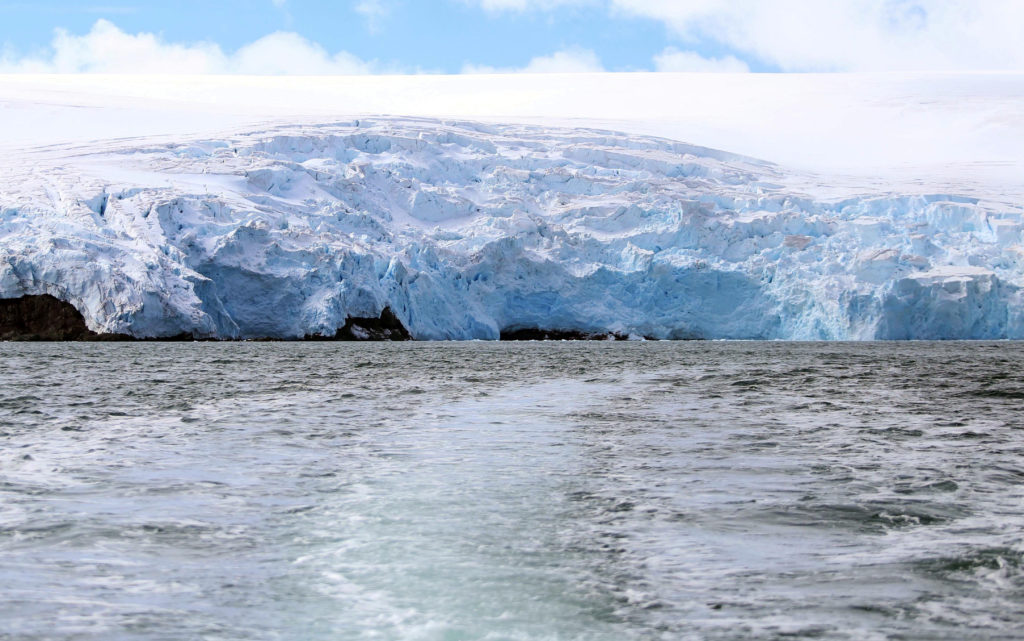
The ice sheets covering Greenland and Antarctica have shed about 12.5 trillion tons of ice since 1979, according to the longest and most comprehensive satellite accounting ever assembled, and the melt is accelerating again after a brief lull. The study, published Wednesday in the journal Scientific Data, is the work of an international team led by the European Space Agency and draws on 45 independent surveys from 27 satellites.
The numbers are hard to picture. Twelve and a half trillion tons (11.3 trillion metric tons) of ice is enough to cover the entire contiguous United States in a layer five feet thick. Melted, it becomes nearly 3 quadrillion gallons of water, and it has raised the global sea level by about 1.2 inches, or 3.1 centimeters. Ines Otosaka of Northumbria University in England, the study's lead author, said each additional third of an inch of sea-level rise exposes another 2 million to 3 million people to annual coastal flooding.
Previous assessments by the same group, known as the Ice Sheet Mass Balance Inter-comparison Exercise, only reached back to the early 1990s, when European radar satellites began systematic measurements. By folding in older NASA data, the researchers extended the Antarctic record to 1979 and the Greenland record to 1972. That longer view shows a clear shape. "In the 1970s, 1980s and into the 1990s, the ice sheets were relatively stable," Otosaka said, "but then melt started happening and it really kicked in during the 2010s." Losses eased between 2020 and 2023, which the authors attribute to short-term weather rather than any change in the underlying trend, and the acceleration has since resumed.
The mechanism is the most important finding. About five-sixths of the loss is not ice melting from the top under warm air; it is ice being eaten from below and from the sides by warming ocean water, which thins the floating ice shelves that hold back glaciers and lets them slide into the sea faster. Greenland's Jakobshavn glacier, the fastest-moving in the world, is now retreating up to 164 feet, or 50 meters, a day. "Most of the loss is coming from dynamic processes," said David Holland of New York University, who was not part of the study. That, he said, is the signature of ice sheets that may be becoming unstable rather than simply melting in step with the temperature.
Because the ocean warms slowly and glaciers respond slowly, the damage already done will keep playing out. "These changes lag the warming by decades," said Andrew Shepherd of Northumbria University, a co-author, "so impacts will continue even if we stop heating the planet." Eric Rignot of the University of California, Irvine, put it plainly: "The ice sheets are melting away fast. Sea level is rising worldwide and will exacerbate the vulnerability of coastal regions."
The new dataset is meant as a reference for the next round of Intergovernmental Panel on Climate Change reports, whose sea-level projections have repeatedly been revised upward as observations outran the models. Shepherd said the value of the longer record is that it turns a set of snapshots into a trend that cannot be explained away by any single hot summer or cold winter.
Originally reported by PBS NewsHour / AP.