Juice Probe Slingshots Past Earth at 8,640 Km, Gaining 3.5 Km/s on Its Way to Jupiter
The European spacecraft bent its path by 20 degrees using only one of six planned course corrections, and used the pass to calibrate its 10 instruments.

The European Space Agency's Jupiter Icy Moons Explorer, known as Juice, swung past Earth on September 28 and used our planet's gravity to change course toward Jupiter. The spacecraft passed 8,640 kilometers (5,369 miles) above the Indian Ocean, with closest approach at 13:45 CEST.
The encounter bent Juice's path by 20 degrees and added 3.5 kilometers per second to its speed, without burning much fuel. "We used only a small amount of the propellant reserved for this flyby," said Angela Dietz, the mission's spacecraft operations manager, leaving more for operations at Jupiter. Of six course-correction opportunities planned for the approach, controllers needed just one.
The flyby was also a test session. Mission teams scheduled operations for all 10 of Juice's science instruments, which gave them a rare chance to calibrate the sensors in real space conditions before the demanding Jupiter campaign. Project scientist Claire Vallat said it was only the third such opportunity, after a lunar-Earth flyby in 2024 and observations of Comet 3I/ATLAS in 2025. Priorities were set by how useful each activity would be for preparing for Jupiter, given limits on power and operations.
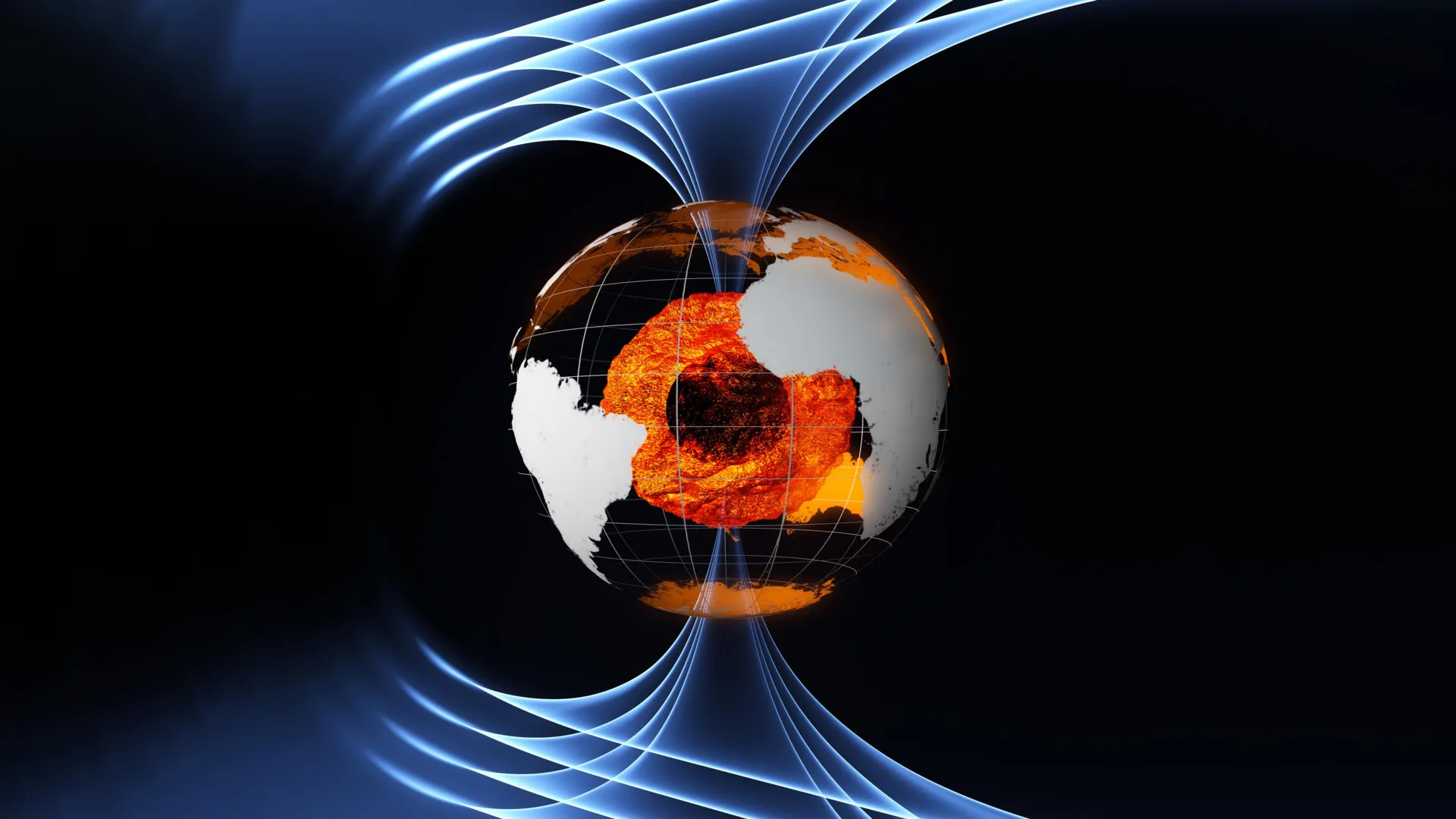
Juice also spent several days passing through Earth's magnetotail, the long tail of the planet's magnetic field stretching away from the Sun, collecting magnetic field and charged-particle data. That created a chance to coordinate with the European-Chinese Smile mission, which was watching the northern auroras closer to Earth at the same time. Scientists hope to link activity in the tail to what happens near the poles.
One image from the flyby, taken by Juice Monitoring Camera 1 at 13:56 CEST as the spacecraft moved away, shows much of Africa with Madagascar to the right. The Moon appears as a tiny grey dot at the upper right of the frame and part of the spacecraft is visible on the left. The camera is a 1,024-by-1,024-pixel unit meant for monitoring spacecraft hardware rather than science, and the picture is a stack of four exposures.
Instrument teams expect to release preliminary images and spectra in the coming weeks, including high-resolution photographs of Earth and the Moon from JANUS, Juice's main science camera. Monitoring of the flyby runs through October 10.
The flyby keeps the mission on schedule. Juice launched on an Ariane 5 from Kourou in April 2023 and will return to Earth for a third and final gravity assist in January 2029. It will arrive at Jupiter in 2031 and then make 35 flybys of three ocean-bearing moons, Europa, Ganymede and Callisto, to judge whether they could be habitats for past or present life. Those encounters will be far more demanding than this one, which is why the instrument checks mattered.