Bennu's Dust Says a Young Jupiter Helped Build the Asteroid Near the Frost Line
ETH Zurich isotope measurements on half a gram of NASA's OSIRIS-REx sample overturn the idea that Bennu formed late and far out, and suggest it holds the original recipe for rocky planets.

Half a gram of dust from the asteroid Bennu has upended two long-held ideas about where and when it formed, and pointed to Jupiter as a hidden architect of the early solar system.
NASA's OSIRIS-REx spacecraft scooped material from Bennu's surface in 2020 and dropped a capsule carrying about 120 grams of it into the Utah desert in September 2023. A small share went to Maria Schönbächler, a professor of isotope geochemistry at ETH Zurich in Switzerland, whose laboratory measured isotopes of iron, titanium and chromium in the grains. Isotopes are versions of the same element with slightly different masses. Together they act like a chemical fingerprint that shows where in the young solar system a body's raw material came from. The results were published in Science Advances.
The fingerprint links Bennu to two close relatives: the asteroid Ryugu, sampled by Japan's Hayabusa2 mission, and the CI meteorites, a rare class of primitive, carbon-rich rocks. All three appear to have formed from the same reservoir of cosmic dust, and all three differ clearly from other asteroids, meteorite groups and planets. The measurements also show titanium and iron are spread evenly through Bennu.
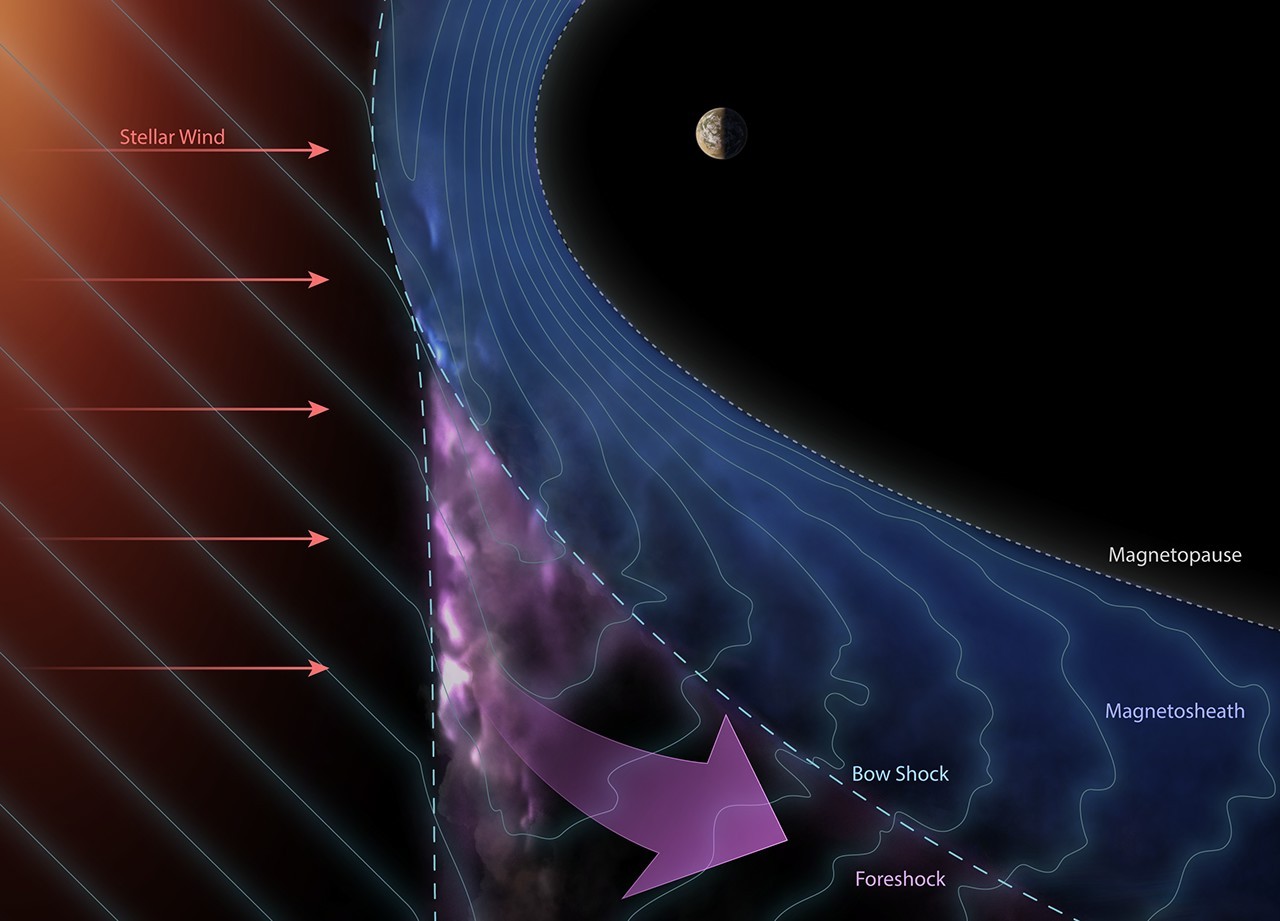
Scientists had assumed that bodies like Bennu formed in the far outer solar system, perhaps where comets were born, and relatively late. The new data contradict both assumptions. The team concludes that Bennu, Ryugu and the CI meteorites most likely formed near the water-ice line, the distance from the young sun where water vapor froze. About 4.5 billion years ago, material from the inner and outer solar system mixed there, and ice acted as a glue that stuck fine dust grains together. "Bennu is a hybrid: the material does not clearly match either the inner or the outer solar system," Schönbächler said.
Jupiter is central to the scenario. The giant planet formed within about a million years of the sun's birth. As it grew, it acted like a bridge pillar in a river, blocking most of the coarse material drifting through the disk of gas and dust around the sun. Fine dust from many regions flowed around it and mixed evenly near the ice line, and Bennu's ancestors formed from that well-stirred dust. That would explain why Bennu's makeup is so close to the sun's own. It would also explain why Bennu is rich in water: ice nearby evaporated, and some of the vapor condensed again where the asteroid was forming.
"Bennu may offer our best glimpse of the original mix of chemical elements from which the terrestrial planets were ultimately built," Schönbächler said. Because the asteroid is also rich in organic material, it offers clues to how the young Earth got the ingredients for life.
Open questions remain, including whether other asteroids share the Bennu–Ryugu signature and how much the young Jupiter really controlled which particles clumped together. Schönbächler now has her eye on Japan's mission to Mars' moon Phobos, due to launch at the end of October. She plans to apply to JAXA for a share of its samples, but the capsule is not due back on Earth until 2031.