NASA's Juno Catches Particles Racing Near Light Speed at Jupiter, Cracking a Cosmic Ray Mystery
Electrons accelerated in the turbulent region ahead of Jupiter's bow shock offer the first direct evidence that the same process powering them also forges cosmic rays across the galaxy.
NASA's Juno spacecraft has captured electrons accelerated to nearly the speed of light in the chaotic region just ahead of Jupiter, delivering the first direct confirmation that the same particle-accelerating process at work around Earth also operates on a grand scale across the universe. The findings, published June 3 in the journal Nature, offer a fresh window into one of astrophysics' enduring questions: where do cosmic rays come from?
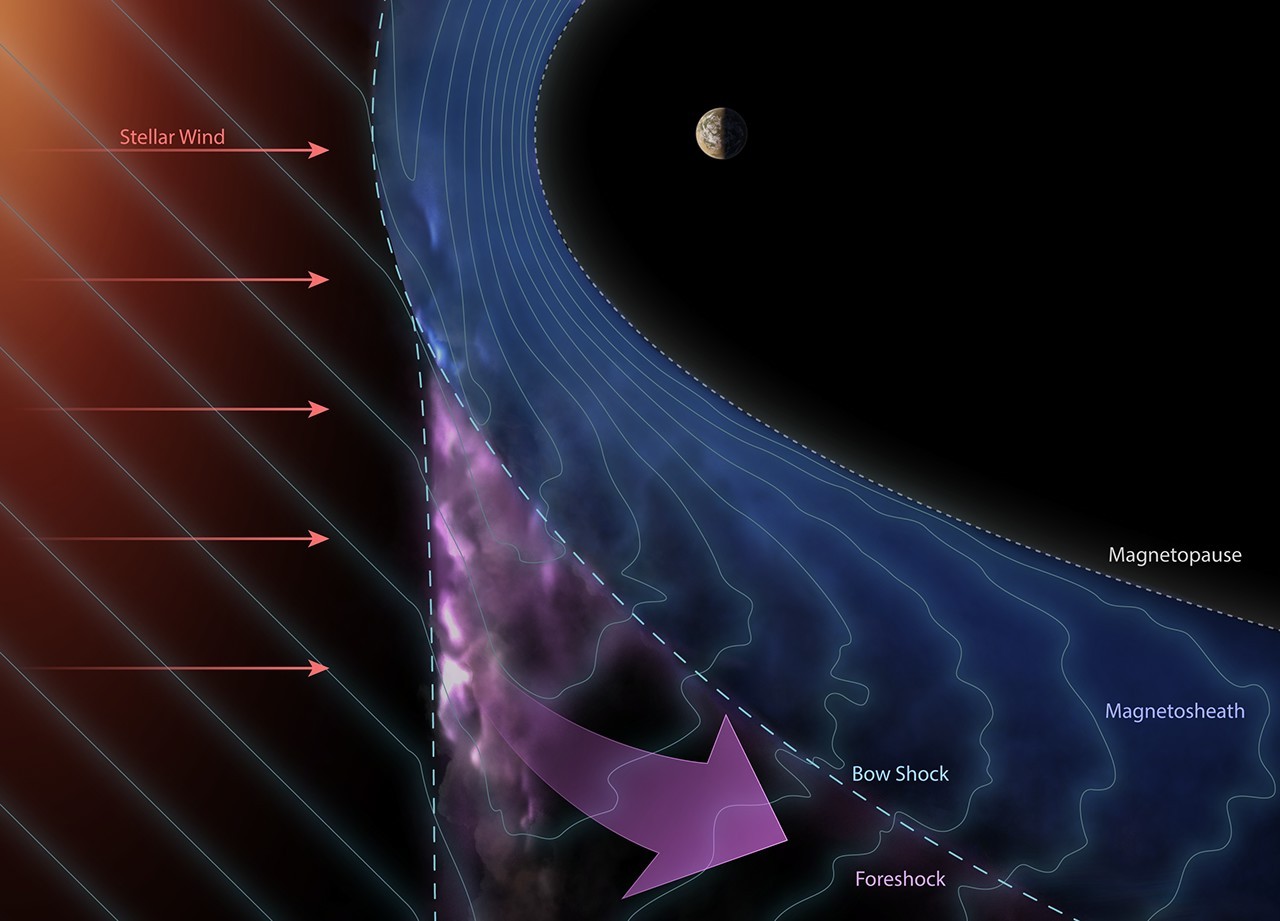
The action takes place at the boundary where Jupiter's vast magnetic field collides with the solar wind, the constant stream of charged particles flowing out from the Sun. That collision forms a bow shock — much like the wave that builds ahead of a boat — and just upstream of it lies a turbulent zone called the foreshock, where magnetic conditions can fling particles to extraordinary energies. Juno, threading through this environment, measured electrons moving even faster than comparable particles detected near Earth.
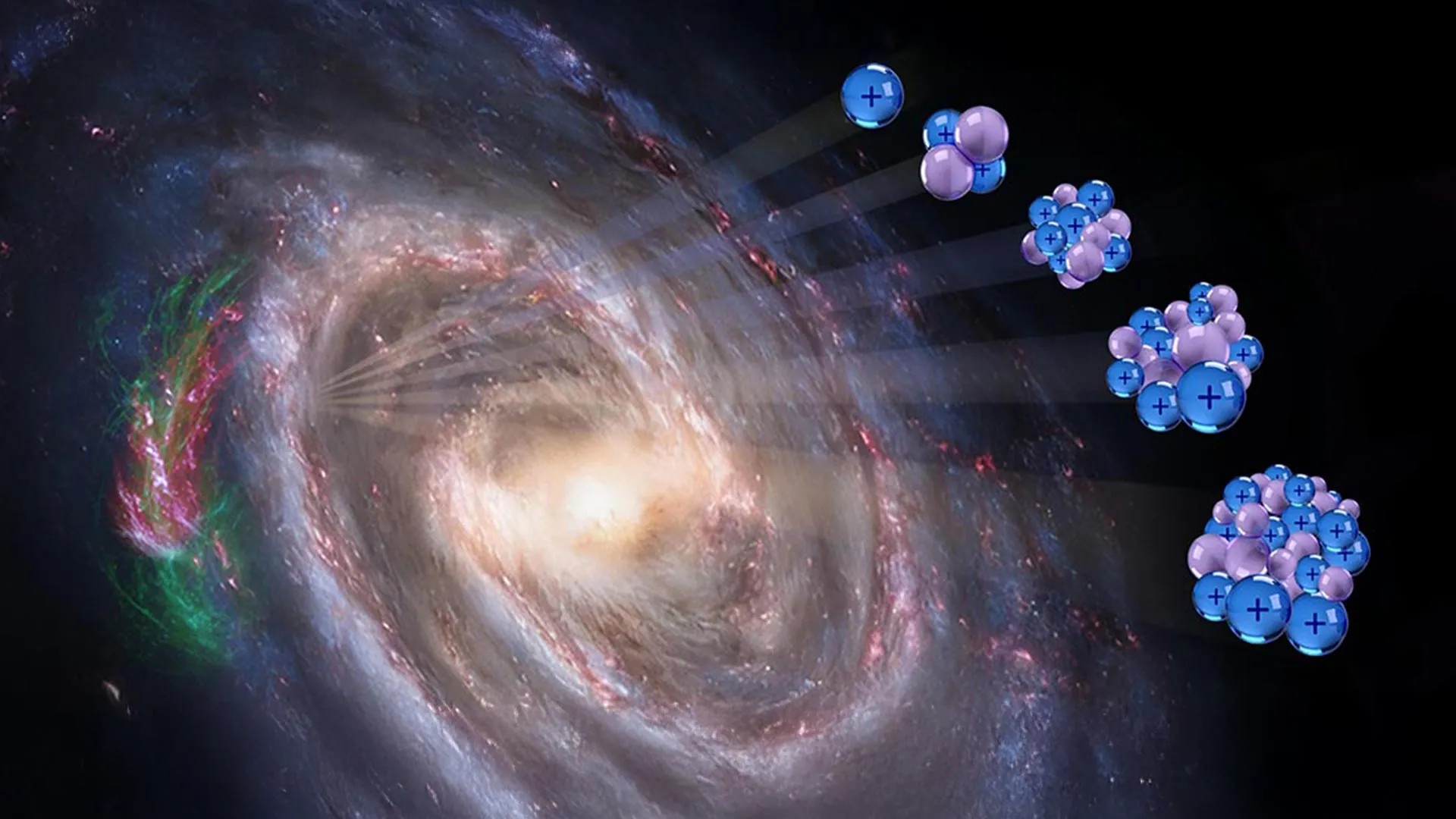
Crucially, the speeds scaled with the size of Jupiter's magnetic environment, which dwarfs Earth's. That scaling relationship is the key result. When researchers compared it to the energies of cosmic rays believed to originate from exploding stars, the numbers matched, suggesting that the same fundamental mechanism accelerating electrons in a planetary foreshock also helps generate the high-energy particles that race across the galaxy from supernovas and other violent cosmic sources.
"This gives us a natural laboratory to study a process we usually can only observe from light-years away," explained researchers at NASA's Goddard Space Flight Center, which led the analysis with collaborators at the Johns Hopkins University Applied Physics Laboratory. Earlier missions such as the Magnetospheric Multiscale (MMS) and THEMIS spacecraft had studied particle acceleration in Earth's foreshock, but Jupiter's far larger system allowed scientists to test whether the physics held up at a dramatically different scale.
Beyond satisfying scientific curiosity, the work has practical stakes. Understanding how and where high-energy particles form helps scientists better predict space weather, the bursts of radiation and charged particles that can disrupt satellites, threaten astronauts and interfere with communications and power grids on Earth. Juno, which has been orbiting Jupiter since 2016 and repeatedly extended its mission, continues to return data that reshapes scientists' understanding not just of the giant planet itself but of processes that play out everywhere from the Sun's neighborhood to the distant reaches of the Milky Way.