Juno Finds Jupiter Blunts the Solar Wind With Layered Shocks That Earth Doesn't Need
Measurements from NASA's Juno spacecraft show richer plasma waves and extra 'shocklets' at Jupiter's bow shock, a nearby test bed for the physics of exploding stars.
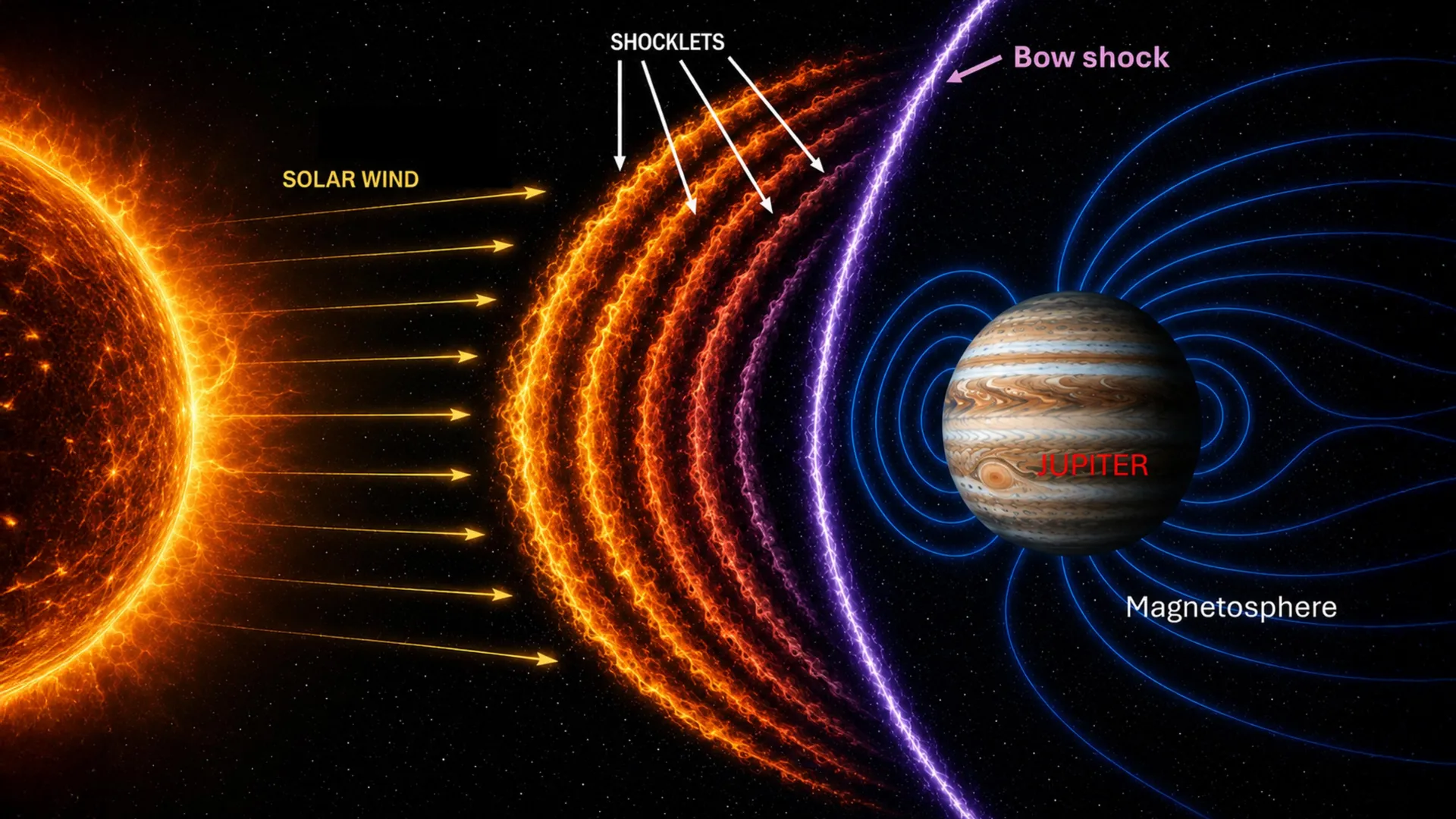
Jupiter handles the stream of charged particles flowing from the Sun in a more complicated way than Earth does, according to new observations from NASA's Juno spacecraft. The findings, led by University of Iowa scientists, give the most detailed look yet at the planet's bow shock, the invisible boundary where the solar wind first meets a planet's magnetic environment.
The Sun constantly releases a flow of electrically charged particles called the solar wind, which often moves faster than the speed at which waves travel through the surrounding plasma. When it reaches a planet with a magnetic field, it hits a bow shock. At Earth, the bow shock slows and heats the incoming particles and helps steer most of the solar wind around the planet, which protects the atmosphere. Scientists had long wanted to know whether Jupiter, with its huge size, powerful magnetic field and gaseous makeup, does the same job differently.
Using Juno's data, the team found that Jupiter relies on plasma waves with multiple frequencies, known as harmonics, to slow and heat incoming particles. The researchers compare it to music: several notes played together make a richer sound than one. Earth's bow shock mainly uses waves concentrated around a single frequency. "Jupiter has found its own way to deal with the solar wind, through plasma waves that are stronger and exhibit richer harmonic structures," said Jayasri Joseph, a postdoctoral researcher in the University of Iowa's Department of Physics and Astronomy and the study's corresponding author. "That's important because if you have multiple frequencies, you can heat more particles in the solar wind and slow them down."
The second difference is an extra line of defense. Before incoming particles reach Jupiter's main bow shock, they can run into smaller shock structures called shocklets, which start to slow the solar wind early. At Earth, the bow shock is generally the main place where that happens. "Earth does not need to take these extra steps to handle the solar wind because the impact isn't as powerful," said Bill Kurth, a research scientist in the department who has worked on the Juno mission since the spacecraft launched in 2011.
The work rests on observations Juno collected in December 2024. The spacecraft has orbited Jupiter since July 2016, and a key instrument in the discovery was Juno Waves, which was designed and built by Iowa physicists. It measures electric and magnetic wave activity and lets researchers study how plasma behaves around the planet. Earlier spacecraft had detected bow shocks at the outer planets but lacked the measurements to resolve the plasma waves in detail.
The results were published online July 31 in Nature Communications, in a paper titled "Plasma wave observations from Juno spacecraft at the Jovian bow shock." Allison Jaynes, Jeremy Faden and Chris Piker of the Iowa department were among the authors, along with Lynn Wilson III and John Connerney of NASA's Goddard Space Flight Center and other researchers.
The payoff reaches far beyond Jupiter. Shock waves occur wherever huge amounts of energy are released, and the most extreme are in supernova remnants, the expanding clouds left when certain dying stars explode. Those shocks are vastly more powerful than the one at Jupiter, but the physics of moving energy through plasma has important similarities. "Because even more powerful shocks occur around astrophysical objects such as supernova remnants, Jupiter's bow shock offers a nearby natural laboratory for exploring and for understanding how nature converts enormous amounts of flow energy into heat and energetic particles," Joseph said.
That makes Jupiter's shock a stand-in for events no spacecraft can visit. Better models of how shocks heat particles and speed them up could improve scientists' understanding of how cosmic rays are produced and how shock waves shape the space around stars far from the solar system.