Moon Rocks From China's Chang'e-6 Reveal How Earth Shields the Lunar Near Side From the Solar Wind
Samples from the Moon's far side show solar-wind particles struck it harder than the near side — because Earth's magnetic field slows the stream that reaches the hemisphere facing us.
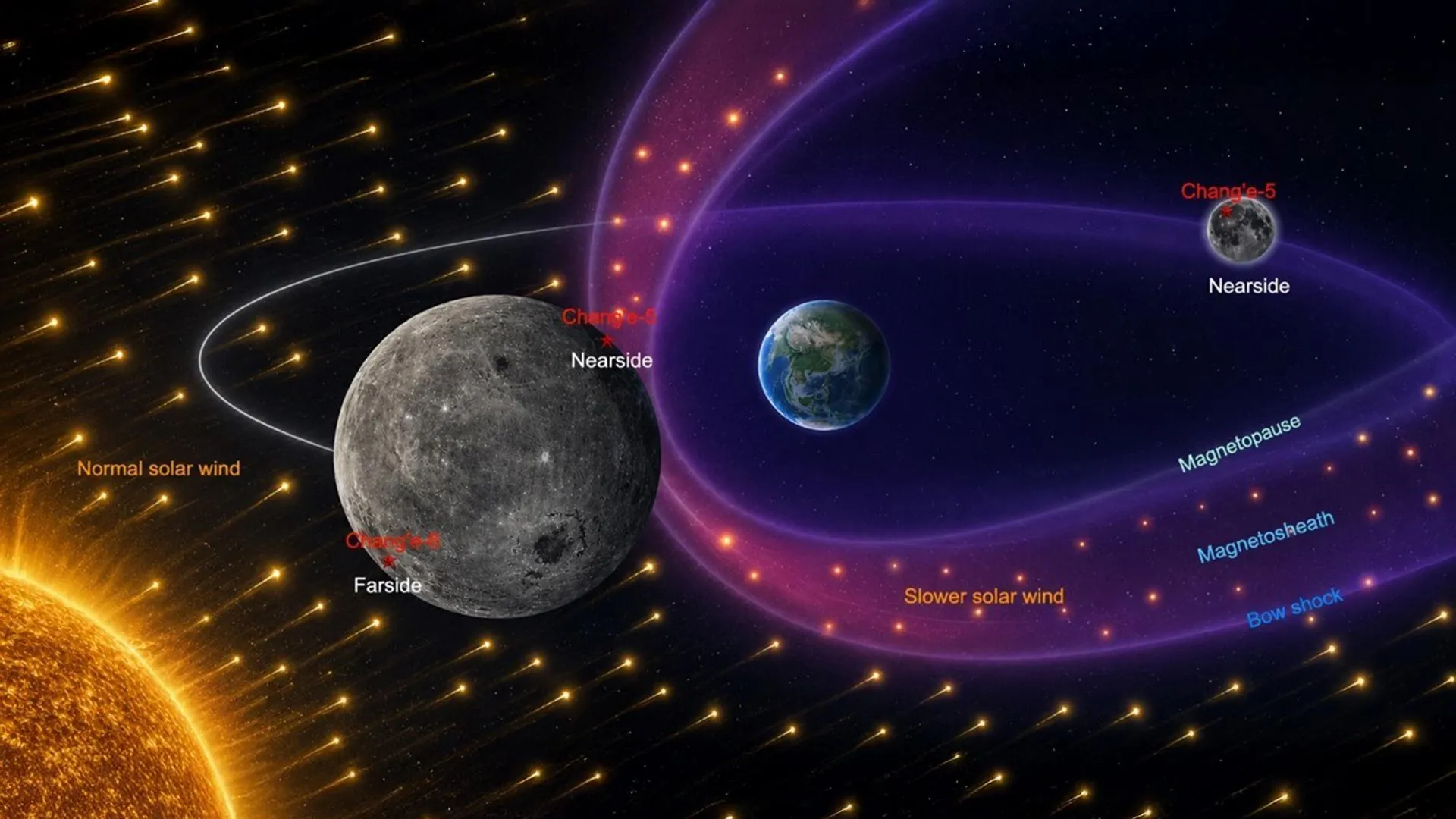
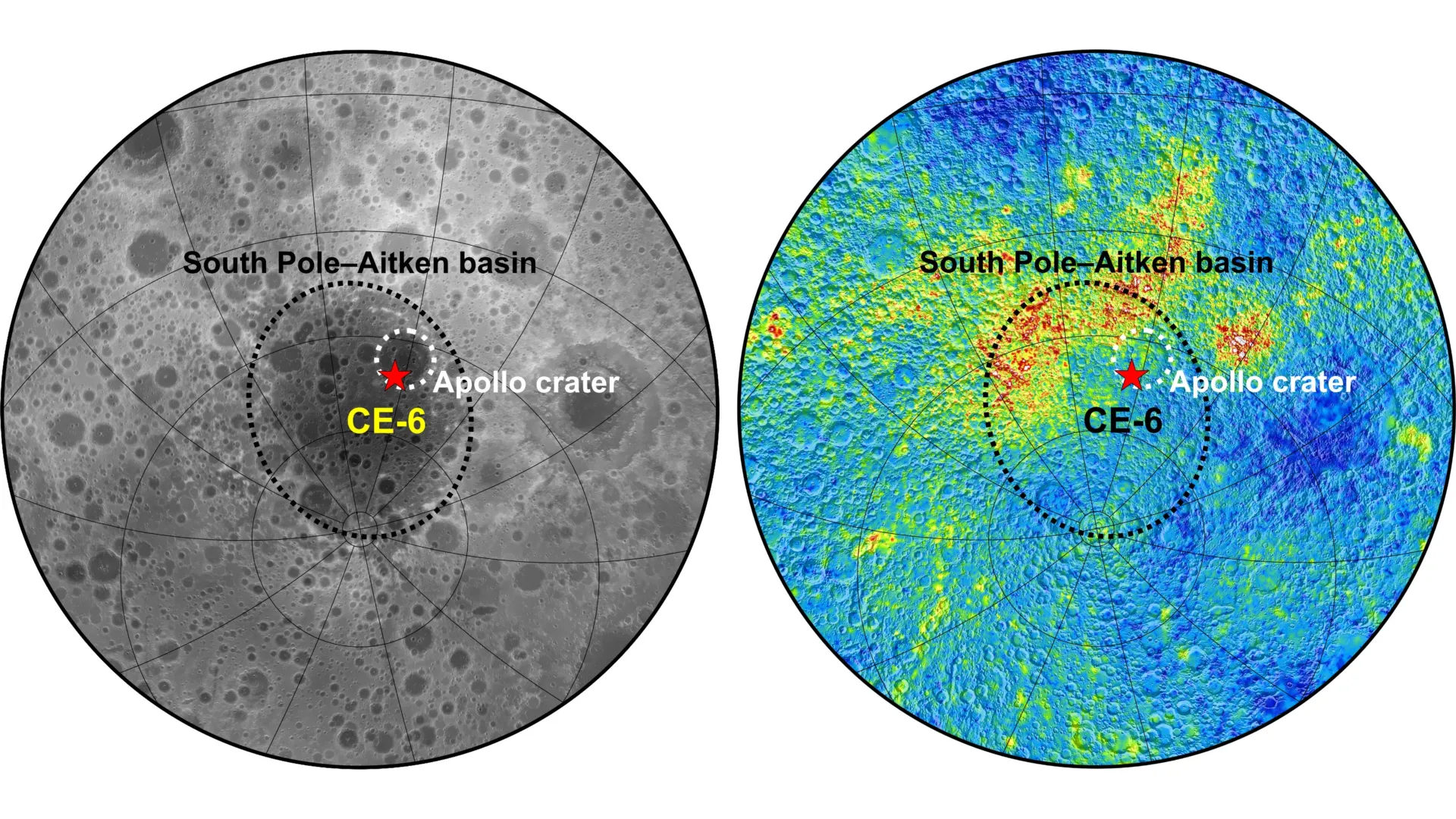
Lunar soil scooped from the far side of the Moon by China's Chang'e-6 mission has uncovered a surprising difference between the Moon's two hemispheres — and traced it back to the invisible shield of Earth's own magnetic field. The research, published in the journal Science Advances, shows that the near side of the Moon, the face that always turns toward Earth, is partly protected from the solar wind by our planet's magnetosphere.
The solar wind is a constant stream of charged particles flowing off the Sun at roughly 400 kilometers per second. When those particles slam into an airless world like the Moon, they become embedded in the surface soil, or regolith. By measuring how deeply the particles penetrated in the far-side samples and comparing them with near-side material, the researchers found a clear asymmetry: solar-wind ions had burrowed significantly deeper into the far-side soil, meaning that hemisphere had been struck by higher-energy particles.
The explanation lies in Earth's magnetosphere, the vast magnetic bubble that surrounds the planet and deflects much of the solar wind. As the Moon orbits Earth, it periodically passes through the magnetosheath, a turbulent buffer zone at the edge of that bubble, where the ambient solar wind is slowed from its usual 400 kilometers per second to roughly 200. That slower, gentler stream falls mainly on the near side, leaving its particles implanted closer to the surface. The far side, which permanently faces away from Earth, gets no such reprieve and is bombarded by the undiminished solar wind.
The key evidence came from noble gases — chemically inert elements such as helium and neon — locked inside the lunar regolith. Because these gases are deposited by the solar wind and preserved for eons in the airless soil, they act as a natural recorder of how energetically the particles arrived. The Chang'e-6 samples, the first ever returned from the Moon's far side, gave scientists their first direct comparison of the two hemispheres' exposure.
Beyond settling a question about the Moon, the discovery hands researchers a new tool for studying Earth. Because the lunar regolith has faithfully archived the imprint of the solar wind over immense stretches of time, those trapped gases may offer a way to trace how Earth's magnetosphere — and by extension its protective magnetic field — has changed over billions of years.
The findings reveal that the relationship among the Sun, Earth and Moon is more intertwined than scientists had appreciated, with our planet quietly casting a magnetic shadow across the face of its companion. In preserving that record, the Moon has become an unexpected witness to the long history of Earth's magnetic environment, and Chang'e-6's far-side cargo has given scientists their first clear look at it.