China's Chang'e-6 Moon Soil Holds a 'Magnetic Fossil' Never Before Found in Lunar Samples
Scientists found nanoscale particles of high-temperature gamma iron preserved in impact glass, locked in a stable magnetic vortex that could record the moon's ancient field.

The moon lost its global magnetic field long ago, but its rocks and soil still carry traces of it. Chinese scientists studying soil brought back from the far side of the moon by the Chang'e-6 mission have now found a new kind of carrier for that ancient record: tiny grains of a form of iron that, by the usual rules, should not exist there at all.
The team, led by Professor Du Haifeng of the High Magnetic Field Laboratory at the Hefei Institutes of Physical Science, part of the Chinese Academy of Sciences, reported the find Sept. 16 in the Proceedings of the National Academy of Sciences, in a paper titled "Magnetic vortex state of natural lunar γ-Fe." It is the first time this iron phase, called gamma iron, has been identified in natural lunar samples.
"This tiny magnetic fossil may help us better understand the moon's ancient magnetic history," said Dr. Li Long of the Hefei institute, a member of the team.
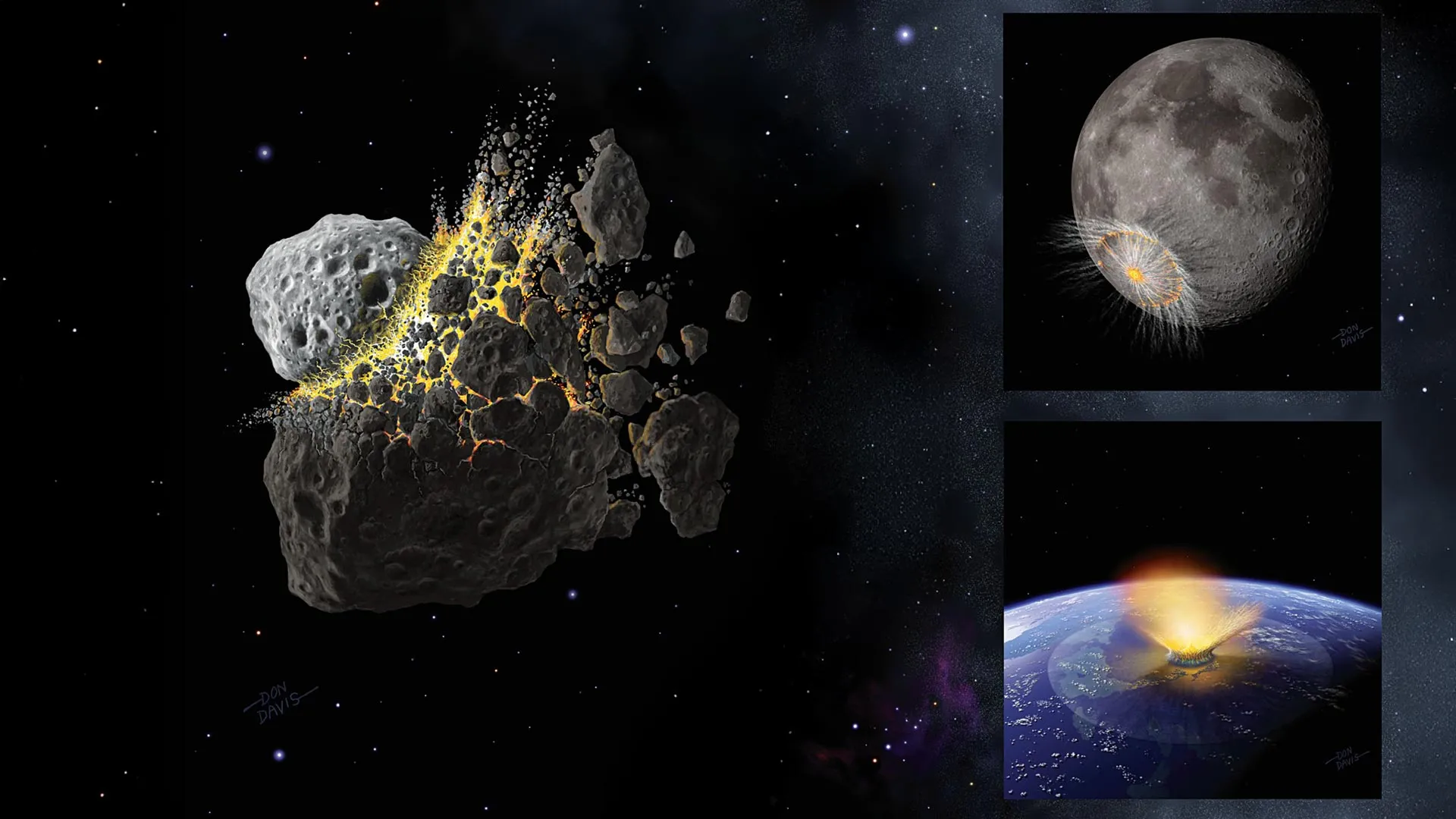
The researchers examined particles of impact glass, the glassy droplets formed when meteorites slam into the lunar surface and melt rock, that contained metallic iron. Using a focused ion beam to slice samples, transmission electron microscopy and chemical analysis, they found numerous nanoscale iron particles scattered through the glass. Some had a face-centered cubic crystal structure, the signature of gamma iron, and in the two impact-glass samples studied it was the dominant form of iron present.
That is surprising. Gamma iron is normally stable only at high temperatures and turns into ordinary alpha iron as it cools. The team concluded that the conditions of a lunar impact may allow it to survive. Trace amounts of carbon and other elements, the very rapid cooling of impact-generated melt, and the surrounding glass may all have helped lock the high-temperature structure in place.
The key test was magnetic. Using a technique called off-axis electron holography, which maps magnetic fields inside individual particles, the team found that the larger gamma-iron grains settled into a stable single-vortex magnetic state, with magnetization curling in a ring, and held a stable response when exposed to an outside magnetic field. Stability is what makes a mineral useful as a recorder: grains that hold their magnetic state can preserve information about the field present when they formed. The researchers say gamma iron may be a previously unknown recorder of magnetic information in lunar material.
The finding widens the list of magnetic minerals known in moon samples. Because gamma and alpha iron form under different conditions and behave differently magnetically, the researchers suggest they may preserve information from different stages of an impact. Future work will test how much these grains can reveal about when and how strongly the moon's magnetic field once operated, one of the enduring puzzles in lunar science. Chang'e-6 returned the first-ever samples from the moon's far side in 2024.