Chang'e-6 Moon Dust Holds a Form of Iron Never Before Seen in Lunar Samples
Chinese researchers found gamma-iron inside impact glass from the Moon's far side, a nanoscale 'magnetic fossil' that may record the Moon's lost magnetic field.
Scientists studying soil returned by China's Chang'e-6 mission have found a form of metallic iron never before identified in natural lunar samples, one that may act as a microscopic record of the Moon's ancient magnetic field. The material, called γ-Fe, or gamma iron, turned up inside tiny particles of impact glass, according to a study published Sept. 16 in the Proceedings of the National Academy of Sciences.
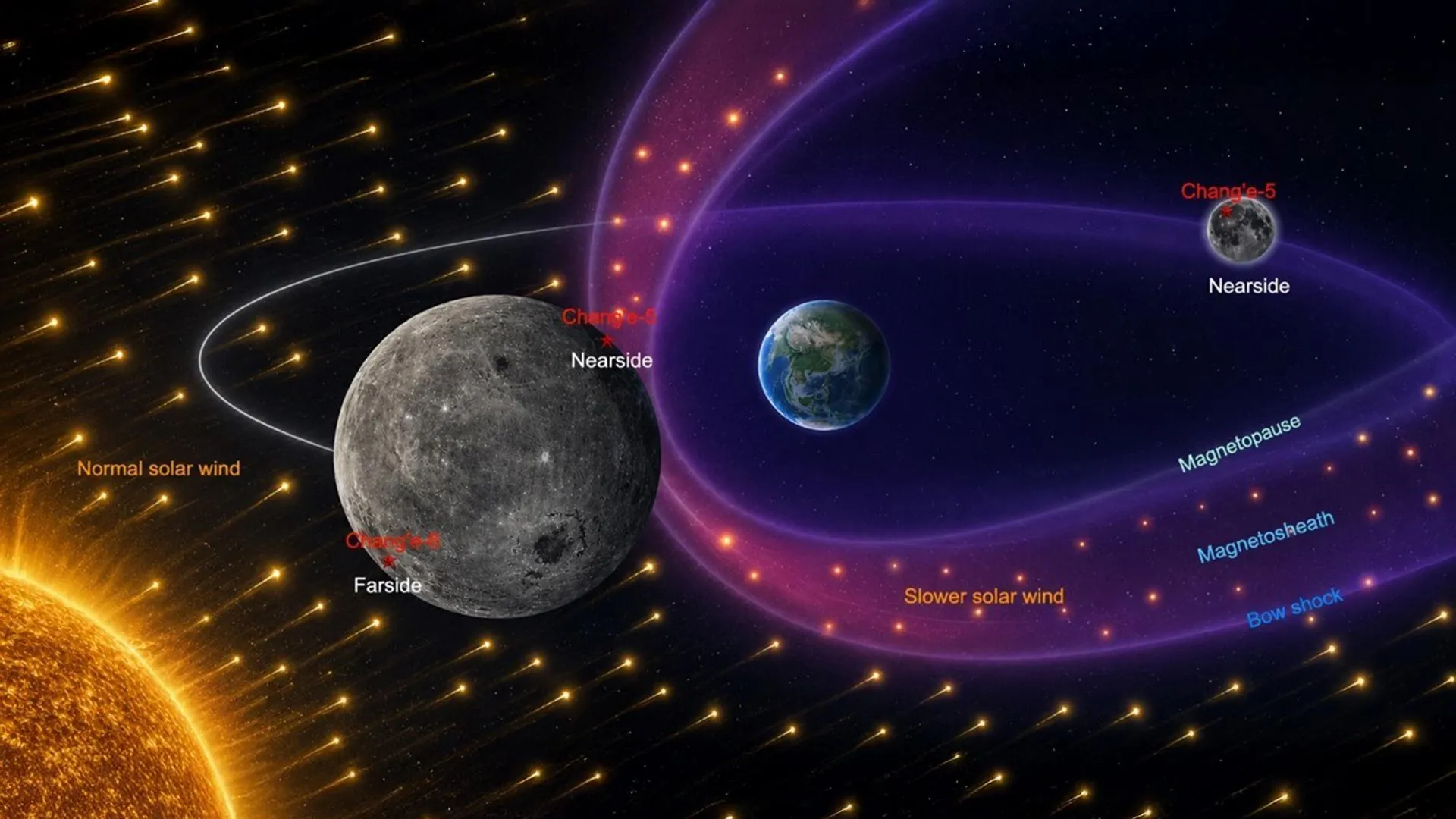
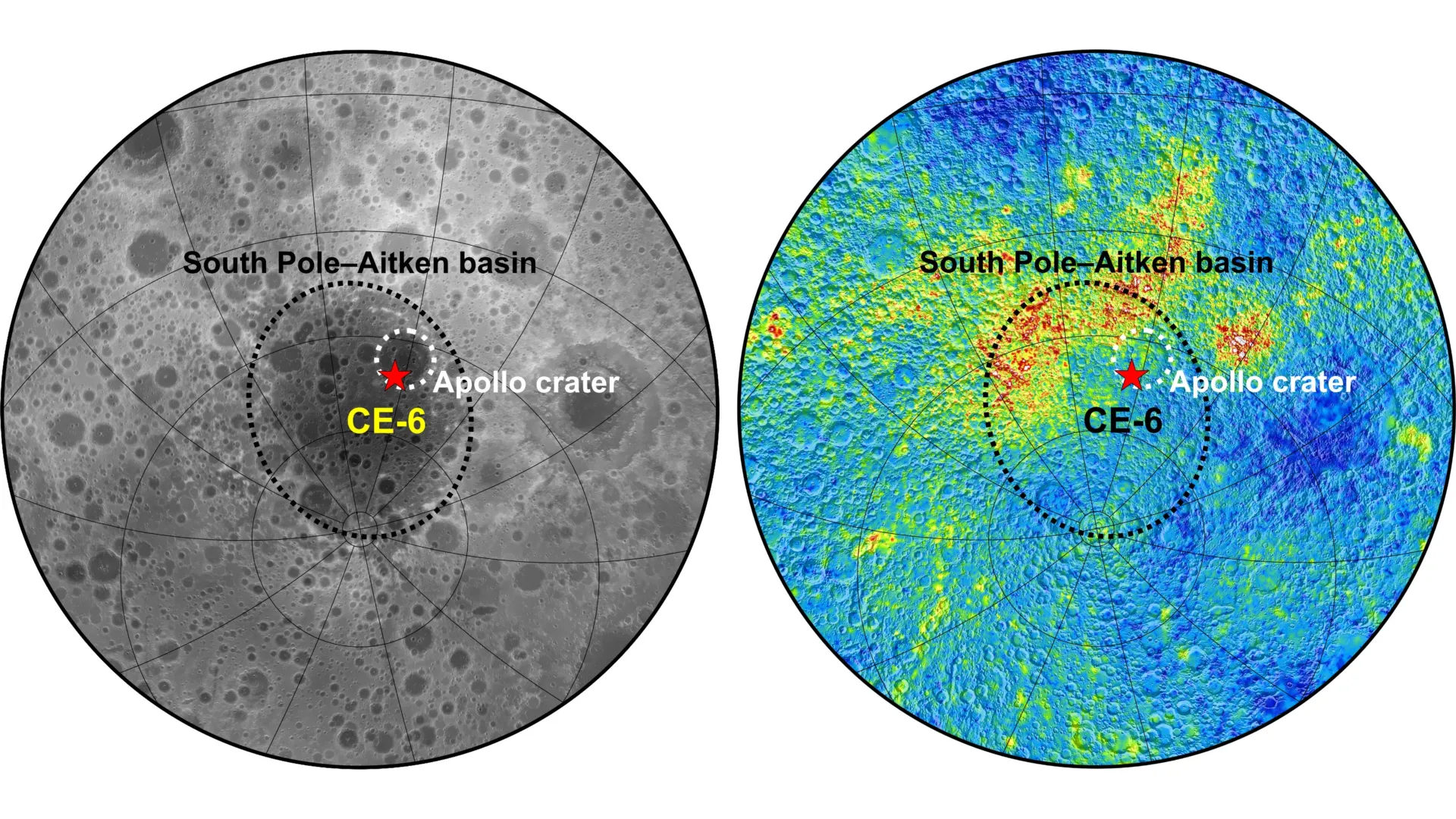
The Moon has no global magnetic field today, but traces of its early magnetism remain locked in rocks and soil. By studying the magnetic minerals preserved there, researchers can reconstruct how the Moon's magnetic environment changed over billions of years. Chang'e-6 collected about 1,935 grams of material from the Apollo basin inside the South Pole-Aitken basin on the far side, one of the largest and oldest impact scars in the solar system and a region with strong magnetic anomalies.
The team was led by Prof. Haifeng Du of the High Magnetic Field Laboratory at the Hefei Institutes of Physical Science, part of the Chinese Academy of Sciences. They prepared samples with a focused ion beam and examined them using transmission electron microscopy and chemical analysis. The images showed numerous nanoscale iron particles scattered through the glassy material. Some were face-centered cubic γ-Fe, and in the two impact-glass samples studied, γ-Fe was the dominant form of iron.
That is unusual. Under normal conditions, γ-Fe is stable only at high temperatures. As the metal cools it typically converts to the common form, α-Fe. The researchers found evidence that the extreme conditions of lunar impacts can let γ-Fe survive at the surface. They proposed that several factors help stabilize it: small amounts of carbon and other elements, the rapid cooling of molten material thrown out by an impact, and protection from the surrounding glass matrix.
The team then used off-axis electron holography to probe the magnetic behavior of individual nanoparticles. They found that relatively large γ-Fe particles can settle into a stable single-vortex magnetic state, and that the particles kept a consistent magnetic response when exposed to an external field. That stability suggests γ-Fe could be a previously unrecognized recorder of magnetic information in lunar material. "This tiny magnetic fossil may help us better understand the Moon's ancient magnetic history," said Dr. Long Li of the institute, a member of the team.
The finding broadens the list of known magnetic minerals on the Moon. Because γ-Fe and α-Fe form under different conditions and behave differently, each could preserve information from a separate stage of lunar impact events. A separate study has also reported tetrataenite, another hard magnetic mineral, in Chang'e-6 soil, which points to space weathering as a second way the lunar surface acquires magnetic carriers.
The researchers caution that much work remains. It is not yet known how much these minerals can reveal about the strength and timeline of the Moon's lost field, or how it evolved. The paper, "Magnetic vortex state of natural lunar γ-Fe," has more than a dozen authors and carries the DOI 10.1073/pnas.2608395123. Chang'e-6 remains the only mission to bring back samples from the lunar far side, so every grain is likely to be studied for years.