Venus Probably Had a Moon. Its Own Spin Dragged the Moon Back In and Destroyed It
A new tidal model run out over 4.5 billion years finds the missing Venusian moon needs no catastrophe to explain. The planet killed it, in as little as 30 million years.

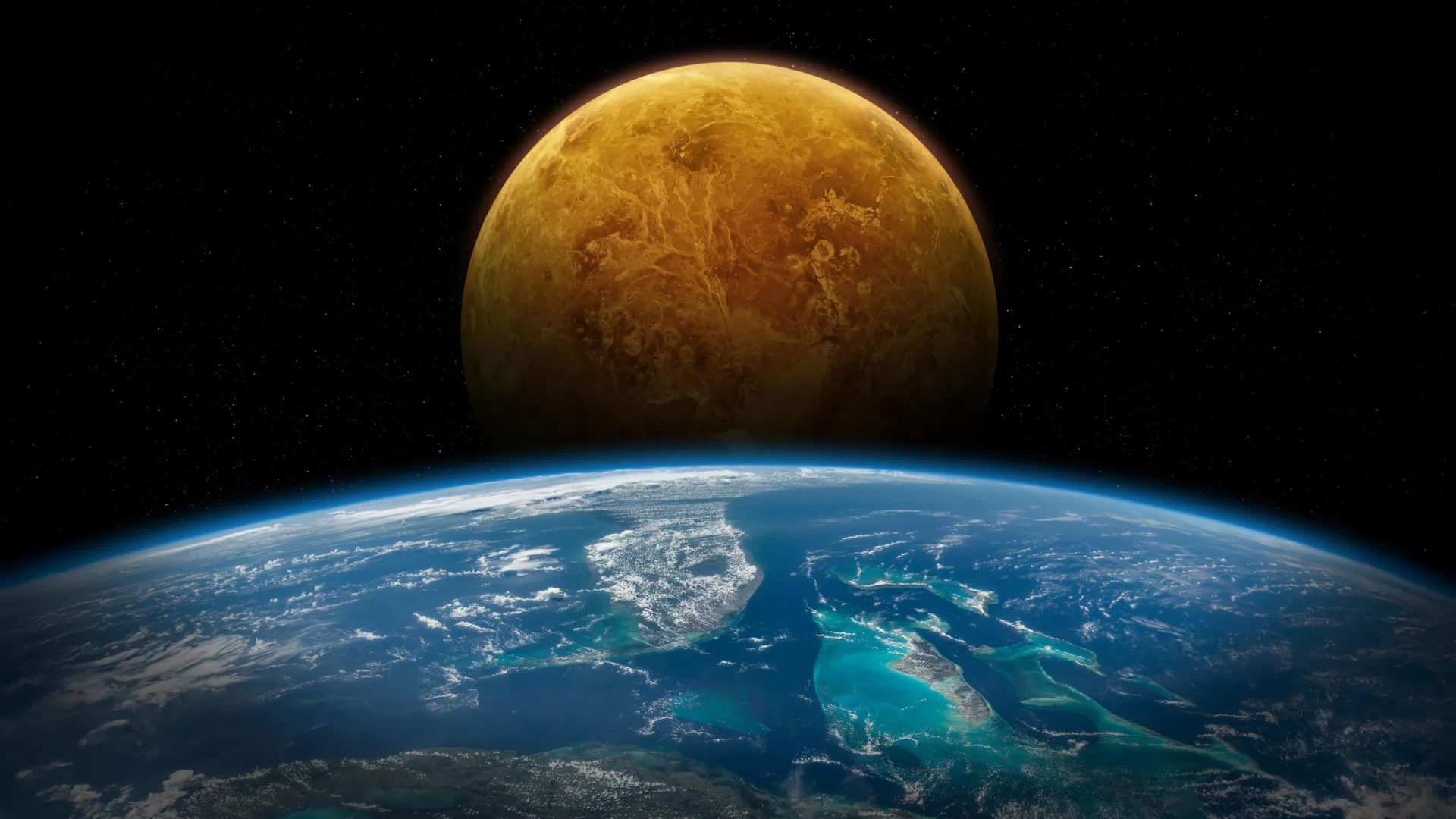
Venus is the same size as Earth, made of roughly the same stuff, and sits one door closer to the Sun. It spins backwards, its surface is hot enough to melt lead, and it has no moon. The last of those is the one planetary scientists have never had a good answer for, and a new paper argues the answer is that Venus had one and then destroyed it without any outside help.
The work, led by Stephen R. Kane and posted to the arXiv preprint server, is a tidal-evolution study. The team built a model containing the quantities that govern the long-term fate of a satellite — the planet's spin rate, the moon's mass, its orbital distance and the internal friction that dissipates tidal energy inside both bodies — and integrated it forward across 4.5 billion years, varying the inputs to see which combinations produced a moon that survives to the present and which produced one that does not.
The mechanism is the same one operating in the Earth-Moon system, running the other way. Our Moon raises a tidal bulge on Earth; because Earth rotates faster than the Moon orbits, that bulge sits slightly ahead of the Moon and tugs it forward, which is why the Moon recedes from us by about 3.8 centimeters a year. Reverse the relationship — slow the planet's rotation below the satellite's orbital rate — and the bulge lags instead of leads, the tug becomes a brake, and the moon spirals inward toward the planet that is pulling on it.
That is what the simulations produce for Venus. In many of the runs where the moon is lost, it first migrates outward, then Venus's own spin changes, the orbit reverses direction and the moon comes back in and is destroyed. How fast depends on the moon's mass and how quickly Venus was rotating to begin with: anywhere from 30 million years after the moon formed to 1.7 billion years. Under some parameter choices a moon does survive the full 4.5 billion years, so the outcome is not forced — but the destructive branch requires nothing exotic.
That is the paper's actual claim, and it is a claim about parsimony. "The absence of a Venusian satellite is a natural consequence of the initial conditions rather than requiring a separate catastrophic event," the authors write. Earlier explanations have generally needed something to happen: a second giant impact to knock a moon loose, or a formation history in which Venus never acquired one at all.
The authors push the point further, toward the question of why two planets this similar ended up so different — one with oceans and plate tectonics and life, the other with a 92-bar carbon dioxide atmosphere. A large moon stabilizes a planet's axial tilt and drives tidal mixing. "The presence or absence of a moon during Venus's early history may represent a critical branch point in this divergence," they write. The paper is a preprint and has not completed peer review.