Venus's Giant Rift Valleys May Still Be Splitting Open Today, Widening Up to 4 Inches a Year
ETH Zurich simulations suggest the planet's vast canyons are far younger than assumed — evidence that Venus is tectonically alive rather than a dead world frozen in place.
Venus has been treated for years as a planet whose geology stopped. New simulations from ETH Zurich argue the opposite: some of its enormous rift valleys may still be pulling apart right now, widening by three to 10 centimeters — roughly one to four inches — every year.
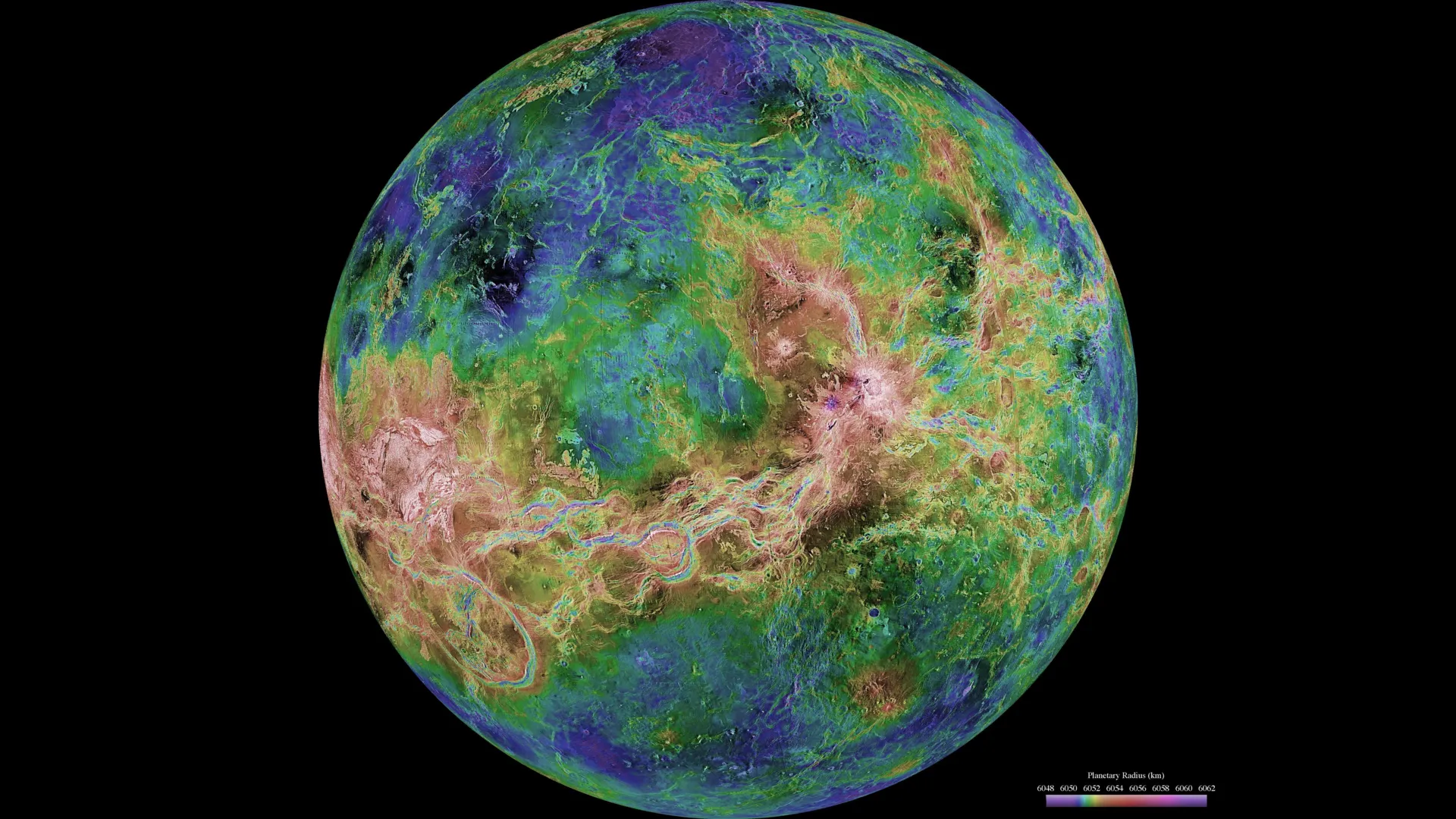
The rifts in question are among the largest structures on any rocky planet, canyon systems thousands of kilometers long carved into the Venusian crust. Radar maps from NASA's Magellan mission in the early 1990s revealed them, and the prevailing interpretation held that they formed more than 100 million years ago and have been sitting inert ever since.
Xi Yang and Taras Gerya of ETH Zurich's Department of Earth and Planetary Sciences, working with co-author Anna J. P. Gulcher, ran high-resolution three-dimensional models of how Venusian crust deforms when it is stretched. The models produced a diagnostic feature the researchers could hunt for in the radar data: rift flanks, the broad elevated ridges that rise along the shoulders of a rift while it is young. In the simulations those flanks sag and flatten as the crust relaxes over geological time.
On Earth, that flattening is mostly the work of wind and water grinding the highlands down. Venus has no rain and no rivers, so erosion cannot explain it. That makes the height of a rift flank a fairly clean clock: tall shoulders mean a young, still-active rift, and subdued ones mean an old, dead one. Applying that test to Venus's rift systems, the team found several with flanks so pronounced that the structures must be geologically recent — and in some cases still extending.
"The work helps better assess the tectonic activity on Venus," Gerya said. The finding, published in Nature Geoscience, points to an interior that is still convecting vigorously enough to stretch and crack the surface, rather than a stagnant lid over a cooling core. It sits alongside recent evidence for active volcanism on Venus, including new lava flows spotted by reanalyzing three-decade-old Magellan radar.
The practical payoff arrives in the 2030s. The European Space Agency's EnVision orbiter, due to launch early in that decade, will carry radar sharp enough to measure whether specific rifts have moved between passes, and NASA has its own Venus missions in the queue. The ETH model gives those missions a target list — a handful of specific rift segments where, if the simulations are right, the ground should be visibly on the move.