Scientists Build a Camera That Sees Invisible Particles in 3D — With as Few as Five Photons
A Swiss team's detector, called PLATON, could replace millions of tiny sensor components with a single block of light-producing material, using a light-field camera and AI to reconstruct particle tracks.
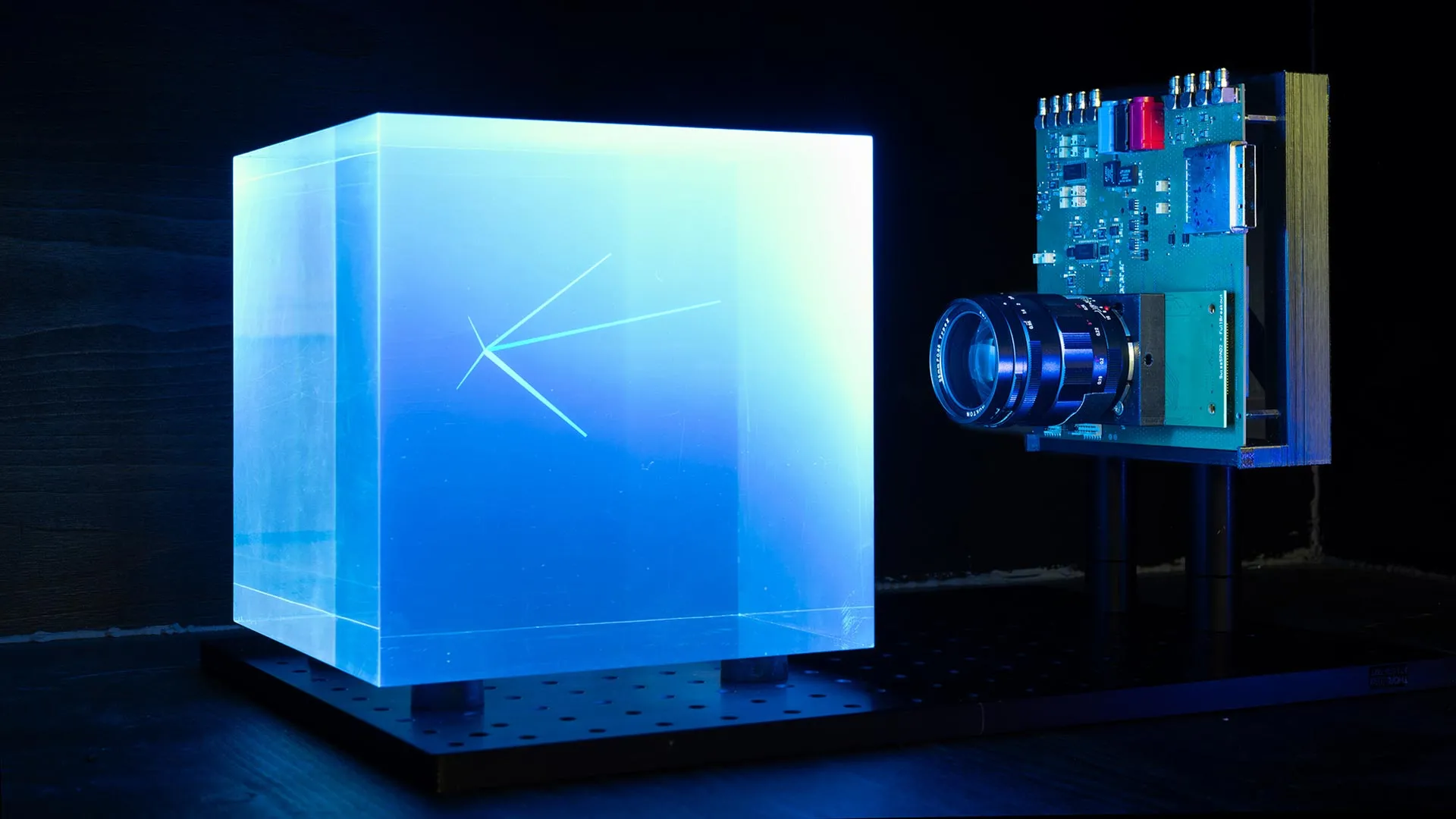
Physicists at ETH Zurich and EPFL have built a particle detector that abandons the central design principle of the field: instead of slicing the detector into millions of individually wired segments, it watches a single, unbroken block of light-producing material and reconstructs what happened inside it in three dimensions.
The system, called PLATON, is described in Nature Communications. It rests on three technologies working together. The first is a plenoptic, or light-field, camera, which uses a micro-lens array placed between the camera lens and the imaging sensor. Each microscopic lens records the scene from a slightly different angle, capturing not just how much light arrives but which direction it came from — enough to recover depth from a flat image. The second is a SPAD array, a grid of single-photon avalanche diodes sensitive enough to register individual photons; the team used SwissSPAD2, developed at EPFL. The third is a Transformer neural network that turns the resulting sparse, faint light patterns into reconstructed particle interactions.
In laboratory tests, the prototype detected electrons using as few as five photons — a signal so faint that conventional readout schemes would lose it in noise. Simulations suggest a 10-by-10-by-10-centimeter version could reach sub-millimeter spatial resolution for neutrino detection, while a full cubic-meter detector could achieve resolution of several millimeters. The team describes that as on par with state-of-the-art plastic scintillator detectors — but without the segmentation those detectors require.
That last point is the substance of the claim. Modern neutrino experiments achieve fine resolution by building enormous arrays of small sensing elements, each with its own readout channel. The cost, complexity and failure surface all scale with the channel count, and the dead material between segments eats into what the detector can see. Replacing that architecture with one continuous block and a camera collapses the engineering problem: nothing to segment, nothing to individually wire, and no gaps.
The work came out of a collaboration between ETH Zurich's Till Dieminger, Dr. Saúl Alonso-Monsalve and Professor Davide Sgalaberna, and EPFL's Professor Edoardo Charbon of the Advanced Quantum Architecture Lab, with optical design contributed by Raytrix GmbH.
The technique may reach patients before it reaches neutrinos. The team has filed three patents covering the use of PLATON in positron emission tomography, spanning both scanner design and the image-processing methods that make the reconstruction work. PET scanners face a version of the same problem — detecting scarce photons emitted from deep inside a body and inferring where they originated — and a detector that squeezes 3D information out of five photons is a plausible fit for a machine whose resolution is limited by exactly that scarcity.