NASA's Webb Uncovers a Hidden Third Planet Around Beta Pictoris, One of Astronomy's Most-Studied Stars
The newly identified world, Beta Pictoris d, makes the young nearby system only the second ever found to host at least three directly imaged planets.
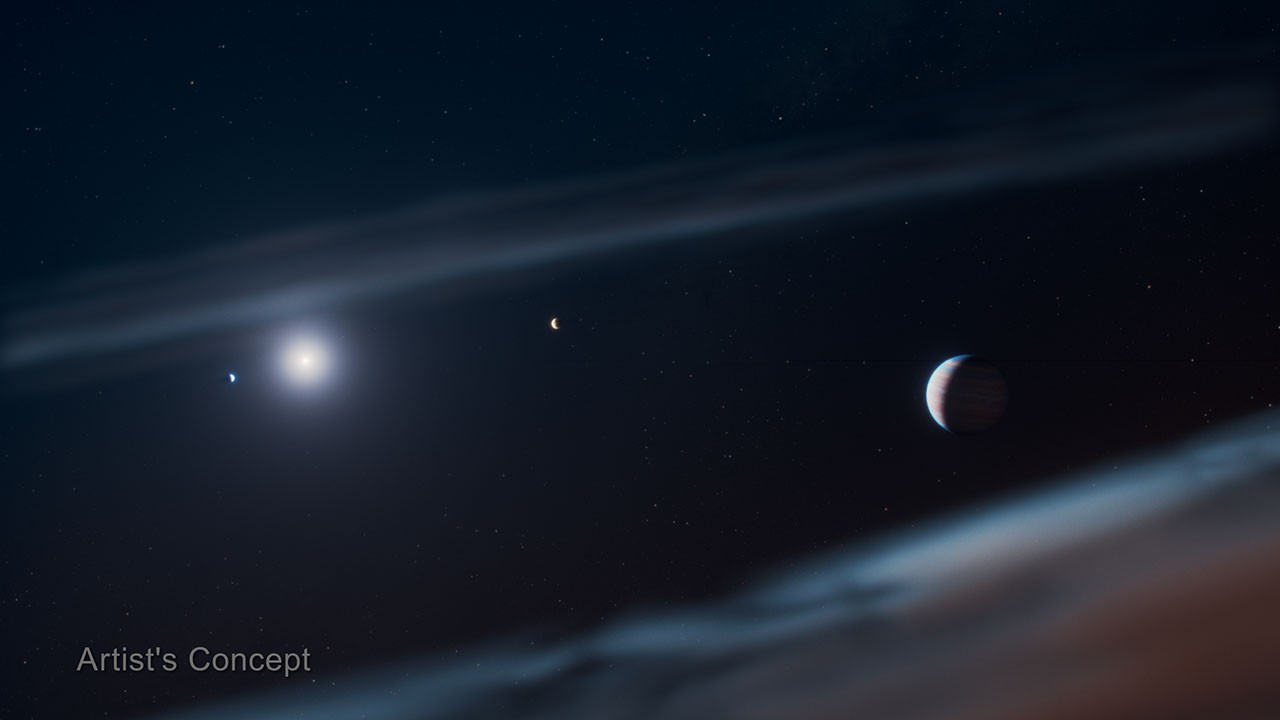
Astronomers using NASA's James Webb Space Telescope have discovered a giant planet hiding within one of the most intensely studied planetary systems in the Milky Way, adding a third known world to the young, nearby star Beta Pictoris. The find turns a system that has served as a testing ground for exoplanet science for decades into an even richer natural laboratory.
Beta Pictoris, a bright star roughly 63 light-years away and only about 20 million years old, was already famous on two counts: it hosts a vast, edge-on disk of debris — the raw material of planet formation — and it is home to Beta Pictoris b, one of the very first exoplanets ever directly imaged. A second planet, Beta Pictoris c, was later confirmed. The newly identified Beta Pictoris d makes it only the second planetary system known to contain at least three directly imaged planets, a rare glimpse of a multi-planet family caught in the act of forming.
The new planet occupies the widest orbit of the three. Modeling suggests it circles its star at roughly 30 astronomical units — comparable to the distance of Neptune from our own Sun. The team estimates Beta Pictoris d is at least twice the mass of Jupiter, which makes it the smallest of the system's three known giants. Because the system is so young, the planets still glow with the leftover heat of their formation, making them bright enough in infrared light for Webb to tease apart from the glare of their host star.
Perhaps as significant as the planet itself is how it was found. Beta Pictoris d is the first directly imaged planet discovered primarily through moderate-resolution spectroscopy — reading the chemical fingerprints in a planet's light — rather than relying solely on traditional coronagraphic imaging, which physically blocks a star's light to reveal faint companions. The result demonstrates that astronomers can pick out worlds embedded in complex, dusty environments by their atmospheric signatures, a technique that could uncover many more hidden planets in crowded systems.
Beta Pictoris has long been a Rosetta stone for understanding how solar systems assemble, and each new discovery there sharpens that picture. Studying a system where multiple giant planets are still settling into their orbits alongside a debris disk lets researchers test theories of planet migration, disk sculpting and the early architecture of planetary systems — including, ultimately, our own. With Webb's sensitivity now proven for this kind of spectroscopic hunt, scientists expect the census of directly imaged planets to grow, and systems like Beta Pictoris to keep yielding surprises.