Scientists Build a Material That Makes Heat 'Programmable,' Breaking a 160-Year-Old Rule
An Osaka team created a device that can steer thermal radiation, switch it on and off, and remember its setting even after the power is cut.
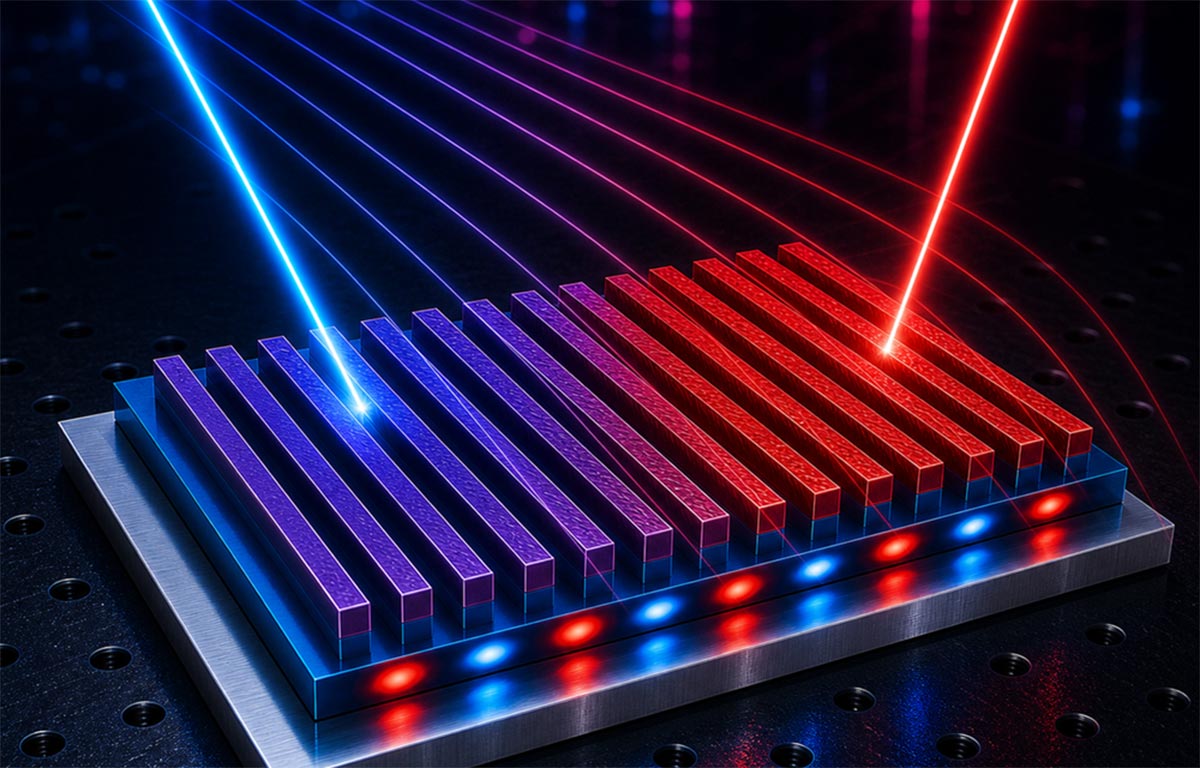
Researchers in Japan have created a material that can control and "program" heat, letting it direct thermal radiation, switch modes on and off, and remember its settings even without a continuous power supply. The advance overturns a long-standing physical principle and could open the door to smarter infrared sensors, more efficient energy technologies, and a new class of memory devices that store information using light and heat instead of electric charge.
The work, led by Professor Koichi Okamoto and Dr. Shunsuke Murai at Osaka Metropolitan University, combines a magneto-optical material with a special phase-change compound known as GST. By pairing the two, the team built a device that can control the direction in which heat is radiated, turn that effect on or off, and hold its state after the power is removed — behaving, in effect, like a rewritable memory for thermal radiation.
The result is striking because it breaks with a rule that has governed the physics of heat for more than 160 years. Under a principle known as reciprocity, closely tied to Kirchhoff's law of thermal radiation, the way a surface absorbs heat and the way it emits heat are inseparable: a surface that absorbs energy efficiently from a particular direction also radiates it back the same way. The new device decouples those two behaviors, allowing absorption and emission to be controlled independently.
That independence is what makes the heat "programmable." Because the phase-change material can be switched between states and retains its configuration without power, the device can be set once and left to hold that arrangement, much as a computer chip stores a bit of data. Engineers could, in principle, write a thermal pattern into the material and have it persist until deliberately changed.
The potential applications range widely. More precise control over infrared radiation could yield better thermal-imaging sensors and improved systems for managing heat in electronics, where wasted warmth is a persistent challenge. The researchers also point to the possibility of optical and thermal memory elements that could complement or extend today's electronic storage, using photons and heat rather than moving electrons.
While the device remains a laboratory demonstration, the team says it establishes a new concept — heat that can be steered and remembered — that could reshape how engineers think about managing thermal energy. By showing that a rule long treated as fundamental can be sidestepped with the right combination of materials, the work adds to a growing effort to bend the behavior of light and heat to human design.