A 200-Year-Old Light Trick Lets Physicists Build Swirling 'Optical Skyrmions' With Just a Laser and a Disc
NTU Singapore researchers used the classic Poisson spot to generate up to four kinds of exotic, knot-like light patterns at once, a strikingly simple recipe for structures that could power future data storage and computing.
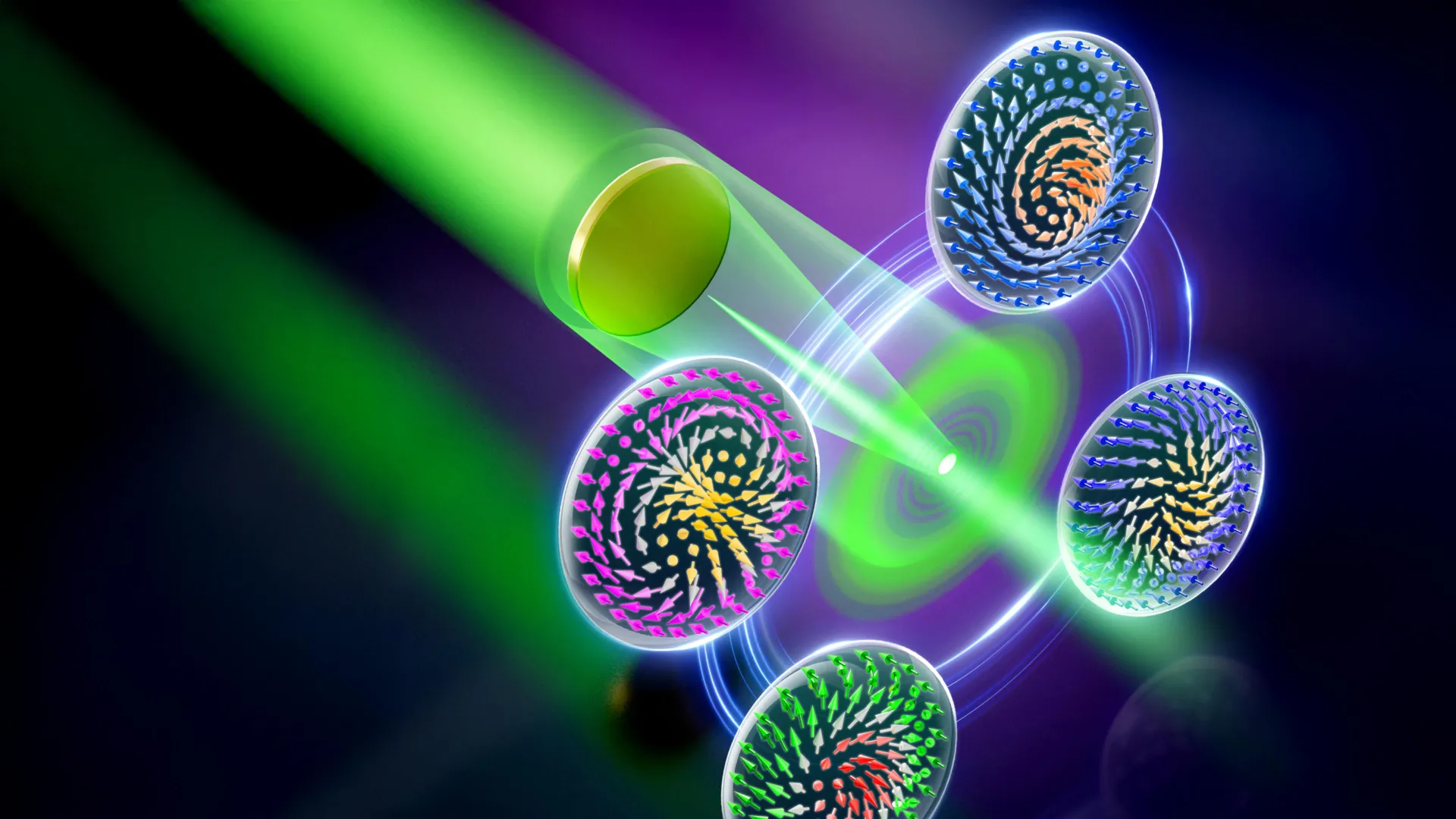
Physicists in Singapore have found a surprisingly simple way to sculpt light into swirling, knot-like patterns called optical skyrmions — using nothing more than a laser and a small circular disc, and reviving an optical effect first described more than two centuries ago.
The technique, reported by a team at Nanyang Technological University (NTU Singapore), relies on the Poisson spot, a bright point of light that appears in the center of the shadow cast by a circular object. First predicted in the early 19th century as a supposed absurdity meant to debunk the wave theory of light — and then embarrassingly confirmed by experiment — the Poisson spot has long been a textbook curiosity. Now it has become a tool for building some of the most intricate structures in modern optics.
Optical skyrmions are tiny, stable configurations in the properties of light, akin to the spiky, hedgehog-like textures that physicists first studied in magnetic materials. They are prized because their twisting geometry is topologically protected, meaning the pattern resists being smoothed out or destroyed — a robustness that makes them appealing for encoding information. Until now, creating them typically required complex, costly engineered materials known as metasurfaces.
The NTU approach strips that complexity away. By simply directing a laser at a small disc, the team found the resulting Poisson-spot light field spontaneously organized itself into as many as four related topological patterns at the same time: spin skyrmions, Stokes skyrmions, electric-field skyrmions and magnetic-field skyrmions. Generating four distinct skyrmion types simultaneously from one simple setup gives researchers an unusually flexible platform to create, study and fine-tune these structures.
The work, titled "Optical Skyrmions in Poisson Spots," was published in the journal Optica and led by NTU Assistant Professor Shen Yijie of the university's School of Physical and Mathematical Sciences and School of Electrical and Electronic Engineering. The result marries a 200-year-old phenomenon with a cutting-edge frontier of photonics.
The potential applications are significant. Because skyrmions can carry information in their stable topology, they could underpin denser data storage, higher-capacity optical communications and new computing architectures that manipulate light instead of electrons. Their resistance to disruption is exactly the property engineers want in systems that must preserve data reliably, and the ability to conjure several skyrmion types at once could let designers mix and match the structures best suited to a given task.
A method this cheap and accessible could accelerate research by putting skyrmion generation within reach of far more laboratories, rather than only the well-funded groups able to fabricate specialized metasurfaces. It is a vivid reminder that even the oldest, most familiar physics can still yield tools for the technologies of the future.