'Mega-Earths' May Be a Mirage: Active Stars Could Be Faking Rocky Planets Over 10 Earth Masses
A new analysis finds all eight suspiciously dense super-heavy planets orbit magnetically active stars, with odds of that happening by chance near 1% for the four rocky ones.

Some of the heaviest rocky planets ever reported may not be as heavy as they look. A new study argues that so-called mega-Earths, rocky planets weighing more than about 10 Earths, could be an illusion created by activity on their host stars. The paper, by astronomers Casey Brinkman and Nicolas Cowan, was posted to the arXiv preprint server on Oct. 8.
Theory sets a limit on how big a bare rocky world can get. Planets begin collecting a gas envelope from their birth disk at about 1.5 to 1.75 times Earth's radius, which corresponds to roughly 4 to 5 Earth masses. Simulations suggest a purely rocky planet is unlikely to grow beyond about 10 Earth masses, because a core that massive should pull in a thick layer of gas. Yet astronomers have found a handful of planets above that line that appear dense and gas-free. If real, they would need unusual origins, such as collisions after the gas disk disappeared, or they would have to be the stripped cores of former giant planets.
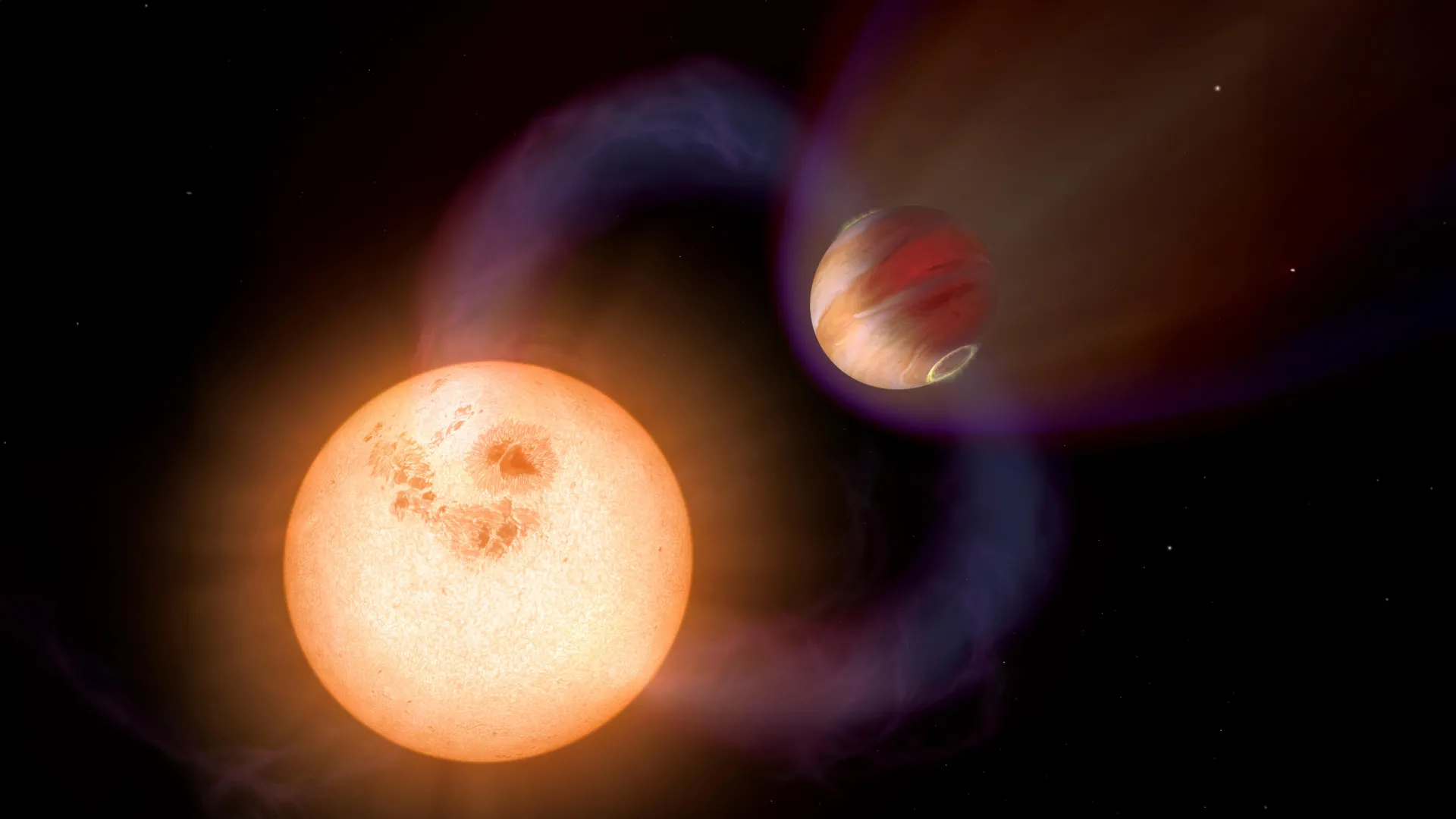
The new study tests a simpler explanation. Planet masses are usually measured with the radial-velocity method, which tracks how much a planet tugs its star back and forth. Stars with strong magnetic activity make that hard. Dark spots and bright patches rotate in and out of view and create wobbles that imitate a planet's gravitational pull. That noise can drown out the faint signal of a small planet or exaggerate it, leaving the mass estimate too high.
Brinkman and Cowan began with small planets under four times Earth's size in NASA's Exoplanet Archive and kept only those with radial-velocity masses. After dropping planets with weak or indirect estimates, they had 333 planets. Plotting mass against size, they found eight with rare combinations, all heavier than about 10 Earth masses. Four had rocky densities: WASP-84 c, TOI-1347 b, TOI-2322 c and HD 63433 b. The other four, GJ 523 b, TOI-815 c, HD 18599 b and GJ 143 b, were dense enough to hold water or other heavy volatiles but little hydrogen and helium.
They then measured how magnetically active each host star is, using calcium emission lines that respond to magnetic heating in the star's atmosphere, and examined TESS light curves for the flicker of spots. All eight host stars turned out to be active. The team put the probability of finding the four rocky mega-Earths around active stars by chance at about 1%, and for all eight it was a fraction of a percent.
They also found no physical reason why young, active stars should favor such planets. If anything, building one that heavy should take longer, which would favor older stars. "We therefore would not expect young stars to preferentially host these worlds," the researchers write, and they predict at minimum a uniform spread of mega-Earths across stellar age and activity if not a lean toward older systems. The authors also flagged several signals that looked unreliable because they were too weak relative to the noise.
The result does not prove any single planet is fake, and the paper is a preprint that has not been peer reviewed. But it gives observers a clear test. Follow-up measurements that filter out stellar activity, or independent mass estimates, should show whether these eight worlds keep their weight or shrink back toward the size theory allows.