Put Rock Strength Into the Simulation and the Moon Comes Out Whole in Five Hours
Southwest Research Institute modeling that accounts for how strong the colliding rock actually was found the Moon can form intact almost immediately — if Earth and Theia were cold enough.

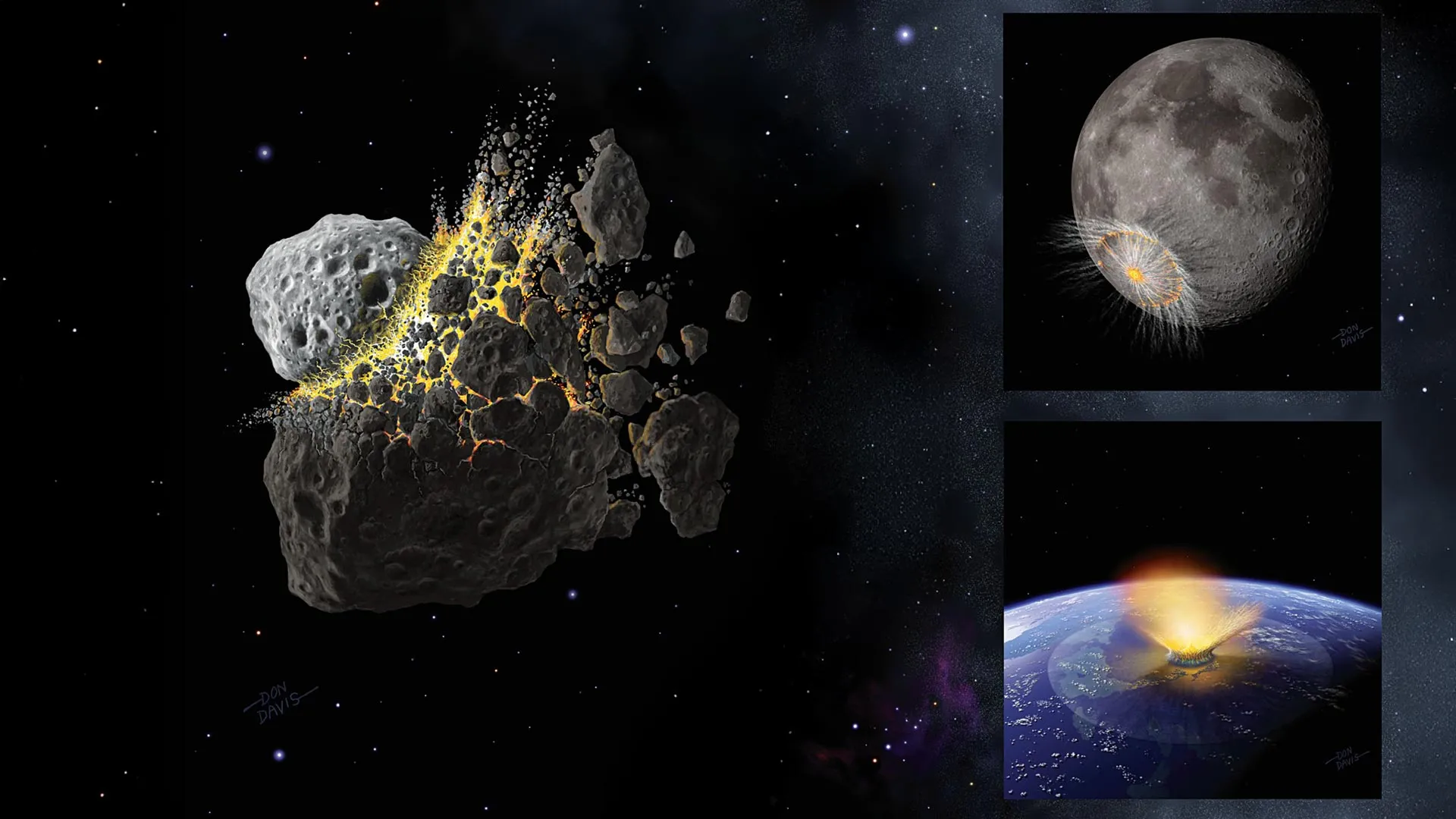
For twenty-five years the standard picture of the Moon's birth has been a slow one. A Mars-sized body called Theia hits the young Earth, the collision throws an enormous ring of vaporized and molten debris into orbit, and the Moon gradually assembles itself out of that disk over months or years. New simulations from the Southwest Research Institute say that picture depends on an assumption nobody had checked: that the strength of the rock does not matter.
It matters. In work published in The Astrophysical Journal Letters, a team led by Dr. C. Adeene Denton, formerly a NASA Postdoctoral Program fellow at SwRI, reran giant-impact simulations with temperature-dependent material strength included for the first time. In some cases the debris disk still forms and the Moon is built out of it over time. In others, a fully assembled Moon simply exists a few hours after the collision.
"When you simulate the Earth and the moon as colliding bodies with geologic properties, it changes how the moon forms out of that impact — that's something we considered unnecessary before," Denton said. Running the model with the same parameters as the original impact work, down to matching temperature structures inside both bodies, produced an intact Moon within about five hours.
The variable that decides the outcome is heat. Hot rock is weak rock. The team ran identical collisions with proto-Earth surface temperatures of roughly 400 K, 800 K and 2,000 K and got different Moons. "Depending on how hot the Earth and Theia are prior to the collision, the impact can destroy Theia and produce this massive disk of debris that eventually forms the moon," Denton said. Colder bodies hold together well enough for a large fragment to survive the encounter and be captured whole.
That is the interesting part, because protoplanets start hot and cool as they age. If a cold collision makes an intact Moon and a hot one makes a debris disk, then the Moon's own structure is a clock. "These surprising and exciting new results imply a potential connection between the physical properties of the moon today, including perhaps its volatile content, and the thermal state of the Earth and Theia at the time of the giant impact," said Dr. Robin Canup, the SwRI vice president whose 2001 paper set the standard disk model and who was not involved in this study. "This in turn might help scientists better constrain when the moon-forming event occurred."
The oldest problem in the field is untouched. Earth and the Moon are chemically almost identical, which is hard to explain if most of the Moon came from Theia. The favored answer is that Theia and proto-Earth condensed out of the same neighborhood of the protoplanetary disk, while Mars, which is compositionally distinct, formed farther out. "Because Earth and Mars formed in the same neighborhood of the solar system, they are like siblings," Denton said. "The moon and Earth are more like fraternal twins." The simulations used giant-impact methods developed at the University of Bern and the University of Arizona, where co-author Dr. Erik Asphaug works.